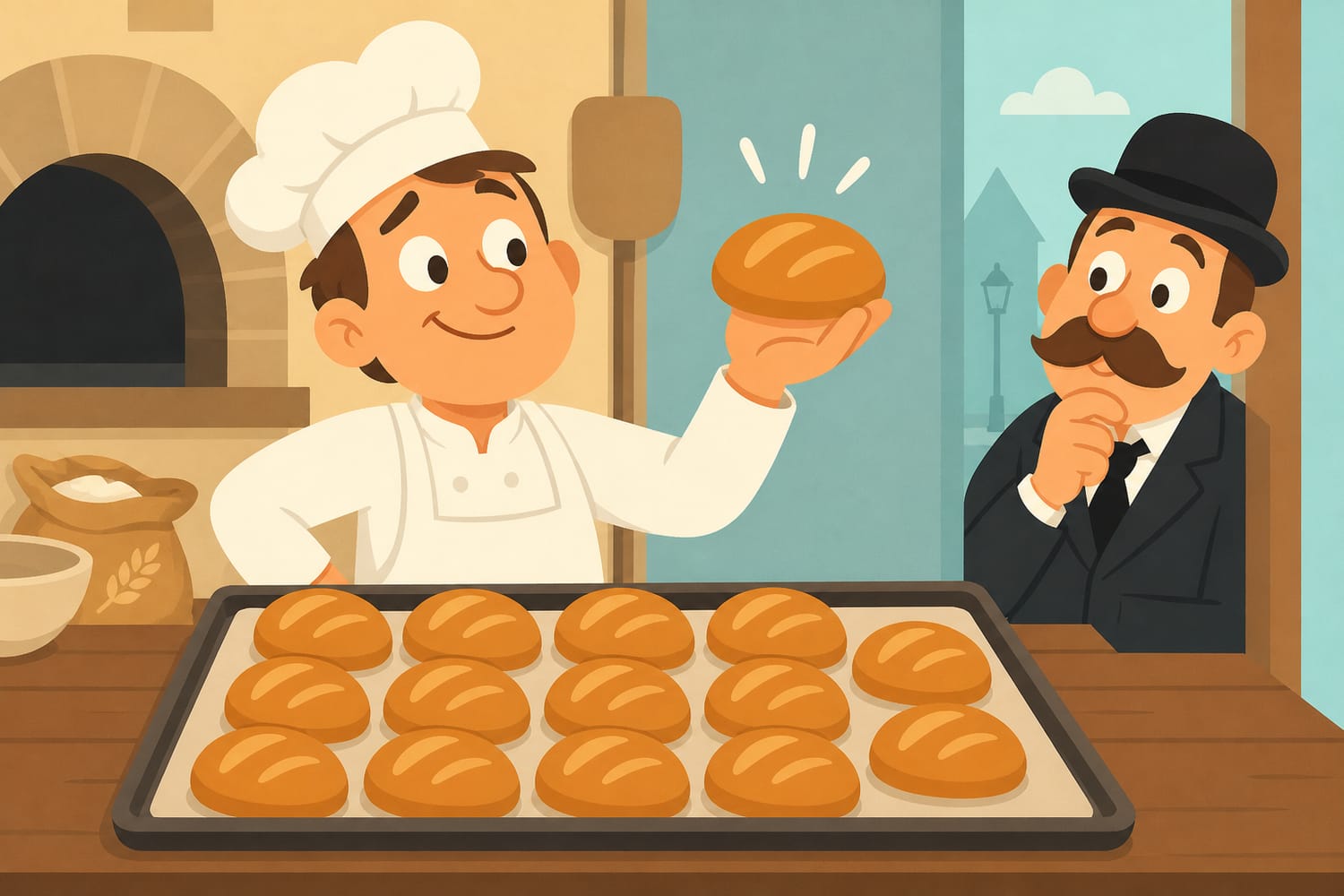
A baker’s dozen means 13 rather than 12. The expression is associated with bakers supplying an extra loaf with a dozen. Why the extra? Two explanations dominate: protection against penalties for short weight, and an allowance for bread resellers. The precise origin remains uncertain.
It sounds like the sort of mathematical adjustment everyone can support. Twelve doughnuts? Lovely. Thirteen doughnuts? Suddenly, arithmetic has improved.
But behind this cheerful expression lies a surprisingly complicated history involving medieval bread regulations, retail profits, and a familiar problem for word detectives: a memorable explanation is not necessarily a proven one.
Let’s follow the crumbs.
The Famous Explanation: An Extra Loaf to Avoid Trouble
The story usually goes like this: English bakers faced serious penalties for selling bread that weighed less than it should. To avoid accidentally shortchanging customers, they supplied an extra loaf whenever they sold a dozen. That thirteenth loaf provided a little edible insurance. This explanation appears in numerous reference works, although its connection to the phrase is disputed.
The legal background is real. Medieval English authorities regulated bread, and penalties for breaking the rules could include fines and the pillory. The Oxford Companion to Sugar and Sweets notes these punishments while warning that the familiar short-weight explanation is probably incorrect.
That distinction matters. “Bakers were punished for underweight bread” and “those punishments created the expression” are two different claims.
Think of it as the difference between finding flour on the counter and proving who baked the cake. The evidence fits a possibility; it does not automatically establish the whole story.
Why Medieval Bread Came With So Many Rules
To understand why this explanation sounds convincing, meet the Assize of Bread and Ale: regulations governing the price, weight, and quality of bread and ale in medieval England. A famous version dates to 1266, during Henry III’s reign, although related regulations existed earlier.
The bread rules were more sophisticated than “make every loaf the same size.” They connected the required weight of particular loaves to the price of grain. Different kinds of bread also had different prescribed weights. You can see the detailed schedules in the medieval bread regulations preserved by Fordham’s Internet History Sourcebooks.
In simple terms, a loaf sold at a particular price could become smaller when wheat became more expensive. When grain was cheaper, that same-priced loaf was supposed to provide more bread. The system adjusted the bread’s weight rather than simply letting the baker charge whatever seemed convenient.
The surviving text also specifies escalating consequences for violations, including fines and, in certain cases, the pillory. This was not merely a sternly worded customer review.
So the extra-loaf story has a believable setting. What it lacks is a clear documentary bridge from those regulations to the birth of the expression.
The Other Explanation: The Thirteenth Loaf Was Someone’s Pay
There is another possibility—and it shifts the spotlight from nervous bakers to the people selling their bread.
Etymologist Anatoly Liberman, writing for Oxford University Press about “a baker’s dozen”, discusses a historical London rule directing bakers to supply female bread retailers with thirteen articles of bread for twelve. The extra bread served as compensation for the retailers’ work.
Here is a simplified illustration of the arrangement:
- A retailer pays a baker for twelve loaves.
- The baker supplies thirteen.
- The retailer sells the bread.
- The extra loaf provides room for earnings.
Under this explanation, number thirteen is not a customer’s surprise bonus. It is part of the business arrangement between producer and seller. Think wholesale allowance, but with a crust.
Liberman regards the historical retailer connection as reasonable, while questioning the documentary support for the more popular punishment story. That does not make every detail of the phrase’s development certain, but it gives us a concrete trading practice to consider.
The contrast is useful: one explanation treats the extra loaf as protection; the other treats it as payment.
When Did “Baker’s Dozen” First Appear?
The expression itself is recorded in 1596, in Thomas Nashe’s pamphlet Have with You to Saffron-Walden. Both the Oxford Companion to Sugar and Sweets and Oxford’s etymology blog identify that date.
Curiously, Nashe’s example concerns almanacs, not an order of bread. That suggests the expression was already useful beyond the bakery by the time it reached the surviving printed record.
Another early example appears in John Cooke’s play Greene’s Tu Quoque, published in 1614, where the phrase occurs during a dice-playing scene. Again, nobody is buying rolls. The expression is being used as a recognizable numerical reference.
Those examples help establish the phrase’s age, but they do not reveal its birthday.
A first surviving written appearance means “we know people were using it by this point,” not “someone invented it that morning.” Nor does a sixteenth-century appearance prove which earlier bakery custom supplied the inspiration.
The paper trail gives us a firm foothold, not a complete recipe.
So Why 13, Specifically?
The basic arithmetic is straightforward: a dozen plus one equals thirteen. Both major explanations involve an extra item supplied alongside twelve, whether as a safeguard or as a retailer’s allowance.
Nothing about the modern meaning requires an elaborate numerical puzzle. The oddity is not that bakers discovered a different way to count. It is that an allowance beyond the standard dozen became memorable enough to acquire its own name.
The extra bread itself was sometimes called “inbread”—bread added to the purchase. Historical discussions of that term describe an additional quantity supplied beyond the dozen.
The safest conclusion is therefore slightly less tidy than the familiar tale: the expression is associated with extra bread, but we cannot confidently identify one original transaction, regulation, or nervous baker as its starting point.
For a similarly curious phrase investigation, explore Uncover Words’ article on “let the cat out of the bag”.
Does a Baker’s Dozen Have to Be Baked?
Not at all. In modern English, a baker’s dozen is a group of thirteen things—not necessarily loaves, pastries, or anything edible. Dictionary examples include books, films, and retired sports numbers.
You could write:
- “We brought a baker’s dozen of bagels to brunch.”
- “Here’s a baker’s dozen of books for your reading list.”
- “She sent a baker’s dozen of suggestions.”
Each example means thirteen. The bakery connection supplies the flavor, not a restriction on what you can count.
There is also a useful distinction between meaning thirteen and getting something free. A baker’s dozen describes a quantity; it does not, by itself, promise thirteen items for the price of twelve. That would need to be part of the offer.
For another helping of food-flavored language, try Uncover Words’ exploration of the expression “spill the beans”.
The Takeaway: Keep the Extra, Keep the Caveat
“A baker’s dozen” gives us a clear modern meaning and a less certain origin. It means thirteen; its history points toward supplying extra bread, with protection against short weight and compensation for retailers offering competing explanations.
The punishment story is wonderfully memorable. The retailer explanation reminds us that an ordinary business arrangement can leave a surprisingly lasting mark on language.
Either way, the phrase offers something worth enjoying: a standard dozen, with one more thrown in.
For once, the historical uncertainty does not interfere with counting the doughnuts.