Why Do We Say “A Dime a Dozen”?
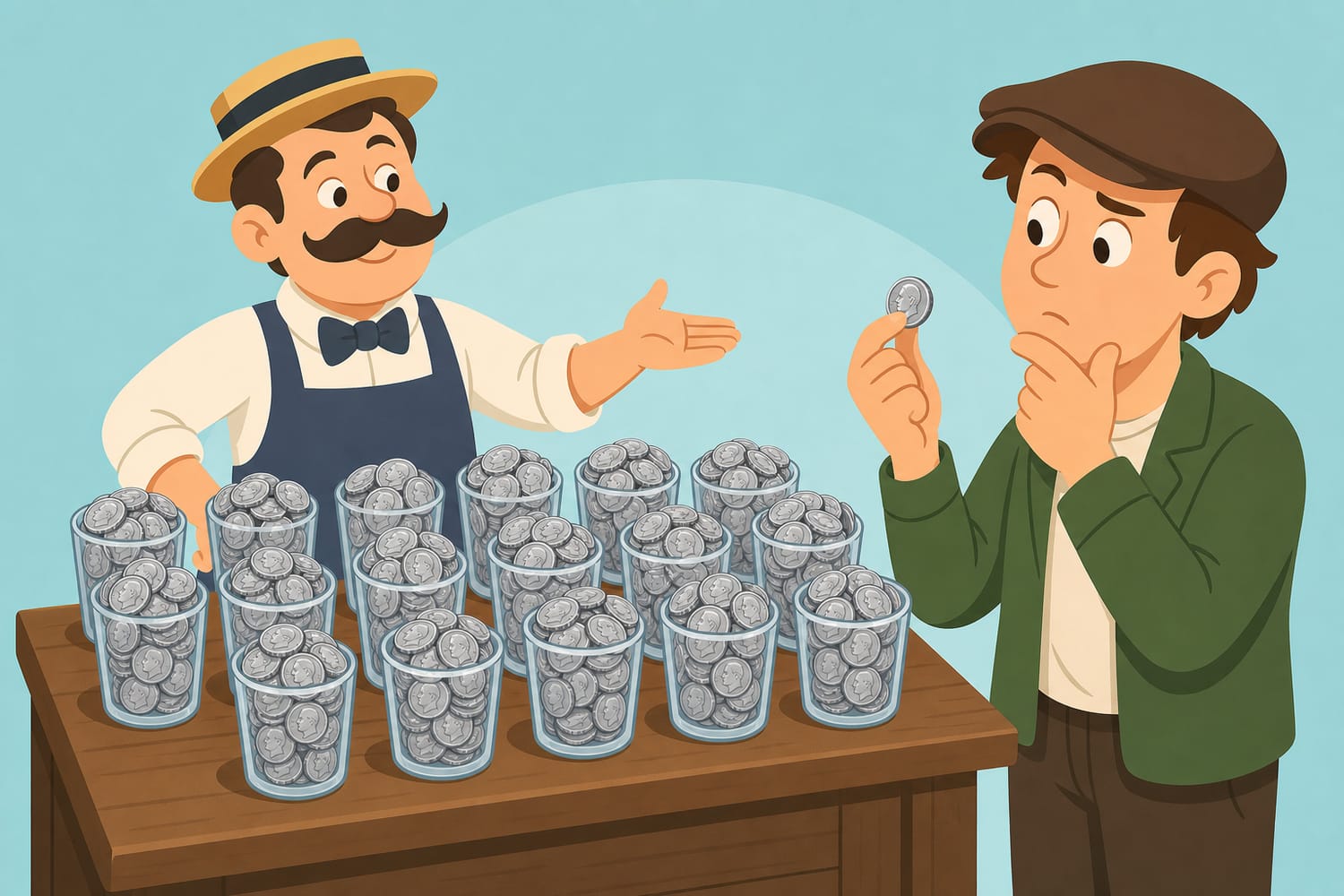
If something is “a dime a dozen,” it is extremely common, easy to obtain, and therefore not considered especially valuable or remarkable. The expression grew from literal American advertisements offering inexpensive goods by the dozen. Over time, a tempting bargain became a mildly dismissive way to say, “There’s nothing unusual about that.”
What Does “A Dime a Dozen” Mean Today?
Imagine that a friend announces, “I’ve developed an app that sends motivational quotes every morning.”
You might reply, “Those apps are a dime a dozen.”
You are not suggesting that twelve apps can be purchased for ten cents. You mean that similar apps are everywhere, so creating another one does not automatically make it special.
The phrase usually carries two closely related ideas:
- There are a lot of these things.
- Because there are so many, each one seems less valuable or impressive.
That second part matters. A dozen eggs may be common without being worthless, but calling something “a dime a dozen” usually adds a note of dismissal. According to Merriam-Webster’s definition, the expression describes something so plentiful or commonplace that it receives little esteem or value.
In other words, “common” is the basic meaning, but “nothing special” is often the attitude hiding behind it.
It Started as an Actual Price
Unlike wonderfully strange expressions involving kicked buckets or escaped cats, “a dime a dozen” began with some perfectly sensible arithmetic.
A dime is worth ten cents. A dozen is twelve. If a merchant offered twelve items for a dime, each one cost less than a cent. That was an easy way to advertise a plentiful, inexpensive product.
During the 19th century, American newspaper advertisements and market reports used phrases such as “a dime a dozen” literally. Eggs, fruit, and other abundant goods could be sold in groups of twelve for ten cents. Etymonline’s history of dime notes literal examples involving prices by the dozen from the 1860s, decades before the expression became firmly established as a metaphor.
The calculation looked like this:
10 cents ÷ 12 items = about 0.83 cents per item
Of course, a dime had considerably more purchasing power in the 1800s than it does today. Even so, twelve items for ten cents clearly communicated abundance and affordability.
It was the old-fashioned marketplace version of a giant red sign shouting BULK BARGAIN!
Why a Dime?
The phrase could not have developed until Americans had dimes to spend.
The Coinage Act of 1792 established the dime—originally spelled disme in the legislation—as a coin worth one-tenth of a dollar. The U.S. Mint’s history of the dime explains that the first dimes were produced in 1796 and were small silver coins.
The word itself has a mathematical family tree. It comes through French from a Latin word connected with “tenth.” That makes sense: a dime is one-tenth of a dollar.
By the 19th century, the coin had become a familiar symbol of a small price. Americans also encountered dime novels, dime museums, dime stores, and other inexpensive entertainment or merchandise carrying the coin’s name.
So when sellers advertised goods at a dime a dozen, shoppers immediately understood the message: these things were cheap, plentiful, and available in quantity.
How a Bargain Became an Insult
At first, “a dime a dozen” could simply describe a good deal. Twelve peaches for a dime? Wonderful—bring a basket.
But language loves to stretch literal statements into metaphors. If a product was so abundant that twelve could be bought for very little money, then other plentiful things could be described the same way, even when no sale was taking place.
The expression gradually moved from the marketplace into everyday speech:
- Literal meaning: Twelve items cost one dime.
- Implied meaning: The items are plentiful and inexpensive.
- Figurative meaning: Something is so common that it is not especially valuable or impressive.
Merriam-Webster dates the first known figurative use to 1919, while other etymological references record the now-familiar sense by around 1930. That does not necessarily mean nobody said it earlier; dictionary dates usually represent the earliest example researchers have located, not the precise moment someone first invented a phrase.
By the early 20th century, the bargain had completed its transformation. “A dime a dozen” no longer made people reach for a coin. It made them lower their expectations.
Why Has the Phrase Survived?
Today, a dime will not buy a dozen of much. It will not buy one egg, one peach, or even one suspiciously small piece of candy in most stores.
Yet the expression survives because idioms do not need to remain economically accurate. They need to be memorable.
“A dime a dozen” has several features working in its favor:
- It is short.
- It has a pleasing rhythm.
- The repeated d sound makes it catchy.
- It creates an immediate picture of abundance.
- Its exaggeration makes the meaning easy to understand.
English is full of phrases that outlived the circumstances that created them. We still “break the ice” to begin a conversation, even when there is no frozen water nearby. We “let the cat out of the bag” without involving cats, bags, or questionable livestock deals. Someone can even be “three sheets to the wind” while standing miles from the nearest sailboat.
Idioms are linguistic souvenirs. They preserve little pieces of older trades, technologies, customs, and prices long after everyday life has changed.
How to Use “A Dime a Dozen” Correctly
The phrase works best when describing something plentiful but unremarkable.
Here are a few natural examples:
- “Cheap phone cases are a dime a dozen.”
- “Ideas are a dime a dozen; carrying one out is the difficult part.”
- “Tourist shops selling identical souvenirs are a dime a dozen near the beach.”
- “Online courses promising instant success are a dime a dozen.”
- “Bad excuses are a dime a dozen around here.”
Notice that the phrase does not always refer to something with a low monetary price. Ideas might be free, while online courses might be expensive. The expression is about perceived scarcity and distinction, not simply the number on a price tag.
It can also describe people, but that use requires care:
“Actors like him are a dime a dozen.”
Grammatically, the sentence is fine. Socially, it may sound insulting because it suggests that the person is easily replaced. When used about someone’s profession, talent, or contribution, the phrase can feel more cutting than playful.
If your goal is merely to say that many qualified people are available, a gentler expression such as “there are plenty of candidates” may be wiser.
Is It “A Dime a Dozen” or “Dime a Dozen”?
The standard form is “a dime a dozen.”
You will sometimes hear people drop the first a and say that something is “dime a dozen.” That shortened version is understandable and appears in informal speech, but the full traditional expression remains more widely recognized.
Hyphens depend on how the phrase is used:
- After a verb: “Those products are a dime a dozen.”
- Before a noun: “The company made another dime-a-dozen sequel.”
In the second example, the phrase acts as a single adjective modifying sequel, so the hyphens help readers understand that the words belong together.
And no, the saying is not “a diamond dozen,” charming though that mishearing may be. A diamond dozen sounds extremely valuable—which would make it nearly the opposite of the original expression.
Do Other Countries Have Similar Expressions?
“A dime a dozen” is distinctly American in origin because the dime is an American coin. However, the idea behind it is far from uniquely American.
British English traditionally uses “ten a penny” or “two a penny” to describe something extremely common. The coins and quantities differ, but the logic is identical: if you can purchase many examples for a tiny amount, none seems rare.
Other expressions with similar meanings include:
- Run-of-the-mill
- Common as dirt
- Nothing special
- Two a penny
- Easy to come by
- On every street corner
Each has a slightly different flavor. “Run-of-the-mill” emphasizes ordinariness, while “a dime a dozen” combines ordinariness with abundance and low perceived value.
The Value of an Old Bargain
“A dime a dozen” traveled an interesting path: from a literal store price to a comment about originality, scarcity, and worth.
Its history also reveals something about how people judge value. We tend to prize what seems rare and overlook what appears plentiful. Whether we are discussing collectibles, ideas, businesses, or talents, abundance can make even useful things feel ordinary.
So the next time someone says a product, trend, or excuse is “a dime a dozen,” picture an old market stall piled high with goods and a sign promising twelve for ten cents. The merchandise may have changed, and the price is certainly outdated, but the message remains perfectly clear:
There is plenty more where that came from.