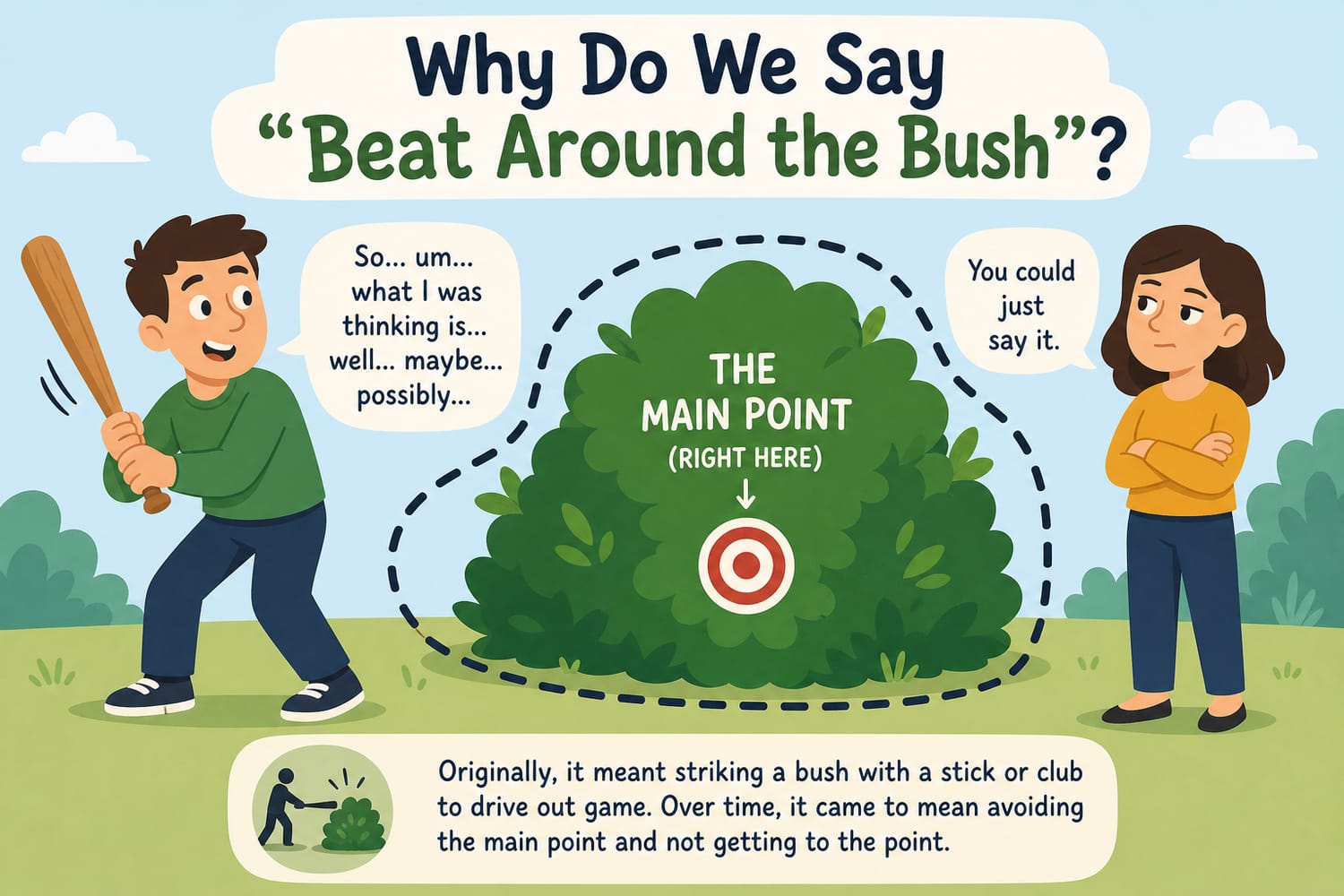
The Short Answer: It Comes From Bird Hunting
To “beat around the bush” means to avoid saying something directly. If someone is nervous, evasive, overly polite, or taking the scenic route through a conversation, we might say:
“Stop beating around the bush and tell me what happened.”
The phrase comes from an old hunting practice. In medieval and early modern England, hunters sometimes used assistants called beaters to flush birds and other small game out of bushes or undergrowth. The beaters would literally beat the bushes with sticks, making noise and movement so the birds would fly out into the open, where hunters could catch or shoot them.
So the original image is wonderfully physical: someone whacking shrubbery, stirring things up, and moving all around the target without actually grabbing it. Over time, that became a metaphor for talking around a subject instead of getting straight to the point.
In other words, if you’re “beating around the bush,” you’re circling the real issue like it’s hiding in a hedge.
What Does “Beat Around the Bush” Mean Today?
Today, the idiom has nothing to do with hunting, birds, sticks, or suspicious shrubbery. It means:
- To avoid discussing the main topic directly
- To speak vaguely or indirectly
- To delay saying something difficult
- To hint instead of being clear
- To dodge a question
For example:
“She beat around the bush for ten minutes before admitting she had lost the tickets.”
Or:
“Don’t beat around the bush—do you like the idea or not?”
The phrase often appears when someone is frustrated by another person’s hesitation. It suggests that the listener already senses there is a main point coming and would very much like the speaker to land the plane.
It can be used in casual conversation, business settings, family arguments, awkward dates, and anywhere else humans perform the ancient art of not quite saying what they mean.
“Beat Around” or “Beat About” the Bush?
Both versions exist, and they mean the same thing.
In American English, people usually say:
“beat around the bush”
In British English, the older and still common form is:
“beat about the bush”
The “about” version is historically earlier. In older English, about often meant “around” or “in the area of,” so “beat about the bush” meant beating in the area around the bushes.
Over time, American English favored around, which feels more natural to American ears. British English kept about, though both forms are widely understood.
So if someone says “stop beating about the bush,” they are not being especially fancy. They are simply using the older form of the idiom.
The Literal Meaning: A Noisy Day in the Woods
To understand the phrase, imagine a group of hunters in the countryside centuries ago.
Birds are hiding in bushes and thick undergrowth. The hunters want the birds out in the open. But instead of reaching into the bush—which might be difficult, ineffective, or a good way to get scratched—the beaters move around the bushes and strike them with sticks.
Whack! Rustle! Flap!
The startled birds fly out, and the hunters can catch them in nets or aim at them.
This practice is where the verb “beat” comes in. Here, “beat” does not mean “defeat,” as in “we beat the other team.” It means to strike repeatedly, as in “beat a drum” or “beat a rug.”
The bush, meanwhile, is just what it sounds like: a shrub, thicket, or patch of undergrowth where small animals and birds might hide.
So “beating around the bush” began as a practical activity: making noise around a hidden target to drive it into view.
How Did a Hunting Term Become a Talking Term?
Idioms often begin as concrete images. People take a familiar activity and use it to explain an abstract idea. In this case, the familiar activity was hunting, and the abstract idea was indirect speech.
If the bird is the truth, then beating around the bush is everything you say before finally revealing it.
That connection makes sense. When someone avoids the point, they may still be talking a lot. They may be circling the topic, hinting at it, poking at it, rustling the leaves, and creating plenty of verbal movement. But they are not yet saying the thing itself.
For example, imagine your friend says:
“So, you know how your car is very important to you, and accidents can happen to anyone, and sometimes driveways are narrower than they look…”
At this point, your friend is not discussing the weather. They are beating around the bush.
Eventually, the bird flies out:
“I backed into your car.”
The idiom captures that suspense perfectly. The real point is hidden, and the speaker is making a lot of noise nearby.
How Old Is the Expression?
The phrase is very old. English speakers have been using versions of “beat about the bush” for hundreds of years.
The literal hunting practice dates back to medieval times, and the phrase began appearing figuratively in English by the early modern period. Like many old idioms, it likely circulated in speech before it was written down.
One related old proverb was along the lines of some people beating the bush while others catch the birds. That saying suggested that one person might do the hard work while another person gets the reward. Over time, however, the phrase “beat about the bush” developed the meaning we know today: approaching something indirectly instead of addressing it head-on.
By the time the idiom became common in modern English, the hunting image was no longer necessary for people to understand it. Even if you’ve never flushed a bird from a hedgerow in your life, the metaphor still works. We all know what it feels like when someone refuses to get to the point.
Why Do People Beat Around the Bush?
Although the phrase is often used with irritation, beating around the bush is a very human habit. People avoid directness for many reasons.
Sometimes they are trying to be polite:
“Your presentation had some really interesting colors…”
Translation: The presentation may need work.
Sometimes they are nervous:
“There’s something I should probably mention, but it’s not a huge deal…”
Translation: It may be a huge deal.
Sometimes they are buying time:
“That’s a complex question with a lot of different angles…”
Translation: I do not know the answer yet.
And sometimes they simply do not want to face the consequences of saying the truth out loud.
Direct speech can be uncomfortable. It can hurt feelings, start arguments, reveal mistakes, or force decisions. So people soften, delay, decorate, and detour. They build a conversational hedge and then wander around it.
The idiom survives because the behavior survives.
Is Beating Around the Bush Always Bad?
Not necessarily.
In many situations, directness is useful. If there is a fire, a medical emergency, or a deadline, nobody wants a poetic introduction.
“I don’t wish to alarm anyone, but there appears to be a lively orange phenomenon developing near the curtains…”
No. Say: “Fire!”
But in delicate conversations, a little indirectness can be kind. If you need to give bad news, offer criticism, or discuss an emotional topic, jumping straight to the bluntest possible version may do more harm than good.
The difference is between being tactful and being evasive.
Tact is gently guiding someone toward the truth.
Beating around the bush is refusing to arrive there.
A tactful person might say:
“I think the report is strong, but the conclusion could be clearer.”
Someone beating around the bush might say:
“Reports are interesting things, aren’t they? Conclusions especially. Clarity is such a fascinating concept…”
One is considerate. The other makes everyone in the meeting stare at the clock.
Similar Expressions
English has plenty of phrases for avoiding the point. Apparently, we needed a full toolbox.
Here are a few close relatives:
- Get to the point — Say the main thing directly.
- Cut to the chase — Skip the buildup and move to the important part.
- Stop dodging the question — Stop avoiding an answer.
- Don’t mince words — Speak plainly and directly.
- Talk in circles — Speak at length without making progress.
- Skirt the issue — Avoid dealing with the main problem.
“Beat around the bush” is especially vivid because it suggests activity without arrival. There is motion, effort, and noise—but not yet the truth.
Examples in Everyday Conversation
Here are some natural ways the idiom might appear:
“You’ve been beating around the bush all morning. What’s wrong?”
“The manager didn’t say layoffs were coming, but he beat around the bush for half an hour.”
“I hate to beat around the bush, so I’ll just say it: we can’t afford the trip.”
“Instead of beating around the bush, ask her directly.”
“He kept beating around the bush because he didn’t want to admit he forgot my birthday.”
The phrase can sound slightly impatient, but it is usually not harsh. It is common, conversational, and widely understood.
The Bush Is Still With Us
“Beat around the bush” has lasted because it turns an everyday communication problem into a memorable picture. We can see the speaker moving through the undergrowth, tapping here, rustling there, avoiding the hidden thing at the center.
Its origin in hunting may feel distant now, but the metaphor remains fresh. People still avoid awkward truths. They still hint, delay, soften, and swerve. And listeners still eventually say, with varying levels of patience:
“Please stop beating around the bush.”
So the next time someone takes five minutes to explain a “small situation” involving your phone, your laptop, or your favorite mug, you’ll know exactly what they’re doing.
They’re not just rambling.
They’re verbally whacking the shrubbery.