The Short Answer
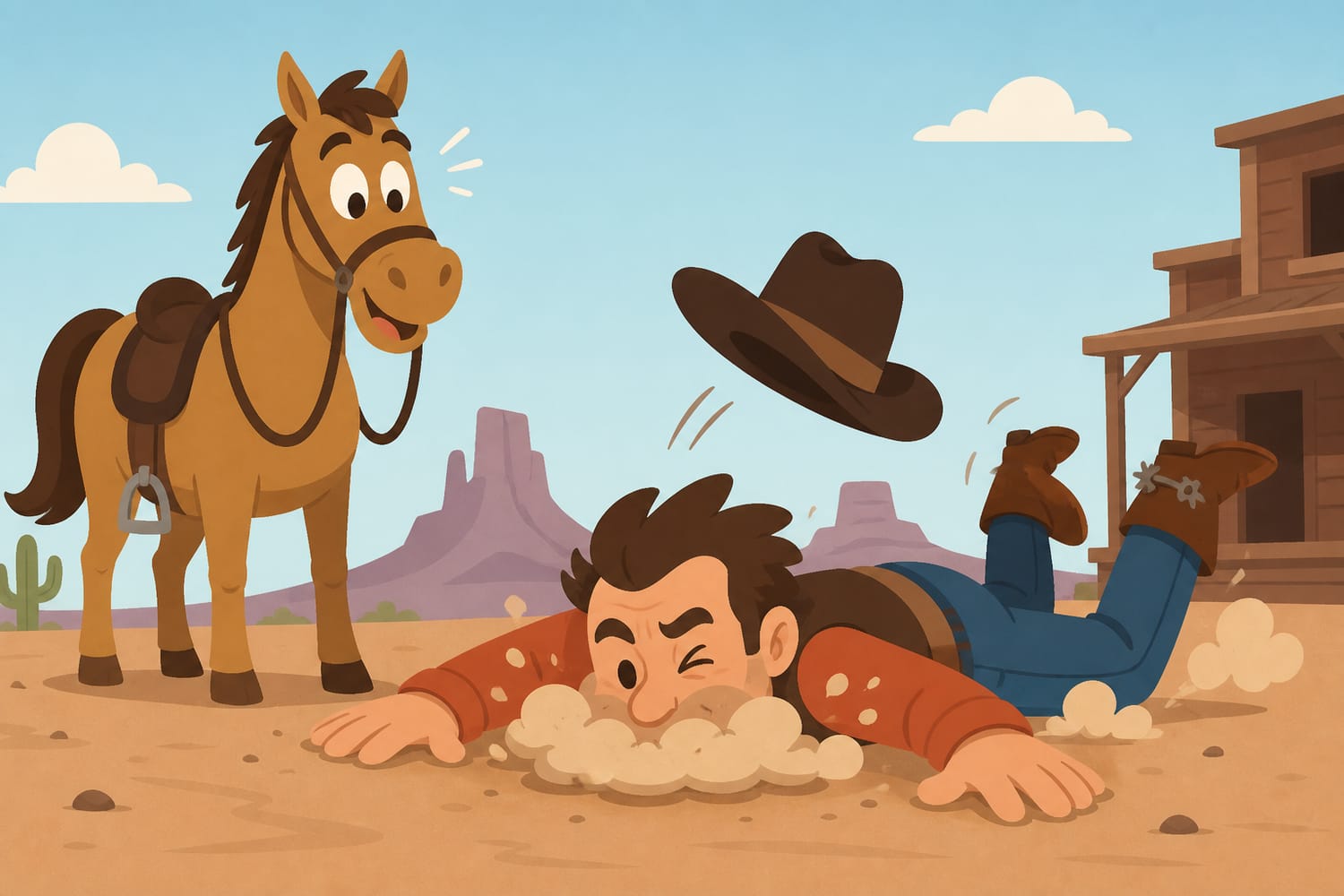
“Bite the dust” means to fall, die, suffer defeat, or fail completely. The expression creates a vivid picture of someone collapsing face-first onto dusty ground. Although cowboy films made it sound like a product of the Wild West, its roots reach much further back—through earlier English expressions, biblical imagery, and ancient descriptions of fallen warriors.
What Does “Bite the Dust” Mean Today?
If someone literally tried to bite dust, they would probably regret it immediately. Fortunately, the phrase is almost always figurative.
To “bite the dust” can mean several closely related things:
- To fall heavily: “Two cyclists bit the dust on the slippery corner.”
- To die: “The villain finally bit the dust.”
- To be defeated: “Three seeded players bit the dust in the opening round.”
- To fail or stop working: “After ten loyal years, my laptop has bitten the dust.”
The Cambridge Dictionary’s definition of “bite the dust” includes falling heavily, dying, ending in failure, and stopping working. That range explains why the expression can describe everything from a warrior’s death to a broken toaster.
In modern conversation, the phrase often sounds humorous or dramatic rather than genuinely grim. A houseplant, business plan, sports team, fashion trend, or household appliance can all bite the dust. The important idea is that something has gone down and is not getting back up—literally or metaphorically.
The Dusty Picture Behind the Phrase
The expression works because its central image is so easy to understand.
Imagine a warrior struck down in battle. He falls forward, his face meets the ground, and his mouth appears to “bite” the dirt or dust. It is not a pleasant picture, but it is certainly memorable.
That image also links death with defeat. A person lying on the ground has not merely lost an argument or received a disappointing performance review. They have been completely overcome. The phrase therefore carries a sense of finality: the contest is over, the machine is broken, or the grand plan has collapsed in a small cloud of imaginary dust.
English has long used physical downward movement to represent failure. We “fall from power,” watch businesses “go under,” and describe failed projects as having “collapsed.” “Bite the dust” belongs to the same pattern, but adds teeth for extra drama.
Is the Expression Really Ancient?
The image behind “bite the dust” is ancient, but the exact English wording requires a little caution.
Ancient Greek and Roman literature often describes defeated warriors falling to the earth. Later English translators sometimes rendered such passages using familiar phrases such as “bite the dust” or “bite the sand.” That does not necessarily mean Homer and other ancient poets used an expression identical to the modern English idiom.
Translation is not a word-for-word time machine. A translator may choose a familiar English saying to communicate the force of an ancient passage. When a nineteenth-century translation of an ancient poem includes “bite the dust,” the English wording belongs partly to the translator’s period, even if the underlying battlefield image is thousands of years old.
Still, the similarity is striking. Warriors have been falling face-first in literature for a very long time, and writers have repeatedly connected the mouth, earth, sand, and death.
It is a little like the history of why we say “in a nutshell”: an ancient literary image helps explain the expression, but the modern idiom took shape through later English usage.
Before Biting Dust, People Licked It
An important relative of the phrase is “lick the dust.”
The King James Bible, published in 1611, uses that wording in Psalm 72:9, where enemies are described as licking the dust. The image represents total submission and humiliation: the defeated person is brought so low that their face is against the ground.
This does not give us the exact phrase “bite the dust,” but it shows that English speakers were already familiar with dust as a symbol of defeat. The Bible also helped carry many striking images into everyday English, including “by the skin of your teeth” and “the writing on the wall.”
Other versions appeared as well. Writers referred to defeated people as biting the ground, biting the earth, or biting the sand. Dust eventually became the favored substance—perhaps because it sounds more dramatic and creates a better picture than “another one bites the moderately damp soil.”
Historical evidence collected by the Oxford English Dictionary dates “bite the dust” to the early eighteenth century, while a frequently cited example appears in Tobias Smollett’s 1750 translation of The Adventures of Gil Blas of Santillane: “We made two of them bite the dust.” The Phrase Finder’s history of “bite the dust” discusses this example alongside the older biblical and classical imagery.
As always with idiom history, an early surviving example is not necessarily the moment of invention. People may have used the phrase in conversation before anyone wrote it in a document that survived. Claims about one neat, certain origin should therefore be treated—as Uncover Words might put it—with a grain of salt.
Did Cowboy Movies Invent “Bite the Dust”?
No, but they certainly gave it excellent publicity.
The expression became strongly associated with Western stories and films, where dusty streets, galloping horses, gunfights, and spectacular falls made the metaphor look almost literal. A defeated outlaw could be thrown from his horse or collapse into the dirt, allowing audiences to watch someone “bite the dust” in suitably theatrical fashion.
Western films became enormously popular during the twentieth century, particularly during the genre’s golden age. Their repeated use of frontier language helped make “bite the dust” sound distinctly American, even though the expression had appeared in English long before movie cowboys rode onto the screen.
Westerns did not create the phrase. They simply supplied it with dust clouds, stunt performers, dramatic music, and villains who were unusually willing to fall off balconies.
Then Queen Made It Impossible to Forget
For many people, the phrase immediately summons the bass line from Queen’s “Another One Bites the Dust.”
Written by bassist John Deacon, the song was released as a single in August 1980 and became one of Queen’s biggest hits. Its title uses the phrase to suggest that another opponent, victim, or rival has been eliminated. The lyrics and relentless rhythm make each downfall sound like part of an unstoppable sequence.
Queen did not invent the expression any more than cowboy films did. By 1980, it had already been circulating for centuries. However, the song gave the idiom a new place in popular culture and introduced it to audiences around the world. Queen’s official history describes the creation and release of “Another One Bites the Dust”, including Deacon’s famous bass line and the single’s enormous success.
The phrase now carries echoes of ancient battlefields, dusty Westerns, sports commentary, and one of rock music’s most recognizable grooves. Few idioms have such an impressive soundtrack.
How to Use the Phrase Correctly
“Bite the dust” is informal, vivid, and sometimes flippant. It works best when describing competition, fictional violence, mechanical failure, or a disappointing ending.
For example:
- “Our old vacuum cleaner finally bit the dust.”
- “Another contestant bites the dust in tonight’s episode.”
- “Several proposals have bitten the dust because of budget cuts.”
- “The defending champion bit the dust in the semifinals.”
Because bite is an irregular verb, its common forms are:
- Present: bite or bites the dust
- Past: bit the dust
- Past participle: bitten the dust
Avoid saying something “bited the dust.” English may be strange, but it has standards.
It is also wise to consider tone. Saying that a fictional villain “bit the dust” sounds playful. Using the expression in a formal obituary or when speaking to a grieving family could sound insensitive. In serious situations, “died,” “passed away,” or another respectful expression is usually more appropriate.
Why Has the Saying Survived?
“Bite the dust” has lasted because it is short, visual, and flexible. We can instantly picture the fall, even when the subject is a printer, political campaign, or soufflé.
The idiom also turns an ending into a tiny story. Something stood up, encountered trouble, and landed face-first in the dirt. That is far more entertaining than simply saying it “failed.”
So, why do we say “bite the dust”? Because dusty ground became a powerful symbol of death, defeat, and complete collapse. Ancient writers used similar battlefield images, biblical English gave us enemies licking the dust, later writers recorded people biting the ground and dust, and popular entertainment carried the expression into modern life.
Today, anything can bite the dust—people, plans, products, trends, and particularly unreliable kitchen appliances. The phrase itself, however, shows no sign of doing so.