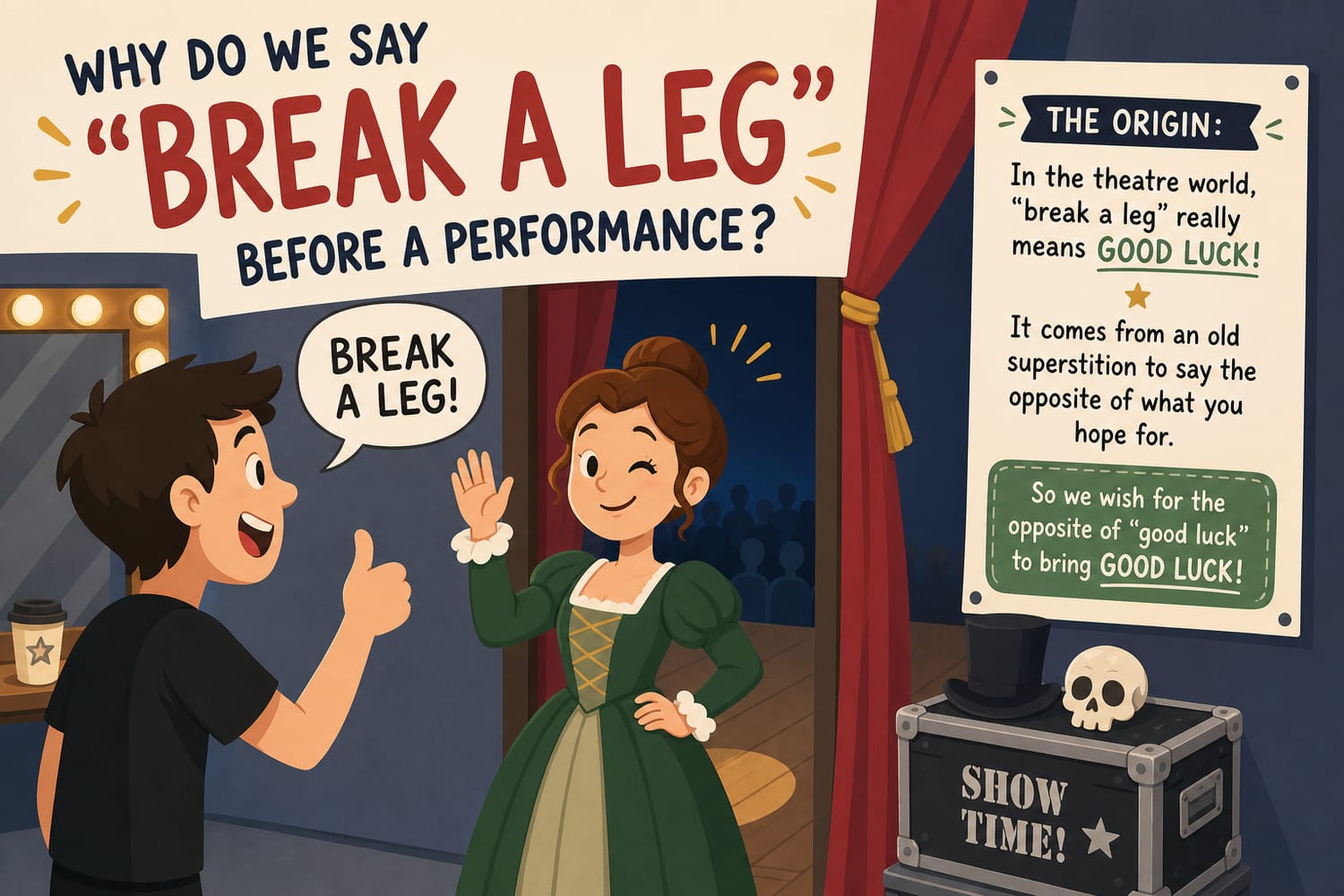
A Curious Good-Luck Wish That Sounds Like a Disaster
If you’ve ever been backstage before a play, dance recital, concert, comedy set, or school musical, you may have heard someone cheerfully say, “Break a leg!”
To anyone outside the performing arts, this sounds… alarming.
Imagine telling a surgeon, “Ruin the operation!” or telling a pilot, “Crash beautifully!” Yet in theaters around the English-speaking world, “break a leg” is one of the most familiar ways to wish a performer good luck before they step into the spotlight.
So why do we say something that sounds like a medical emergency when we mean, “Do brilliantly”?
The short answer is: nobody knows for certain. The longer answer is much more entertaining. The phrase probably grew out of old theatrical superstitions, where saying “good luck” directly was considered risky, arrogant, or tempting fate. Over time, “break a leg” became the playful, upside-down way to wish success without angering the mysterious forces of the stage.
Let’s raise the curtain on this odd little phrase.
The Theater Has Always Been a Superstitious Place
To understand “break a leg,” you first have to understand theater people.
For centuries, actors, stagehands, dancers, and musicians have worked in a world full of uncertainty. A performance depends on memory, timing, props, costumes, lighting, audience reaction, and dozens of tiny things going exactly right. Something as small as a missed cue, a stuck door, or a misplaced hat can derail a scene.
So perhaps it’s no surprise that theater developed a rich collection of superstitions.
Many actors avoid saying the name of Shakespeare’s Macbeth inside a theater, calling it “the Scottish play” instead. Whistling backstage has traditionally been considered bad luck, partly because stagehands once used whistle signals to move scenery. A careless whistle could accidentally call in a heavy backdrop at the wrong time.
And then there’s the big one: many performers don’t like being told “good luck” before a show.
Why? Because saying “good luck” was thought to invite bad luck. It was as if fate, hearing the words, might decide to interfere. So performers developed indirect or ironic ways to wish one another well.
In that world, “break a leg” makes a strange kind of sense. It says the opposite of what you mean, thereby sneaking good wishes past whatever mischievous spirits may be lurking in the wings.
The Most Likely Explanation: Reverse Psychology for Fate
The most widely accepted explanation is that “break a leg” is an example of wishing someone the opposite of what you actually hope will happen.
This kind of expression is not unique to English. Many cultures have traditions in which people avoid saying something too positive directly, especially before an important event. The idea is that openly wishing success might be boastful, unlucky, or tempting the universe to prove you wrong.
In theater, this became part of the performance ritual. Rather than say, “I hope you have a wonderful show,” a performer might say something that sounds negative but is understood to be positive.
“Break a leg” works because everyone in the theater knows it is not literal. No one is actually hoping the lead actor tumbles into the orchestra pit. It’s a coded phrase. It belongs to the private language of performers.
In this sense, it’s similar to saying “knock ’em dead” before a speech or “kill it” before a concert. We don’t mean actual violence. We mean, “Go out there and impress everyone.”
Language loves drama. Theater loves drama even more.
Did It Come from Bowing?
One popular explanation connects the phrase to bowing.
According to this theory, to “break a leg” originally meant to bend the leg while taking a bow or curtsy. In older theatrical language, “breaking” could refer to bending something from its straight position. So “break a leg” might have meant, “May you perform so well that you have to bow to thunderous applause.”
It’s a charming idea. Picture an actor bending their knee again and again while the audience cheers. In that interpretation, “break a leg” doesn’t mean injury at all. It means success, applause, and curtain calls.
Is this definitely the true origin? Unfortunately, no. Like many phrase origins, it’s difficult to prove. The expression became widely known in the 20th century, and earlier records are limited. The bowing theory is plausible, but not certain.
Still, it has one major advantage: it turns a violent-sounding phrase into something elegant. Less emergency room, more standing ovation.
What About the “Leg Line” Theory?
Another theater-related theory involves something called the “leg line.”
In traditional theaters, the “legs” are the tall, narrow curtains hanging at the sides of the stage. They hide backstage areas from the audience’s view. To “break” the line of the legs could mean to step out from behind the curtains and onto the stage.
According to this theory, telling someone to “break a leg” meant wishing that they would get onstage and perform. For understudies or chorus members, it might even have meant, “May you get a chance to appear tonight.”
This explanation is often repeated, especially in theater circles, and it fits neatly with stage vocabulary. The “legs” are real theater curtains, and crossing from backstage into the audience’s view is a meaningful moment.
But again, we should be careful. There is no universally accepted proof that this is the exact source of the phrase. It may be part of the story, or it may be a later attempt to explain a saying that was already popular.
Phrase origins are often like backstage props: some are solid, some are painted cardboard, and from a distance they can look surprisingly similar.
A Possible Link to German and Yiddish Expressions
Another interesting possibility is that “break a leg” was influenced by older European expressions.
In German, the phrase Hals- und Beinbruch literally means “neck and leg break,” but it is used to mean “good luck.” There are similar expressions in other languages where people wish something apparently bad as a way of wishing good fortune.
Some scholars have suggested that the German phrase may itself have been influenced by a Hebrew blessing, possibly through Yiddish. One suggested connection is to the Hebrew phrase hatzlacha u’bracha, meaning “success and blessing,” which may have been humorously or phonetically transformed in German-speaking Jewish communities. However, this connection is debated and not certain.
What matters is that the idea of wishing “bad luck” to mean “good luck” already existed in other languages and cultures. English-speaking performers may have adopted or adapted a similar idea.
This reminds us that phrases rarely grow in isolation. They travel with people. Actors, musicians, immigrants, comedians, vaudeville performers, and touring companies all carried words and customs from one place to another. The theater has always been a crossroads of language.
Did John Wilkes Booth Have Anything to Do with It?
One dramatic but unlikely theory links “break a leg” to the assassination of President Abraham Lincoln.
John Wilkes Booth, who assassinated Lincoln at Ford’s Theatre in 1865, was an actor. After shooting Lincoln, Booth leapt from the presidential box to the stage and injured his leg. Some versions say this event inspired the phrase.
It’s a memorable story, but it is almost certainly not the origin of “break a leg.”
The main problem is evidence. The phrase does not appear to have become a standard theatrical good-luck saying immediately after Lincoln’s assassination. If such a famous event had created the expression, we would expect clearer records from the late 19th century. Instead, “break a leg” appears to have gained wider use later, especially in the early-to-mid 20th century.
The Booth theory is one of those explanations that feels dramatic enough to be true—but language history is not always written by the best storyteller. Sometimes the most exciting origin is also the least reliable.
When Did People Start Saying It?
The exact first use of “break a leg” is hard to pin down.
The phrase became especially common in American theater during the 20th century. Written evidence from the early 1900s suggests that similar expressions existed, and by the mid-20th century, “break a leg” was widely recognized as theatrical slang for “good luck.”
It likely spread from stage performers to other kinds of entertainers, and then into everyday speech. Today, people say it before exams, presentations, auditions, job interviews, sports matches, and all kinds of nerve-racking events.
Of course, if someone is about to run a marathon, you may want to choose your words carefully.
Why Not Just Say “Good Luck”?
You can, of course. Most people won’t panic if you say “good luck” before a school play.
But among performers, traditions matter. Saying “break a leg” is part of the ritual of theater. It creates a sense of belonging. It says, “I know the custom. I’m with you. Go do your thing.”
That’s one of the wonderful things about idioms. They are not just definitions in a dictionary. They are social signals. They carry history, humor, and community.
When actors say “break a leg,” they’re participating in a tradition shared by generations of performers. It’s a wink, a charm, and a pep talk all at once.
Why “Break a Leg” Works So Well
Part of the reason the phrase has survived is that it’s memorable.
“Good luck” is pleasant, but plain. “Break a leg” grabs attention. It has surprise built into it. The words seem wrong, so your brain pauses for a moment. That makes the phrase stick.
It also has emotional usefulness. Before a performance, people are nervous. A normal good-luck wish might increase the pressure: “Yes, I really do need to be good!” But “break a leg” adds humor. It cuts through the tension. It lets performers smile right before they walk into a very exposed situation.
And performing is exposed. Whether you’re playing Hamlet, singing karaoke, giving a wedding toast, or presenting quarterly sales numbers, you’re stepping into a spotlight of some kind. A slightly silly phrase can be exactly what you need.
Other Strange Ways We Wish People Luck
“Break a leg” is not alone in the world of backwards good wishes.
In opera, singers may hear the Italian phrase in bocca al lupo, meaning “into the wolf’s mouth.” The traditional response is crepi il lupo, often translated as “may the wolf die.” It’s another dramatic, dangerous-sounding way to wish someone success.
Dancers sometimes say “merde,” the French word for, well, something rather impolite. One explanation connects it to the days when audiences arrived by horse-drawn carriage: lots of horse droppings outside the theater meant a large crowd had come to see the show.
In English, we also say things like “knock ’em dead,” “slay,” “crush it,” and “kill it.” Apparently, when humans want to encourage one another, we reach for vocabulary that sounds like a medieval battlefield.
Language is funny that way.
So, Why Do We Say “Break a Leg”?
We say “break a leg” because performers developed a tradition of avoiding direct good-luck wishes. The phrase probably comes from theatrical superstition and the habit of saying the opposite of what is meant to outsmart bad luck.
Other explanations may also have influenced it. It may connect to bending the leg during a bow, stepping past the stage “legs,” or similar good-luck phrases in German and other languages. But no single origin has been proven beyond doubt.
What we can say with confidence is that “break a leg” became a beloved theatrical idiom because it does several things at once: it wishes success, respects superstition, builds camaraderie, and lightens the mood.
Not bad for three little words that sound like a trip to urgent care.
Final Curtain
The next time someone says “break a leg,” you don’t need to call an ambulance. They’re not being cruel. They’re using one of the theater’s most famous expressions—a phrase wrapped in superstition, humor, history, and a dash of dramatic flair.
It reminds us that language doesn’t always move in straight lines. Sometimes we say the opposite of what we mean. Sometimes bad luck means good luck. And sometimes, before the curtain rises, the best thing you can say to someone is the last thing you would ever want to happen.
So if you’re heading onto a stage, into an audition, or up to a microphone, here’s wishing you the traditional way:
Break a leg.