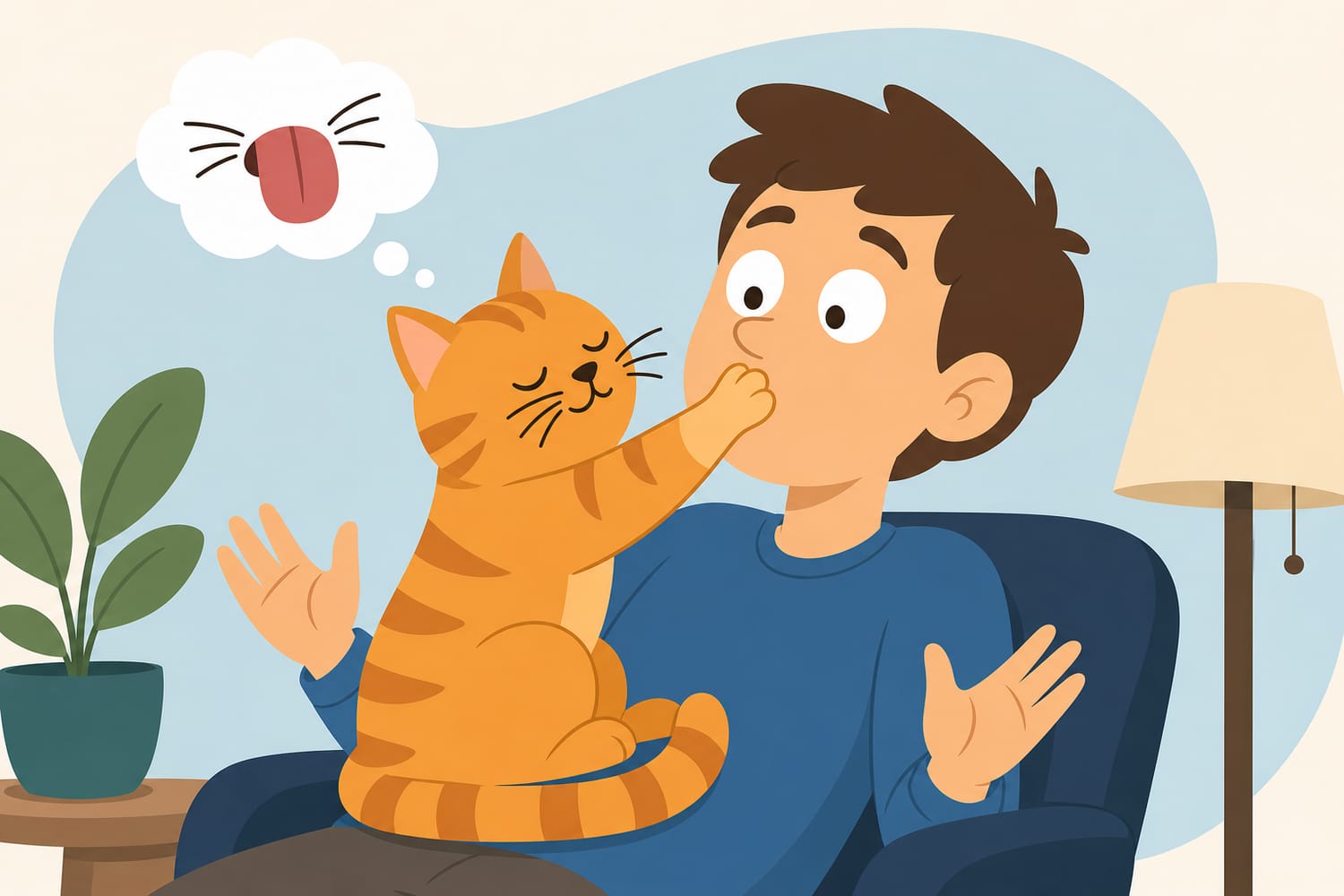
The Short Answer: It Means “Why Are You So Quiet?”
“Cat got your tongue?” is one of those wonderfully strange English expressions that sounds like it escaped from a cartoon. We usually say it when someone is unusually silent, hesitant, embarrassed, or refusing to answer a question.
For example:
“You were full of opinions five minutes ago. What’s wrong—cat got your tongue?”
The phrase is most often used playfully, though it can also sound teasing or mildly impatient depending on the situation. You might hear it from a parent to a shy child, from one friend to another, or in a movie when a character suddenly has nothing to say.
Of course, no one actually believes a cat has stolen anyone’s tongue. Like many idioms, the meaning has drifted far away from the literal image. But that image—a cat somehow responsible for a person’s silence—is exactly what makes the phrase memorable.
So where did it come from? That is where things get interesting.
The Honest Truth: We Don’t Know for Sure
The origin of “cat got your tongue?” is uncertain. That may sound disappointing, but it is actually fairly common with old sayings. Many idioms began as casual speech long before anyone thought to write them down. By the time they appear in print, they may already have been used for decades.
What we can say with confidence is that the expression became visible in English in the late 19th and early 20th centuries. It appears especially in American and British conversational contexts as a teasing question asked of someone who is silent.
Most serious word historians and dictionary editors treat its origin as unknown. That is important because there are many colorful “explanations” floating around online, and some are repeated so often that they sound official. But sounding dramatic is not the same as being true.
The best answer is this: “Cat got your tongue?” probably developed as a playful, slightly absurd way to ask why someone was not speaking. The exact reason a cat was chosen is unclear.
Still, the theories are worth exploring—especially because they reveal how people try to make sense of strange phrases.
Theory One: The Cat-o’-Nine-Tails
One popular explanation claims that the phrase comes from the “cat-o’-nine-tails,” a type of whip historically used for punishment, especially in naval and military contexts. According to this theory, a sailor or prisoner who had been whipped would be in too much pain—or too afraid—to speak. In other words, the “cat” had “got” his tongue.
It is a vivid theory, but there is a problem: there is no strong evidence connecting the idiom to the whip.
The cat-o’-nine-tails was certainly real. It was a multi-tailed lash used as a disciplinary tool, and it was commonly nicknamed “the cat.” But the jump from that punishment to the phrase “cat got your tongue?” is not supported by clear historical records.
If this were the true source, we might expect to find earlier uses of the expression in naval writing, military slang, or accounts of punishment. Instead, the phrase appears mainly as a casual question, often used toward children or in light conversation. That does not prove the theory impossible, but it makes it less convincing.
So while the cat-o’-nine-tails explanation is dramatic, it is best treated as speculation rather than fact.
Theory Two: Ancient Egypt and Cat Worship
Another story claims the phrase comes from ancient Egypt, where cats were highly respected animals. Some versions say that liars or blasphemers had their tongues cut out and fed to cats. Others claim that cats were linked to silence through religious customs.
This explanation has all the ingredients of a good myth: ancient civilization, sacred cats, gruesome punishment, and mysterious symbolism. Unfortunately, it lacks evidence.
Ancient Egyptians did indeed value cats. Cats were associated with protection, grace, and the goddess Bastet. They were admired for hunting pests and were often depicted in art. But there is no reliable historical evidence that the English idiom “cat got your tongue?” comes from Egyptian punishment rituals.
The biggest issue is the timeline. The phrase is an English expression that becomes visible much later, and there is no clear path showing how an ancient Egyptian custom—real or imagined—would have turned into a modern English teasing question.
It is a fascinating tale, but not a proven origin.
Theory Three: Witches, Cats, and Stolen Speech
Because cats—especially black cats—have long been linked with witches in European folklore, another theory suggests that the phrase may come from magical beliefs. Perhaps, the idea goes, a witch’s cat could steal someone’s ability to speak.
This one is at least thematically plausible. Cats have appeared in folklore for centuries as mysterious, independent, and slightly supernatural creatures. In many traditions, they are associated with secrets, night, silence, and watchfulness. If any animal were going to “steal” your tongue in a folktale, a cat would be a good candidate.
But again, there is no solid evidence that the idiom came directly from witchcraft stories. It may be that cats already had a reputation for mystery and silence, making them a natural fit for a playful phrase about speechlessness.
In other words, folklore may have helped the expression feel sensible, even if it did not directly create it.
Why a Cat, Though?
Even if we do not know the exact origin, we can still ask: why does the phrase work so well?
Cats are quiet animals. They move softly, watch carefully, and often seem to know more than they are willing to reveal. A dog may bark at everything; a cat may simply stare at you as if judging your life choices.
That quiet, secretive quality makes cats perfect for an idiom about silence.
There is also something funny about imagining a cat as a tiny thief. Cats steal chairs, socks, bits of food, warm laundry, and occasionally the entire emotional atmosphere of a room. So the idea that a cat might somehow “get” your tongue feels absurd but not completely out of character.
The phrase also has a pleasing rhythm. “Cat got your tongue?” is short, punchy, and easy to say. It uses simple one-syllable words, which makes it memorable. Idioms often survive not just because of what they mean, but because they sound good.
The Importance of the Tongue
The “tongue” part of the expression is easier to understand. Across many languages and cultures, the tongue is strongly associated with speech.
We say someone has a “sharp tongue” if they speak harshly. A “silver tongue” means persuasive speech. If something is “on the tip of your tongue,” you almost remember it. A “slip of the tongue” is a verbal mistake. If you “hold your tongue,” you stay quiet.
So “cat got your tongue?” fits neatly into a long tradition of using the tongue as a symbol for the ability—or willingness—to speak.
The phrase does not ask, “Cat got your voice?” or “Cat got your words?” It asks about the tongue because the tongue has long stood for speech itself.
How the Phrase Is Used Today
Today, “cat got your tongue?” is usually informal and lightly teasing. It is not something you would normally say in a serious business meeting or to someone who is clearly upset. Used at the wrong time, it can sound rude or dismissive.
For example, if someone is grieving, anxious, or uncomfortable, “cat got your tongue?” would probably not be kind. But in a playful setting, it can be harmless and even funny.
Here are a few typical uses:
“You were so confident before the quiz started. What happened—cat got your tongue?”
“Well? Are you going to explain why there’s glitter in the microwave, or has the cat got your tongue?”
“She asked him who ate the last cookie, and suddenly it was like the cat had got his tongue.”
Notice that the phrase often appears when someone is expected to answer but does not. It highlights a sudden silence.
Is It Rude?
It can be.
Like many teasing phrases, “cat got your tongue?” depends heavily on tone. Said with a smile among friends, it can be playful. Said sharply by a teacher, parent, boss, or interrogator, it can feel embarrassing or aggressive.
It is often directed at someone who is shy, caught off guard, or guilty-looking. That means it can put pressure on the person to speak. For that reason, it is best used gently, if at all.
A softer alternative might be:
- “You’re quiet—everything okay?”
- “What are you thinking?”
- “No answer?”
- “Take your time.”
Still, as an idiom, “cat got your tongue?” remains widely understood and frequently used in humorous writing, dialogue, and everyday conversation.
Similar Expressions About Silence
English has plenty of ways to describe someone who is not talking.
Someone may be:
- “Speechless”
- “Lost for words”
- “Tongue-tied”
- “Struck dumb”
- “Quiet as a mouse”
- “Keeping mum”
- “Clammed up”
“Tongue-tied” is especially close in meaning. It describes the feeling of being unable to speak, often because of nervousness, surprise, or embarrassment.
“Cat got your tongue?” is different because it is usually asked as a question. It is not just describing silence—it is challenging it.
That is part of its charm. It turns an awkward pause into a tiny comic mystery.
So, What’s the Best Explanation?
The most accurate explanation is also the simplest: “Cat got your tongue?” is an idiom of uncertain origin that became common by the late 19th or early 20th century. It means “Why aren’t you speaking?” or “Why are you so quiet?”
The dramatic stories about whips, ancient Egypt, and witchcraft are interesting, but none is firmly proven. They may explain why people find the phrase intriguing, but they should not be presented as definite facts.
The phrase probably survived because it is playful, vivid, and just odd enough to stick in the mind. A silent person is ordinary. A silent person whose tongue may have been stolen by a cat? That is unforgettable.
Final Meow
“Cat got your tongue?” is a perfect example of how strange and delightful idioms can be. We use it without picturing the literal scene, yet the literal scene is exactly what gives the expression its flavor.
Its true origin remains a mystery, but perhaps that is fitting. Cats are mysterious creatures. They appear when they want, vanish when they please, and refuse to explain themselves.
So if you ever ask someone, “Cat got your tongue?” just remember: the phrase may not have a clear history, but it has plenty of personality.
And if a cat is nearby, maybe ask politely. It might know more than it’s saying.