Why “Make a Beeline” Means Heading Straight There
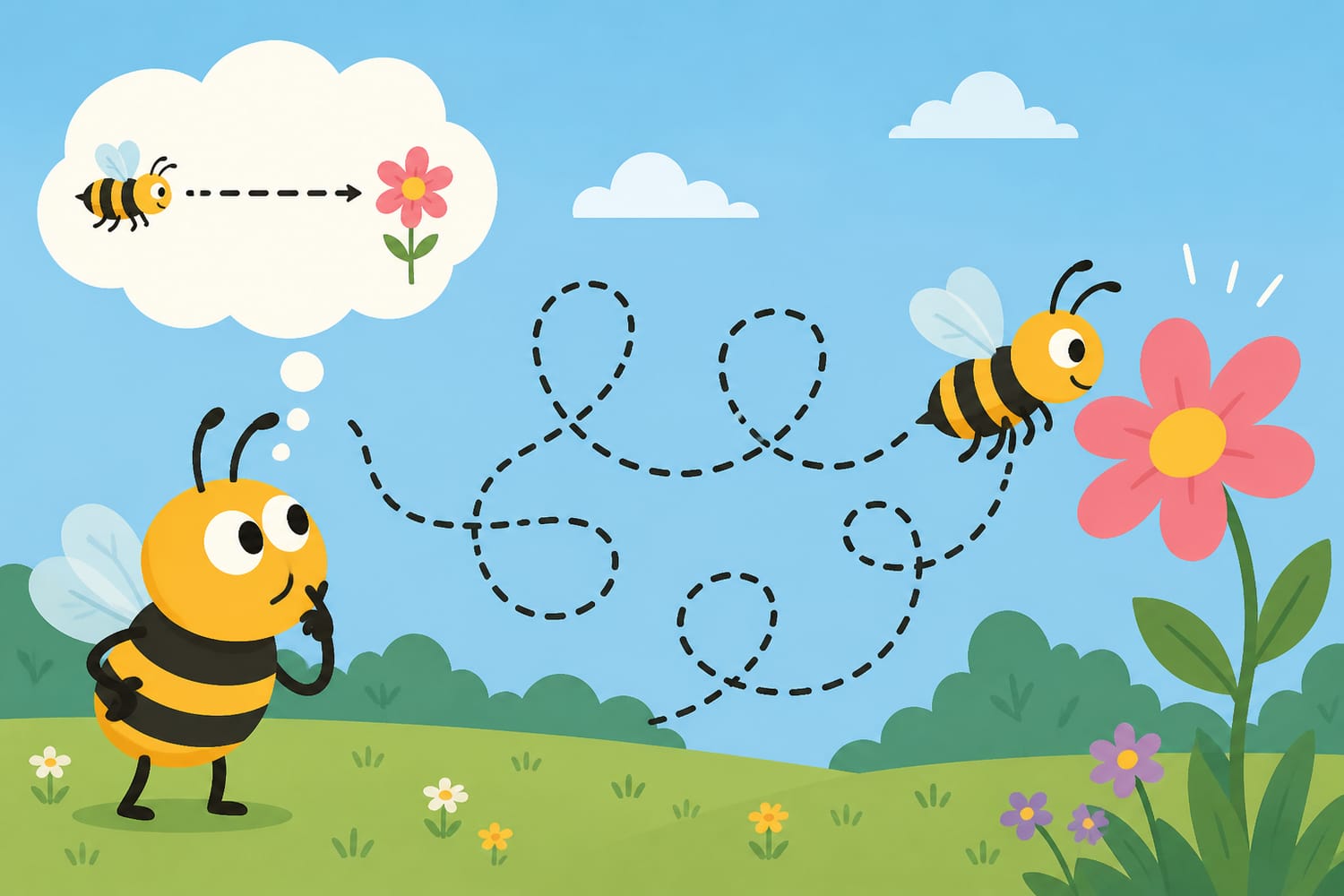
To “make a beeline” means to go quickly and directly toward something. The expression comes from honeybees’ reputation for flying straight back to their hive after foraging. That reputation has a basis in reality—but bees do not spend every flight traveling as though someone drew their route with a ruler.
Picture someone arriving at a party, spotting the dessert table, and immediately abandoning all other plans. No sightseeing. No small talk. Just a determined journey toward a brownie.
That is a beeline. But watch a bee investigating flowers, and the comparison suddenly seems questionable. Surely this zigzagging little creature is an odd mascot for direct travel?
The explanation depends on which part of the bee’s journey you are watching.
Where Did the Expression Come From?
The history of beeline leads back to an observation about honeybees returning home—not a claim that every movement a bee makes is perfectly straight.
According to Merriam-Webster’s account of the expression’s history, the hyphenated form bee-line appeared in an 1828 book review in The American Quarterly Review. The passage described a method of finding wild bees’ nests by releasing captured bees and observing their homeward direction.
By 1829, a Philadelphia newspaper was using bee-line figuratively for human movement. In other words, the jump from insect behavior to everyday expression happened early in its recorded history.
You may also encounter 1830 as the word’s first-use date, including in dictionary entries. That reflects the evidence recorded by those references; the 1828 example supplies an earlier documented appearance. Neither date tells us the exact moment somebody first said it aloud.
The important distinction is between an expression’s earliest surviving paperwork and its actual birthday. Language rarely keeps the receipt.
Bee-Lining Was More Than a Figure of Speech
Before beeline became a handy description of someone approaching a buffet, following bees was a practical way to locate their nests.
The basic principle was straightforward: observe the direction in which honeybees departed for home, then use that information to narrow down the nest’s location. The historical account quoted by Merriam-Webster describes taking bearings from different release points to work out where the bees’ home lay.
This practice, called bee-lining, connects the expression to something more substantial than a charming animal stereotype.
In an excerpt from Thomas D. Seeley’s Following the Wild Bees, published by Harvard Magazine, the bee researcher describes attracting captured foragers to sugar syrup and releasing them. Returning bees—and the nestmates they recruit—give the observer repeated opportunities to watch homeward flights and record their direction.
Think of it as detective work in which the witnesses are tiny, airborne, and primarily interested in lunch.
It also explains why the homeward journey matters so much to the idiom. A bee searching for food is not necessarily pointing toward anything useful. A bee heading home can provide a much clearer clue.
Do Bees Really Fly in Straight Lines?
Honeybees can fly remarkably direct routes, but “bees always fly straight” is an oversimplification. Searching, learning, navigating, and returning home involve different kinds of movement. Research tracking individual bees has recorded both relatively straight flight segments and searching flights with frequent changes of direction.
Searching Is Not the Same as Commuting
A honeybee investigating a flower patch has a different task from one traveling to a known destination. Finding and visiting food involves responding to the flowers and surroundings, rather than simply maintaining one heading. Honeybees learn features such as flowers’ colors, shapes, and scents, along with landmarks that help them navigate.
Imagine the difference between browsing supermarket aisles and walking directly to the checkout. Both are purposeful, but only one looks like a beeline.
Getting Home Can Involve Course Corrections
In a radar-tracking study, researchers moved honeybees away from their expected routes. Some initially flew in the direction they would have taken before being moved, then searched, and eventually began rapid, relatively straight flights toward home or a familiar feeding location.
That is impressive navigation, but it is not an uninterrupted straight line from the moment of release.
The useful takeaway is that a direct destination does not guarantee a perfectly straight flight path. The idiom captures a recognizable part of honeybee behavior, not an ironclad rule governing every bee in every situation.
How Does a Honeybee Know Which Way to Go?
The surprising part is not that honeybees sometimes turn. It is that they can travel away from their nest and find their way back at all.
Their navigation draws on several kinds of information rather than one magical homing instinct.
A Compass in the Sky
Honeybees use the sun as a directional reference and can compensate for its changing position during the day. They can also obtain compass information from patterns of polarized light in the sky when suitable patches of sky are visible.
So “keep the sun on your left” would be a rather incomplete bee instruction. The system has to account for time, too.
Familiar Views and Landmarks
Bees also learn visual features of their surroundings. Research shows that landmarks associated with food sources play an important role in navigation, particularly as bees approach their destination.
A familiar landscape is therefore useful information, not merely scenery passing beneath their feet.
Keeping Track of the Journey
Another important process is path integration: combining information about movement to maintain an estimate of direction and distance from a starting point. This can allow a homeward route to be more direct than the outward journey.
Honeybees estimate travel distance largely through optic flow, the apparent movement of the visual world across their eyes as they fly. It is rather like judging movement by watching the landscape slide past a train window—although the bee’s version requires neither a ticket nor a window seat.
What About the Famous Waggle Dance?
Honeybees do not only navigate for themselves. Successful foragers can communicate information about profitable food locations through the waggle dance.
The dance conveys direction and distance. On a vertical comb, the angle of the waggle run relates the food’s direction to the sun, while the duration of that run provides information about travel distance.
It is tempting to connect this directly to the expression: one bee dances, another receives directions, and off it goes on a beeline.
However, the historical evidence for the word points to observations of bees’ homeward flights, rather than to the dance itself. The dance belongs to the fascinating science behind their journeys, but it is not needed to explain the expression’s origin.
The communication is useful to humans, too. Researchers at the University of Sussex explain how they decode waggle dances to investigate where honeybees forage, turning movements inside the hive into information about feeding locations outside it.
A bee cannot hand over a map. A dance, apparently, will do.
How to Use “Make a Beeline”
In ordinary English, the expression emphasizes quick, direct movement toward a destination. The destination need not be home, and nobody expects you to prove that your route was geometrically perfect.
For example:
- “When the doors opened, Lena made a beeline for the front row.”
- “The dog made a beeline for the muddy puddle.”
- “After the meeting, I made a beeline for the coffee machine.”
In each sentence, the image is of someone—or something—heading straight toward a clear target.
That is part of the pleasure of idioms: a small physical picture carries a bigger meaning. We can “break the ice” to begin a conversation without touching anything frozen, just as we can make a beeline without sprouting wings.
The Verdict: A Good Observation, Not a Flight Guarantee
“Make a beeline” preserves a genuine observation: honeybees can take impressively direct routes home. What it leaves out is the searching, learning, and navigational adjustment that can surround those straight stretches.
So the expression is neither nonsense nor a complete biology lesson. It is a useful snapshot.
The next time you make a beeline for the last slice of cake, consider the honeybee your linguistic inspiration—not your geometry examiner.