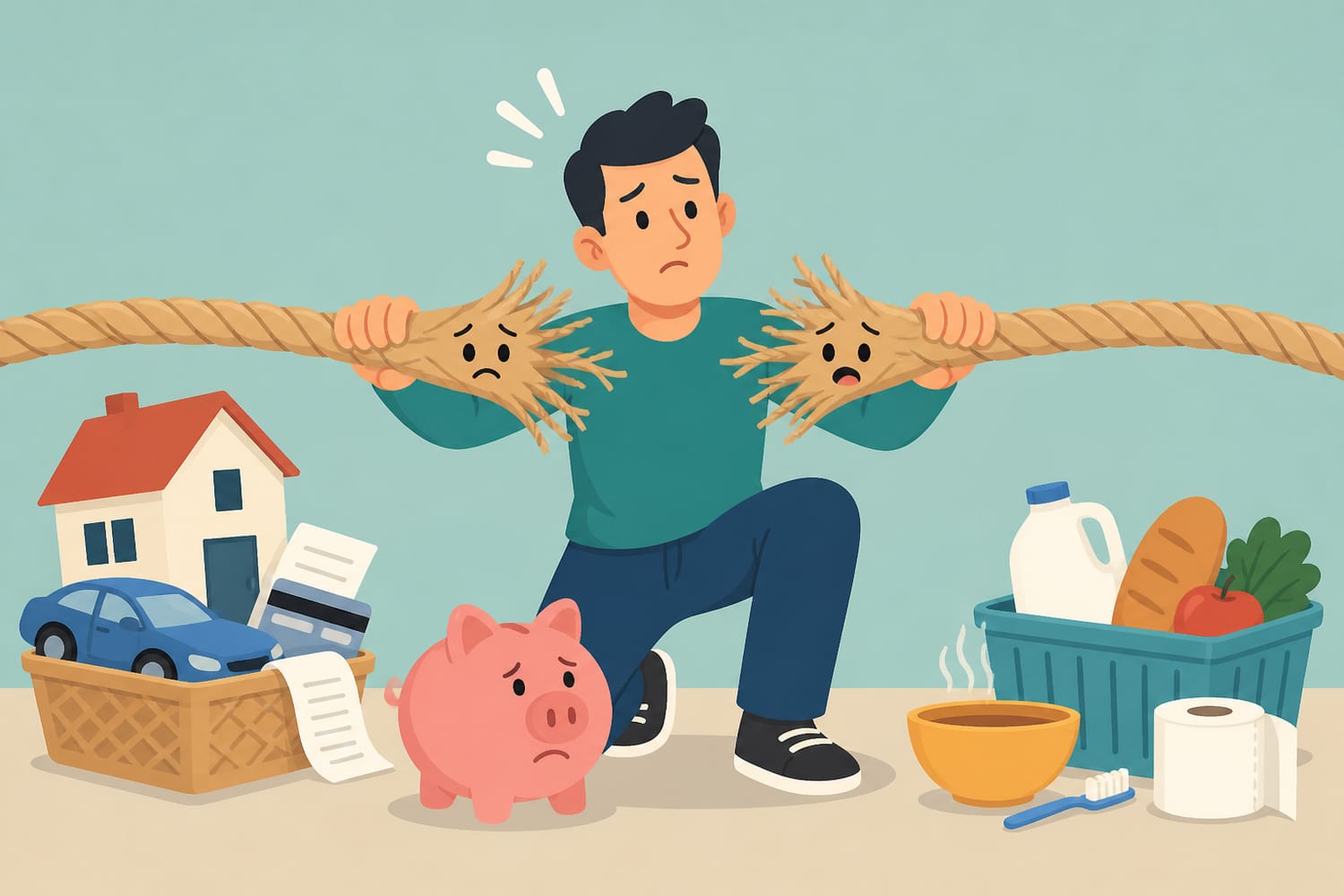
The Short Answer: What Are the “Ends”?
To make ends meet is to have enough money to cover what you need. The “ends” are the two sides of a tight fit—but which fit gave us the expression is uncertain. They might evoke income reaching expenses, money lasting from the start of a year to its end, or even cloth stretching far enough to meet around a body.
That uncertainty is part of the fun. We all know what the phrase means when the rent is due. Ask what, exactly, is supposed to be meeting, though, and a simple money expression turns into a small historical mystery.
What Does “Make Ends Meet” Mean Today?
Imagine your take-home pay for the month is $2,500, and the bills and necessities come to $2,480. You’ve made ends meet—with $20 of breathing room and perhaps a wary glance at the refrigerator. If those costs come to $2,550, the ends don’t quite meet.
The phrase describes having enough for essentials, not necessarily living comfortably or building savings. As the Cambridge Dictionary definition puts it, the money is just enough to pay for what you need. That little word “just” does a lot of work.
People most often say they’re struggling to make ends meet. Someone who covers the basics but has to juggle bills, postpone a purchase, or hope the car behaves itself may be making ends meet—barely. The expression is about the margin, or lack of one, between what comes in and what must go out.
The Older Phrase Had an Extra Word
Long before anyone worried about an internet bill, people were trying to make both ends meet. An early recorded example appears in Thomas Fuller’s The History of the Worthies of England, published in 1662. Writing about Edmund Grindal, Fuller says he wanted only to “make both ends meet” and gave away what “lapped over.”
That is a useful glimpse of the phrase in action: enough to get by, with a little left over. It also sounds as though Fuller expected readers to recognize the expression already. An early appearance in a book tells us the saying existed by then; it does not tell us who coined it or what object its first users had in mind.
The word both makes us picture two distinct ends coming together. Modern English often drops it, but the financial balancing act remains. You can still say “make both ends meet,” though “make ends meet” will sound more familiar to many readers.
Three Ways to Picture the Ends
1. Income and expenses
The most immediate picture is a budget. On one side is the money coming in; on the other is the cost of living. If income covers expenses, the figures line up. If it doesn’t, there’s a gap to close.
It is a neat explanation, and it matches how we use the phrase today. But a modern interpretation of a saying is not automatically its original image. Word historian Michael Quinion, writing for World Wide Words, cautions that the familiar bookkeeping explanation cannot be established with certainty.
2. The beginning and end of the year
Perhaps the ends are points in time instead: the beginning of a year, when money is available, and its end, which you hope to reach without running out. In this reading, making the ends meet means stretching your resources across the whole period.
There is historical support for people understanding the saying that way. In Tobias Smollett’s 1748 novel The Adventures of Roderick Random, a character manages to make “the two ends of the year meet.” It is an unusually helpful version because it names the year outright. The catch? The shorter “both ends” form was recorded earlier, so Smollett’s wording does not prove that a calendar year inspired the phrase in the first place.
We tend to think in paychecks and months now. That makes “get to the end of the month” an easy way to grasp the idea, even if we should resist presenting it as the phrase’s documented birthplace.
3. The edges of a piece of cloth
Here is a more tangible possibility: you have just enough fabric to wrap around a body and bring its edges together. No generous overlap, no room to spare—just enough to make the ends meet.
This reading makes Fuller’s phrase “lapped over” especially intriguing. A 1699 dictionary also pairs “make both ends meet” with the advice to cut your coat according to your cloth. As Word Histories’ examination of the early evidence notes, those details lend the clothing interpretation some appeal. They still don’t amount to proof that a tailor invented the expression.
It is easy to see why this image would travel. Whether you are short of fabric or short of cash, the question is the same: Can I make what I have cover what I need?
What About Sailors and Rope?
Another story says sailors spliced together the ends of ropes to save money, giving us make ends meet. It’s vivid, but vivid stories need evidence too. The early examples of this phrase do not establish a shipboard origin, and specialists treat its beginnings as uncertain.
It’s tempting to give every puzzling expression a dramatic scene on a sailing ship. Some sayings really do have nautical connections—Uncover Words explores one in “Three Sheets to the Wind”. For make ends meet, though, a rope is a possible image, not a verified answer.
A French Phrase Joins the Conversation
English isn’t alone in imagining financial survival as joining two ends. French has joindre les deux bouts—literally, “join the two ends”—and an older French version explicitly refers to the ends of the year. The resemblance is striking. It suggests a shared way of picturing the problem, although it does not, by itself, settle precisely how the English expression arose.
That is one of the delights of idioms: a picture can make immediate sense across languages even while its exact path through history remains hard to trace. Two ends, not quite enough in the middle, and a determined attempt to bring them together—no spreadsheet required.
So Which Explanation Wins?
If you need a plain-English answer, the ends are whatever must be brought together for your resources to be enough. In everyday use, that is the money available and the cost of necessities. The older wording also allows other pictures: the two ends of a year or the two edges of barely sufficient cloth.
If you need a definitive origin story, the honest answer is that we don’t have one. The clothing clues are suggestive. The year-long budget appears explicitly in a later version. Income versus expenses captures today’s meaning beautifully. None gives us permission to announce, with complete confidence, “These were the original ends.”
That may be less tidy than a tale about one ingenious tailor—or one thrifty sailor—but it reveals something more interesting about language. A useful image can outlive the details that first gave rise to it. Much like the question behind “Kick the Bucket”, the words invite a literal picture without handing us a simple, certain explanation.
The next time you hear that someone is making ends meet, you’ll know what matters most: they’re finding a way to cover what they need. The ends may remain mysterious. Getting them together is the hard part.