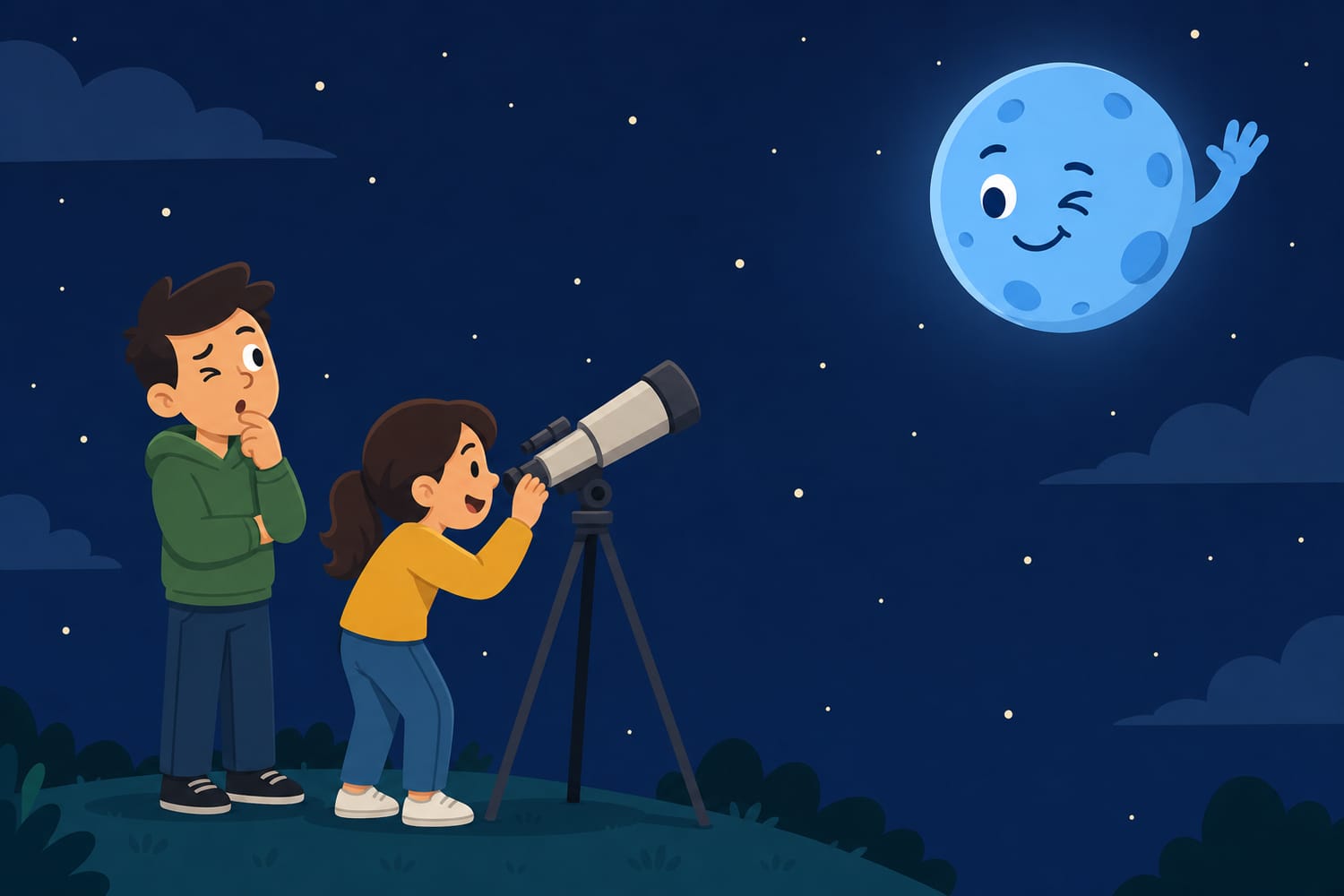
A Rare Phrase for a Rare Occasion
If someone says, “I only clean out the garage once in a blue moon,” you probably don’t rush outside to inspect the sky. You understand the meaning immediately: it happens rarely. Very rarely. Perhaps suspiciously rarely.
“Once in a blue moon” is one of those wonderfully vivid English expressions that sounds poetic, mysterious, and just a little bit magical. It gives everyday speech a sprinkle of moonlight. But where did it come from? Is the moon ever actually blue? And how often is “once in a blue moon,” really?
The short answer: the phrase means “very infrequently,” and it grew out of older ideas about something being absurd, impossible, or extremely unusual. The longer answer involves medieval wordplay, folklore, astronomy, almanacs, volcanic eruptions, and one surprisingly influential mistake.
So let’s look up.
Does the Moon Actually Turn Blue?
Most of the time, no. The moon is not literally blue.
The moon usually appears white, gray, yellowish, or orange, depending on its position in the sky and what’s going on in Earth’s atmosphere. When the moon is low on the horizon, its light passes through more of the atmosphere, scattering shorter blue wavelengths and often making the moon look golden or reddish. This is the same basic reason sunsets can look red or orange.
But under unusual conditions, the moon can appear blue.
This happens when the air contains particles of just the right size, usually from smoke, dust, or volcanic ash. These particles can scatter red light while allowing more blue light to pass through, creating the strange effect of a bluish moon.
One of the most famous examples followed the eruption of Krakatoa in Indonesia in 1883. The eruption blasted enormous amounts of ash and dust into the atmosphere, and for months afterward, people in various parts of the world reported unusually colored sunsets and moons that appeared blue or green.
Similar effects have been reported after major forest fires. For instance, smoke from Canadian forest fires in 1950 caused blue-looking moons in parts of North America and Europe.
So yes, a truly blue-looking moon is possible. But it’s rare enough that if you see one, you’ve earned the right to dramatically whisper, “Behold.”
The Older Meaning: When the Moon Is Blue
The phrase “blue moon” has been around for centuries, but it did not always mean what it means today.
In the 1500s, saying the moon was blue was like saying pigs could fly. It suggested something absurd, impossible, or ridiculous. One early example comes from a 1528 work by William Barlow, who wrote about people being expected to believe something even “if they say the moon is blue.”
In other words: “They could tell you the moon is blue, and you’d still believe them.”
At that time, a “blue moon” was not an astronomical event. It was an impossibility, or at least something wildly unbelievable. The idea was simple: everyone knows the moon is not blue, so claiming it is blue must be nonsense.
Over time, the meaning shifted. Instead of referring to something impossible, “blue moon” came to suggest something extremely rare. After all, if the moon did appear blue, that would be a remarkable event indeed.
This is a common pattern in language. Words and phrases often soften over time. “Impossible” becomes “unlikely.” “Unlikely” becomes “rare.” And eventually, someone uses it to describe how often they floss.
So What Is a “Blue Moon” in Astronomy?
Here’s where things get interesting: today, many people use “blue moon” to mean the second full moon in a calendar month.
A full moon occurs about every 29.5 days. Since most months are 30 or 31 days long, it is possible to have two full moons in the same month. When that happens, the second one is commonly called a blue moon.
This kind of blue moon happens roughly once every two and a half to three years. So “once in a blue moon” is rare, but not “the comet has returned after 75 years” rare. More like “I found matching socks on the first try” rare.
However, this popular definition has a funny backstory.
The older astronomical meaning of “blue moon” was a little different. Traditionally, especially in the Maine Farmers’ Almanac, a blue moon referred to the third full moon in a season that had four full moons.
Normally, each season has three full moons. Many of those full moons had traditional names, often tied to agriculture, weather, or religious calendars. But occasionally a season would contain four full moons instead of three. To keep the traditional naming system in order, the extra one — specifically the third full moon of that season — was called a blue moon.
Then, in 1946, an article in Sky & Telescope magazine simplified and misinterpreted this older rule, describing a blue moon as the second full moon in a calendar month. That version was easier to understand, easier to remember, and apparently much easier to spread. It became widely popular, especially after being repeated in broadcasts and later in calendars and reference books.
So the modern “second full moon in a month” definition is not ancient folklore. It is a 20th-century reinterpretation that caught on in a big way.
Language, like the moon, goes through phases.
How Often Is “Once in a Blue Moon”?
If we use the modern calendar-month definition, a blue moon occurs about every 33 months, or roughly every 2.7 years.
Why? Because the lunar cycle is shorter than most calendar months. Each full moon arrives about 29.5 days after the previous one. Over time, the lunar calendar and our regular calendar drift out of step. Eventually, a full moon lands at the very beginning of a month, leaving just enough time for another full moon at the end.
February, being short and dramatic, usually cannot contain two full moons. In fact, in rare cases, February can have no full moon at all, which can make room for blue moons in both January and March. Calendar nerds rejoice.
The seasonal definition also produces blue moons at a similar interval, because it depends on the same mismatch between lunar cycles and the solar year.
So if someone says something happens “once in a blue moon,” technically they might mean once every few years. But idioms aren’t usually that precise. If your friend says they go jogging once in a blue moon, don’t mark your calendar for 2.7 years from now and show up with running shoes.
They just mean: not often.
Why “Blue,” Though?
Good question. English has many color-based idioms: “green with envy,” “red-handed,” “white lie,” “black sheep,” “golden opportunity.” Colors carry emotional and symbolic weight, and blue has been especially flexible.
Blue can suggest sadness, as in “feeling blue.” It can suggest nobility, as in “blue blood.” It can suggest something risqué, as in “blue humor.” And in the case of “blue moon,” it came to suggest something strange, unexpected, and rare.
The phrase may have survived partly because it is so visually striking. “Once in a rare moon” would be clear, but dull. “Once in a blue moon” is memorable. It creates an image your brain wants to keep: the familiar moon, suddenly unfamiliar.
That is one reason idioms last. They are not just definitions; they are tiny pictures.
A Phrase with a Life of Its Own
By the 19th century, “blue moon” was being used in English to mean a long period of time or a rare occurrence. The fuller phrase “once in a blue moon” became a natural way to say “hardly ever.”
Its meaning has stayed remarkably stable since then. You might hear it in casual conversation, novels, songs, sitcoms, or advertising. It works in both playful and serious contexts:
- “We eat out once in a blue moon.”
- “He calls his old friends once in a blue moon.”
- “Once in a blue moon, everything goes exactly according to plan.”
The phrase has also benefited from the moon’s permanent place in human imagination. For thousands of years, people have used the moon to measure time, tell stories, plan harvests, navigate darkness, and inspire poetry. Add the color blue, and suddenly the expression feels both ancient and charmingly odd.
It is rare for an idiom to be so easy to understand and so rich in history at the same time. But once in a blue moon, language gives us a gift.
The Moon, the Mistake, and the Meaning
What makes “once in a blue moon” especially delightful is that it has several layers of meaning stacked on top of one another.
First, there is the old idea of a blue moon as something impossible or absurd. Then there is the real atmospheric phenomenon, where smoke or dust can make the moon appear blue. Then there is the traditional seasonal blue moon. Then there is the modern calendar blue moon, popularized by a misreading that became more famous than the original.
And somehow, all of these meanings point in the same general direction: unusualness.
The phrase works because a blue moon feels like something you would stop and notice. It is not part of ordinary life. It interrupts the expected order of things. Whether the moon is literally blue, calendrically unusual, or just metaphorically rare, it captures the same feeling: this does not happen every day.
Final Thought: Look Up Once in a While
So, why do we say “once in a blue moon”?
Because for centuries, a blue moon has represented something strange, rare, and surprising. The phrase began with the idea of impossibility, evolved into rarity, and eventually became linked with actual lunar events that occur only every few years.
Today, when we say something happens “once in a blue moon,” we are not usually talking about astronomy. We are using a bit of old sky-colored poetry to say, “Don’t count on it happening often.”
Still, the next time there is a blue moon on the calendar, take a moment to look up. It probably will not be blue in color. It will most likely look like the same beautiful moon humans have been watching forever.
But knowing the story behind the phrase might make it shine a little differently.