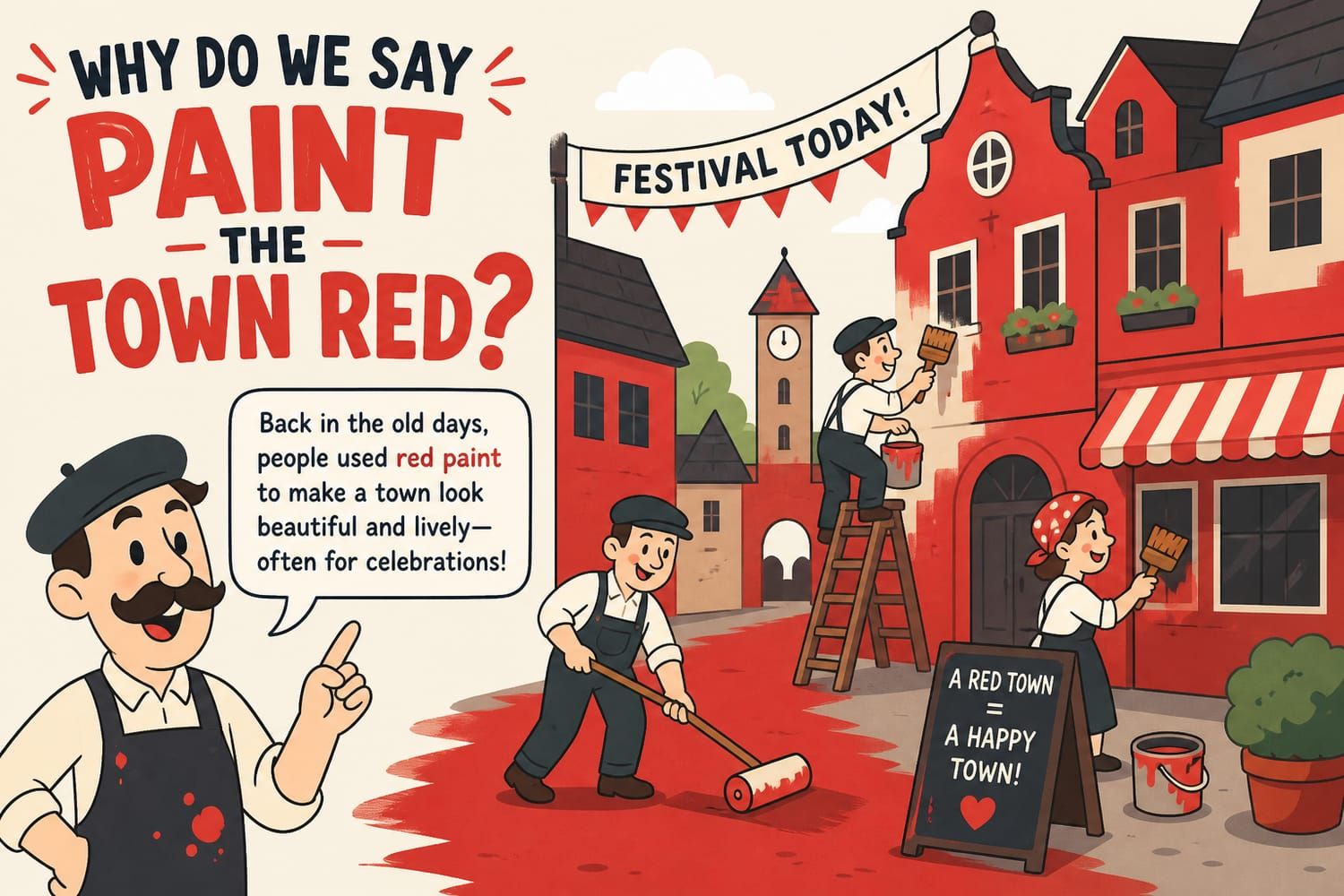
A Colorful Way to Say “Let’s Go Out”
To “paint the town red” means to go out and celebrate in a lively, noisy, extravagant way. It’s what you do after finishing exams, getting a promotion, winning the championship, or simply deciding that Friday night deserves a little enthusiasm.
If someone says, “We’re going to paint the town red,” they probably do not mean they’re heading to the hardware store for several hundred gallons of crimson exterior paint. They mean: dinner, drinks, dancing, laughter, late-night snacks, and possibly a story that begins the next morning with, “So… about last night.”
The phrase has been around since the late 19th century, and like many great idioms, its exact origin is a little messy. There’s a famous story involving a drunken aristocrat, an English town, and actual red paint. There are also strong clues that the expression developed from American slang for rowdy celebration.
So where did it really come from? Let’s grab a metaphorical paintbrush and find out.
What Does “Paint the Town Red” Mean?
Today, “paint the town red” usually means to enjoy yourself in public with energy and excitement. It suggests more than a quiet cup of tea. It has a sense of spectacle.
You might say:
- “After the wedding, the whole family went out to paint the town red.”
- “It’s her birthday, so we’re painting the town red tonight.”
- “When the team won the final, the fans painted the town red.”
The phrase often implies celebration, but it can also carry a hint of wildness. Not necessarily criminal wildness, but definitely “the neighbors may remember this” wildness.
It belongs to the same family of expressions as “go out on the town,” “let loose,” “live it up,” and “make a night of it.” The difference is that “paint the town red” feels more vivid. It turns the entire town into a canvas for your excitement.
The Famous Melton Mowbray Story
The most popular origin story takes us to England in 1837, to the market town of Melton Mowbray in Leicestershire.
The main character is Henry de la Poer Beresford, the 3rd Marquess of Waterford. He was a wealthy young aristocrat with a reputation for heavy drinking, practical jokes, and behavior that polite society might describe as “high-spirited” if it was feeling generous.
According to the well-known story, Waterford and some friends arrived in Melton Mowbray after a day at the races or hunting. They had been drinking, and at some point their evening became less “gentlemanly amusement” and more “public nuisance with accessories.”
They reportedly damaged property, caused chaos, and daubed parts of the town with red paint. Accounts of the incident often mention red-painted doors, signs, and a tollgate. The event became infamous enough that it was later commemorated in a painting called A Spree at Melton Mowbray, which shows the rowdy group causing trouble in the streets.
It’s easy to see why people love this explanation. It is wonderfully literal. A group of drunken young men went out, misbehaved, and actually painted parts of a town red. Case closed, right?
Well… not quite.
The Problem With the Perfect Story
The Melton Mowbray tale is entertaining, and the incident itself really did happen in some form. But there’s a problem: the phrase “paint the town red” does not appear to have been recorded until decades later.
Most dictionary evidence places the expression in print in the 1880s, especially in American sources. That is nearly fifty years after the Melton Mowbray incident.
This doesn’t completely rule out the Waterford story. Phrases can circulate in speech long before someone writes them down. It’s possible that the Melton Mowbray escapade helped inspire the expression, or that the story was later connected to a phrase already in use.
But from an evidence-based point of view, we have to be careful. The most honest answer is:
The Melton Mowbray incident may have influenced the phrase, but it is not proven to be the true origin.
Idioms often attract colorful origin stories after the fact. We like language to have neat beginnings: one person, one moment, one hilarious disaster. Real linguistic history is usually more like a crowded party where everyone claims they brought the dip.
The American Slang Connection
The earliest known printed uses of “paint the town red” appear to come from the United States in the late 19th century. This was a period rich in slang, especially in newspapers, theater, politics, and frontier storytelling.
In that context, “painting” something could suggest covering it, transforming it, or making a dramatic mark on it. And “red” was already a powerful color in the imagination: red could suggest fire, blood, danger, excitement, passion, anger, and excess.
So “paint the town red” may have developed as a vivid way to describe turning an ordinary town into a scene of noisy celebration or reckless fun.
Some explanations connect the phrase to cowboys or frontier towns, imagining drunken revelers riding in, firing guns, and creating mayhem. That picture certainly fits the idiom’s spirit. However, like the Melton Mowbray story, it is difficult to prove as the single source.
What we can say with confidence is that by the late 1800s, the expression was being used to mean something close to what it means today: to go out and celebrate boisterously.
Why Red?
Why not paint the town blue? Or green? Or tasteful eggshell white?
Red is one of the most symbolically loaded colors in human culture. It grabs attention. It is the color of fire, blood, warning signs, flushed faces, theatre curtains, Valentine hearts, and emergency buttons that probably should not be pressed.
In language, red often suggests intensity. Think of expressions like:
- “red-hot”
- “see red”
- “red-blooded”
- “red alert”
- “caught red-handed”
Red is rarely boring. If a town is metaphorically painted red, it has been transformed into a place of heat, energy, and excitement. The color makes the phrase feel alive.
There may also be a hint of mischief in the choice. Red paint is bold and hard to ignore. If someone literally painted a door red without permission, everyone would notice. That sense of visible, public disturbance fits the idiom perfectly.
From Rowdy Mayhem to Harmless Fun
When “paint the town red” first became popular, it likely carried a stronger sense of rowdiness than it does now. It could suggest drinking, disorder, and behavior that might end with broken furniture or an uncomfortable conversation with a magistrate.
Over time, the phrase softened.
Today, if your grandparents say they’re going to paint the town red, they may mean dinner at 6:30, a show at 8, and home by 10:45. The phrase still sounds lively, but it no longer automatically implies vandalism, violence, or scandal.
This is common with idioms. Expressions that once had rough edges often become playful over time. “Paint the town red” now belongs more to the language of celebration than destruction.
Still, it retains just enough wildness to be fun. “We’re going out for a moderate evening of responsible enjoyment” does not have quite the same ring.
How to Use the Phrase
“Paint the town red” is informal and cheerful. It works best when describing a celebration or night out.
For example:
“After months of hard work, the team decided to paint the town red.”
“It’s our anniversary, so we’re going to paint the town red.”
“When the exams were finally over, the students painted the town red.”
It can be used sincerely, jokingly, or with gentle exaggeration. You might say it before an elegant evening at the opera or before a chaotic karaoke session. Context does the work.
One small note: because the phrase can imply drinking or nightlife, it may not fit every setting. In a formal business memo, “Following the merger, the accounting department painted the town red” might raise questions.
Similar Expressions in English
English has plenty of ways to describe celebration. Some are close cousins of “paint the town red.”
“Go out on the town” means to spend an evening enjoying restaurants, bars, theatres, or other entertainment.
“Live it up” means to enjoy yourself extravagantly.
“Let your hair down” means to relax and behave more freely than usual.
“Make merry” is an older expression meaning to celebrate cheerfully.
“Raise the roof” means to make a lot of noise in celebration, especially through cheering, music, or applause.
“Paint the town red” is perhaps the most visual of the group. It makes celebration feel like a public art project, although hopefully one that does not require police involvement.
So, Why Do We Say It?
We say “paint the town red” because red is the color of excitement, spectacle, and intensity, and “painting the town” suggests transforming an ordinary place into a scene of celebration.
The phrase became popular in the late 19th century, especially in American usage, to describe wild public enjoyment. A famous 1837 incident in Melton Mowbray, England, where the Marquess of Waterford and his friends reportedly caused chaos and used red paint, may have helped shape or reinforce the expression. But the direct connection is not certain.
In short: the phrase probably grew out of slang for noisy, exuberant revelry, with red chosen because it is bold, dramatic, and impossible to ignore.
Which is exactly how a good night out likes to think of itself.
A Final Splash of Color
“Paint the town red” has survived because it does what the best idioms do: it turns an ordinary idea into a picture. Instead of merely saying “celebrate,” it gives us a whole town glowing with color, noise, and energy.
Whether its roots lie in aristocratic misbehavior, American nightlife, frontier swagger, or all of the above, the phrase still feels fresh. It reminds us that language is not just a tool for describing life. Sometimes it throws on a bright coat of paint and joins the party.