A Tiny Phrase with a Big Talent for Dodging Responsibility
To “pass the buck” is to shift responsibility to someone else—especially when that responsibility is awkward, inconvenient, or likely to end with someone saying, “Well, whose fault was this?”
If a manager blames a missed deadline on “the team,” a politician blames “the previous administration,” or a child explains that the dog somehow completed their math homework incorrectly, we are in classic buck-passing territory.
It’s a phrase we use for blame-shifting, excuse-making, and the fine art of making a problem travel across the room like an unwanted party balloon. But the expression did not begin in boardrooms, press conferences, or family kitchens. It comes from a much smokier, more card-filled setting: the poker table.
And no, despite how it sounds, the original “buck” was not a dollar.
The Short Answer: It Comes from Poker
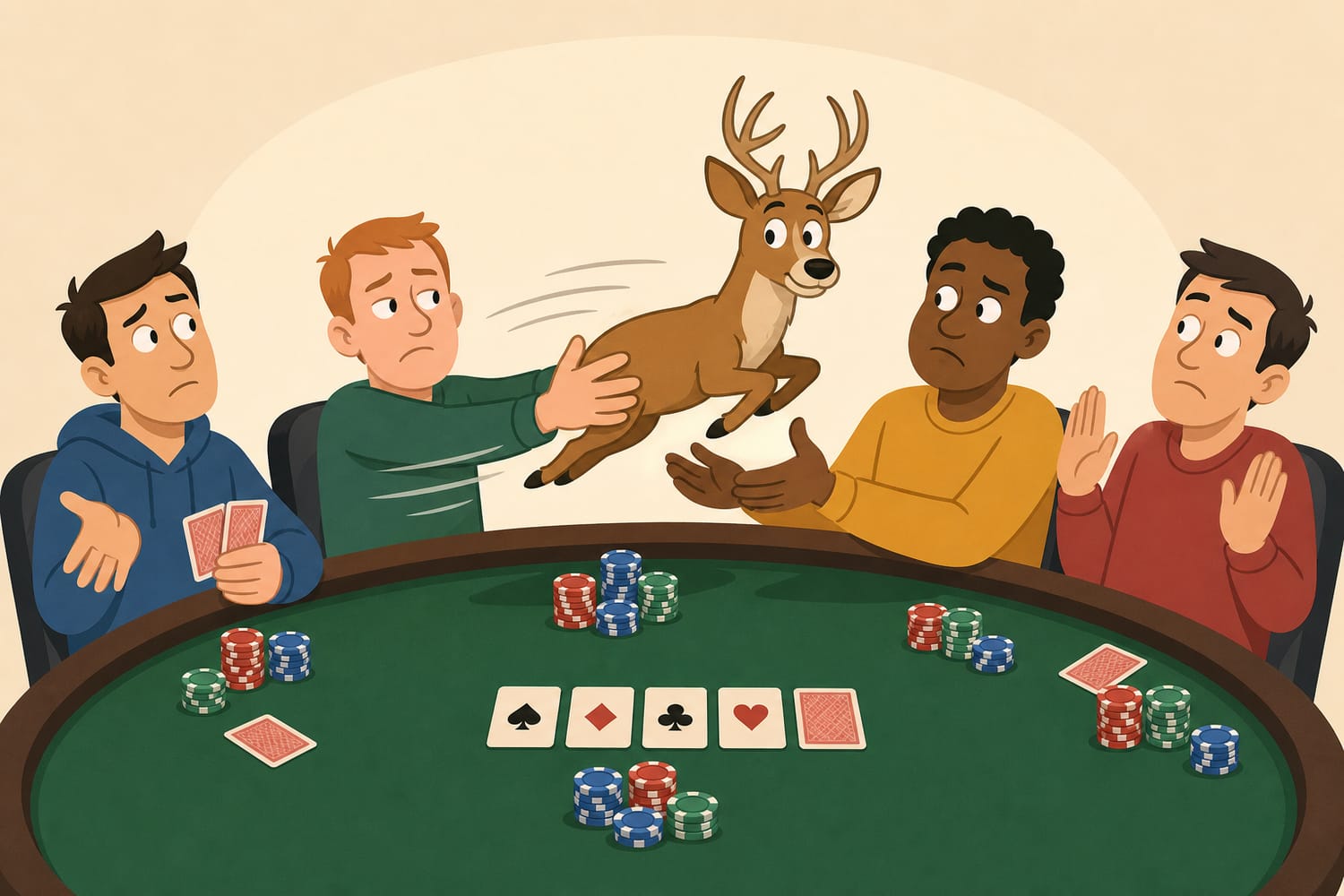
“Pass the buck” comes from 19th-century American poker. In some poker games, players used a small object called a “buck” to mark whose turn it was to deal the cards. After each hand, the buck was passed to the next player, moving the responsibility of dealing around the table.
Over time, “passing the buck” came to mean passing responsibility in general—not just the duty of dealing cards. From there, it developed its modern meaning: avoiding responsibility by handing it off to someone else.
So when someone “passes the buck,” they are metaphorically sliding the dealer’s marker away and saying, “Not my turn. Try the next person.”
A neat little phrase, shuffled straight out of gambling culture.
So What Exactly Was “the Buck”?
At old poker tables, the “buck” was a marker. It could be almost any small object placed in front of the dealer to show whose turn it was to deal.
One commonly cited version is that the marker was a knife with a handle made of buckhorn—that is, horn from a male deer, or buck. Such knives were common in the American West and on the frontier. If a buckhorn-handled knife was used as the dealer marker, it is easy to see how the object might have been nicknamed “the buck.”
This is the most widely accepted explanation for the phrase’s origin. The “buck” was not originally a dollar bill, though “buck” later became a common slang term for a dollar. In this phrase, the poker-table marker came first.
In modern casinos and home poker games, the same basic idea survives in the form of the dealer button: a small disc marked “Dealer” that moves around the table after each hand. It tells everyone who is notionally dealing, even if a professional dealer is physically handling the cards.
In other words, today’s poker “button” is a polished descendant of the old “buck.”
Why Did the Dealer Need a Marker?
In a casual poker game, especially in the 1800s, players often took turns dealing. This mattered because dealing was not just a ceremonial role. It came with responsibility.
The dealer shuffled, distributed the cards, and often had a positional advantage depending on the rules of the game. Since poker involves money, suspicion, and human beings—three ingredients that have never formed a completely peaceful stew—players needed a clear system for whose turn it was.
The buck solved that problem.
Place the buck in front of the dealer, and everyone knows who is responsible. When the hand is over, pass the buck to the next player. Simple, visible, and much less likely to lead to arguments than someone saying, “Wait, didn’t Dave deal twice already?”
The marker kept the game orderly. It also spread the work and responsibility around fairly.
From “Your Turn to Deal” to “Your Problem Now”
At first, “passing the buck” was literal. It meant moving the dealer marker to the next player.
But language loves a good metaphor. Once people were familiar with the idea of passing the buck as passing the duty of dealing, it was not a huge leap to use it more broadly.
If a person didn’t want to make a decision, handle a problem, or accept blame, they could be said to “pass the buck.” The phrase gradually moved away from cards and into everyday speech.
This is a common pattern in English. Phrases often begin in a specific setting—sailing, farming, printing, sports, gambling—and then escape into general conversation. Most of us say things like “learning the ropes,” “on the same page,” or “ballpark figure” without thinking about ships, printing presses, or baseball stadiums.
“Pass the buck” made a similar journey. It began as poker table logistics and became a universal expression for responsibility-dodging.
Was Passing the Buck Always a Bad Thing?
Not originally.
At the poker table, passing the buck was normal and fair. It simply meant the next person’s turn had arrived. No shame, no trickery, no scandal. Just the orderly movement of responsibility.
The negative meaning developed later, when the phrase was applied to people trying to avoid responsibility rather than merely rotate it.
That distinction is important. In poker, passing the buck is part of the rules. In life, passing the buck usually means refusing to do what you should.
Imagine an office version of the poker table. If a project manager says, “It’s your turn to lead this week’s meeting,” that’s just assigning responsibility. But if the same manager says, “The project failed because accounting, marketing, the weather, and Mercury in retrograde all conspired against us,” then we’re getting into buck-passing country.
The phrase became negative because it captured a very human habit: moving blame away from ourselves as quickly as possible.
Enter Harry Truman: “The Buck Stops Here”
No discussion of “pass the buck” is complete without its famous opposite: “The buck stops here.”
This phrase is most closely associated with U.S. President Harry S. Truman. Truman kept a sign on his desk in the Oval Office that read: “The Buck Stops Here.” It became one of the best-known symbols of his leadership style.
The message was simple: responsibility would not be passed along any further. The final decision—and the final accountability—rested with him.
Truman used the phrase to express the burden of presidential decision-making. A president, in his view, could receive advice, hear opinions, and delegate tasks, but ultimately could not dodge responsibility for major decisions.
“The buck stops here” is powerful precisely because it depends on the older phrase. If “passing the buck” means sending responsibility onward, then “the buck stops here” means responsibility has reached its final destination.
No forwarding address. No return to sender. No “please contact another department.”
Why the Phrase Still Works So Well
“Pass the buck” remains popular because it is short, vivid, and instantly understandable. Even if someone has never played poker, the phrase feels physical. You can almost picture a small object being slid across a table.
That image is part of its charm. Responsibility becomes something solid—something you can hold, avoid, or shove toward someone else with suspicious enthusiasm.
The phrase also survives because buck-passing is, unfortunately, timeless. Every generation discovers its own ways to avoid blame. Ancient officials probably blamed scribes. Medieval knights probably blamed squires. Today, we blame “the system,” “the algorithm,” or “a communication issue,” which is modern business language for “somebody definitely dropped the ball, but let’s not get specific.”
The wording may change, but the instinct remains the same.
Common Misunderstanding: Is the “Buck” a Dollar?
Because “buck” is such familiar slang for a dollar, many people assume “pass the buck” must originally have meant passing money. Maybe a bribe? A debt? A gambling stake?
It is an understandable guess, but the evidence points elsewhere.
In “pass the buck,” the buck refers to the poker marker, not to a dollar. The marker may have been a buckhorn-handled knife, which is where the name likely came from. The dollar meaning of “buck” has its own history, probably connected to buckskins as items of trade in early America, though that is a separate story.
So the phrase is related to poker, not payment. It is about transferring responsibility, not handing over cash.
Though, to be fair, in both poker and life, money has a way of making responsibility feel much more urgent.
The Dealer Button: The Buck’s Modern Cousin
If you watch a poker game today, especially Texas hold ’em, you may see a small round disc moving from player to player. That is the dealer button. It marks the theoretical dealer position and determines the order of betting.
This button does essentially the same job the old buck did. It tells everyone where the deal begins and how play proceeds.
In a casino, a professional dealer usually deals every hand, so the button does not mean the player physically deals the cards. But it still marks the dealer position for game structure.
That means every time the dealer button moves, a little echo of the old phrase remains. The buck—or its modern replacement—is still being passed.
A Phrase That Calls Our Bluff
The origin of “pass the buck” is wonderfully fitting. Poker is a game of risk, responsibility, strategy, and bluffing. So it makes sense that a phrase from poker would become a way to describe people trying to avoid accountability.
At the table, passing the buck was useful. It kept the game moving and made sure everyone took a turn. Away from the table, though, passing the buck became a sign of evasion.
The phrase reminds us that responsibility has to land somewhere. You can slide it around for a while, but eventually someone has to deal the cards.
And when they do, the rest of us will know exactly who has the buck.