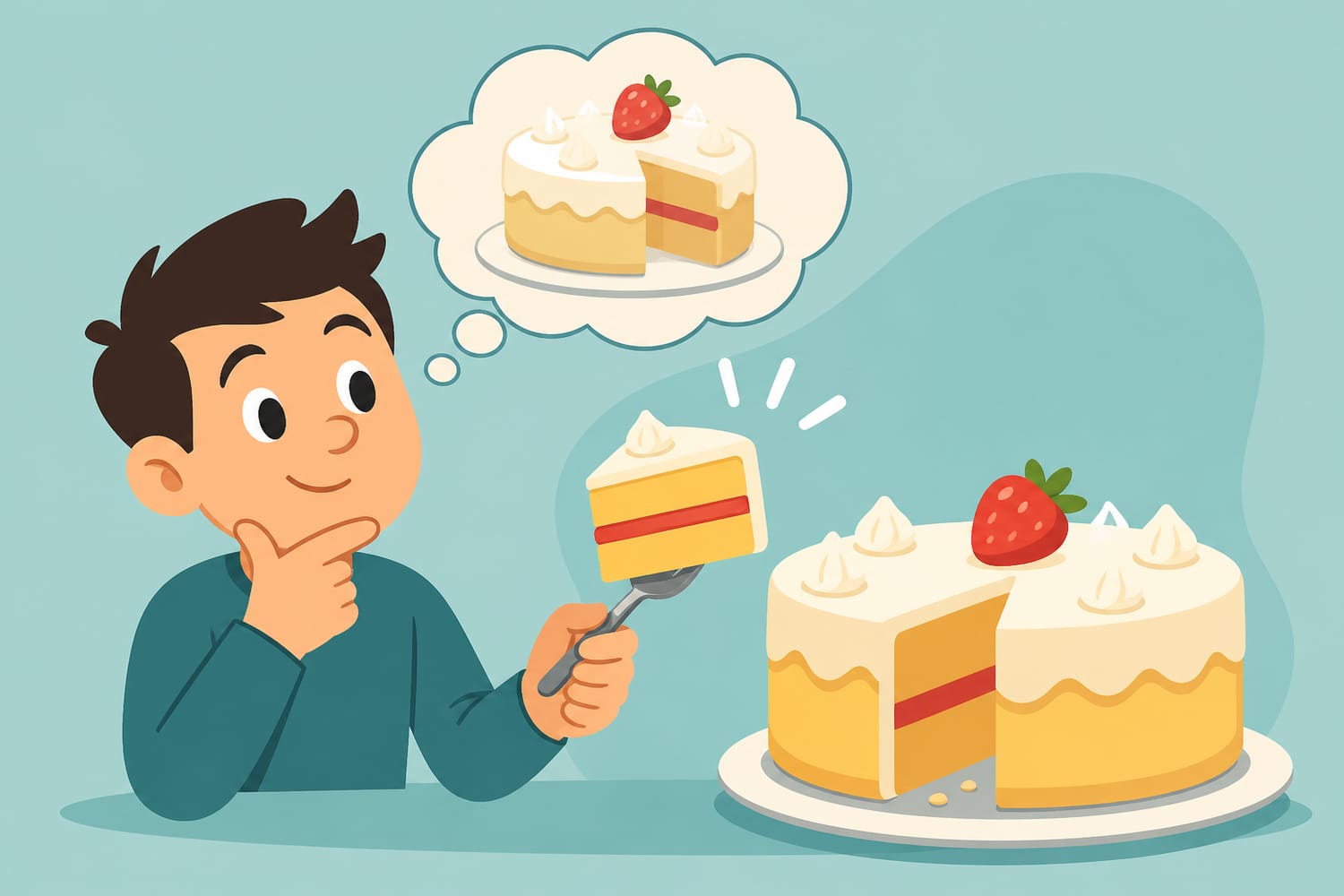
The Short Answer: Why Does “Piece of Cake” Mean Easy?
We call an easy task “a piece of cake” because cake has traditionally represented something pleasant, desirable, and effortless to enjoy. The expression appeared in American English by the 1930s. Although its exact inspiration is uncertain, the basic comparison is simple: completing the task should be as enjoyable as eating dessert.
What Does “A Piece of Cake” Mean?
When someone says a job will be “a piece of cake,” they mean it will require very little effort. Merriam-Webster defines the phrase as something easily done, similar to a “cinch” or a “breeze.”
You might use it when talking about a genuinely easy activity:
“Once I learned the controls, the game was a piece of cake.”
You can also use it confidently before attempting something:
“Don’t worry—I’ve repaired this kind of faucet before. It’ll be a piece of cake.”
Of course, English speakers also enjoy using the phrase ironically. If someone returns from assembling a complicated bookcase with three extra screws, a bruised thumb, and a thousand-yard stare, they might announce, “Piece of cake.”
The idiom can describe a task, experience, competition, or period of life. What it does not usually describe is the process of baking an actual cake—which, depending on the recipe, can involve collapsed layers, stubborn frosting, and a sudden shortage of eggs.
The First Known Slice Appeared in the 1930s
The earliest known printed use of “piece of cake” in its familiar figurative sense comes from American poet and humorist Ogden Nash. It appeared in his 1935 collection The Primrose Path:
“Her picture’s in the papers now,
And life’s a piece of cake.”
Nash was describing life as easy and pleasant rather than comparing it with a specific task. The line shows that the expression was already understandable enough to work without explanation. Dictionaries date the first known use to 1935, although—as with many idioms—the phrase may have circulated in conversation before anyone happened to record it in print.
That distinction is important. The first surviving written example is not necessarily the moment an expression was invented. Everyday language often spends years being spoken at kitchen tables, workplaces, schools, and street corners before appearing in a book or newspaper.
But Why Cake?
The most convincing explanation is also the simplest: cake is enjoyable.
For centuries, cake has been associated with treats, celebrations, rewards, and the good things in life. The Oxford English Dictionary’s history, summarized by Grammarphobia’s discussion of the expression, notes that cake has long carried the figurative sense of something desirable or delightful.
Eating a slice requires no great courage or preparation from the person holding the fork. The cake has already been mixed, baked, decorated, and presented. Your responsibility is merely to enjoy it—and perhaps pretend you were not hoping for the corner piece with extra frosting.
That makes cake a natural metaphor for an experience with two attractive qualities:
- It is easy to handle.
- It is pleasant to complete.
The expression is therefore less about making cake and more about receiving it. “This job is a piece of cake” does not mean “This job is as easy as carefully measuring flour, separating eggs, and keeping a sponge from sinking.” It means “This job is as easy as eating the finished result.”
Did the Expression Come From the Cakewalk?
Possibly—but the connection is not proven.
A cakewalk was originally a Black American contest and performance in which participants displayed elaborate walking steps, with a cake awarded as a prize. The tradition developed into a stage dance, although it was also presented through the racist stereotypes and conventions of minstrelsy. The Library of Congress description of cakewalks identifies both the cake-prize contest and the later high-stepping dance.
“Cakewalk” eventually developed the figurative meaning of an easy victory or effortless task. Because that expression existed before “piece of cake,” some accounts suggest that one influenced the other.
It is certainly possible. Both expressions connect cake with success, pleasure, and an enviable reward. However, there is no decisive evidence showing that “piece of cake” was directly created from “cakewalk.” They may simply belong to the same delicious branch of English metaphor.
In other words, the cakewalk is part of the story surrounding the phrase—but we should not present it as a solved linguistic mystery.
English Has a Serious Sweet Tooth
“Piece of cake” is hardly the only expression that turns dessert into a metaphor. English has an entire bakery counter of them:
- Easy as pie: Extremely simple
- Take the cake: Be the most remarkable or surprising example
- The icing on the cake: An extra benefit added to something already good
- Sell like hotcakes: Sell very quickly
- Have your cake and eat it too: Try to enjoy two incompatible advantages
These expressions work because food is immediate and familiar. Nearly everyone understands treats, hunger, sharing, mess, and anticipation. That is also why we talk about revealing secrets by “spilling the beans” or enjoying luxury by living “high on the hog”.
Food gives abstract ideas a shape, flavor, and texture. “That examination was easy” communicates the facts. “That examination was a piece of cake” communicates the facts while handing your listener an imaginary fork.
Why the Phrase Has Lasted
Idioms survive when they are short, vivid, and flexible. “Piece of cake” checks every box.
First, it creates an instant mental picture. A slice of cake is easier to imagine than an abstract concept such as “minimal difficulty.” Second, it sounds cheerful and reassuring. If someone is nervous about a task, saying it will be “a piece of cake” feels friendlier than announcing that it has “a low level of operational complexity.”
The phrase is also easy to adapt:
- “The interview was a piece of cake.”
- “Finding the hotel should be a piece of cake.”
- “For an experienced mechanic, that repair is a piece of cake.”
- “I thought the hike would be a piece of cake. I was incorrect.”
Like “let sleeping dogs lie”, it succeeds because the image is memorable even when the situation has nothing to do with the literal words.
Is It Always Positive?
Usually, but not necessarily.
Calling something “a piece of cake” can reassure a worried person or express pride in mastering a skill. It can also sound dismissive if the task is easy for you but difficult for someone else.
Imagine a fluent speaker telling a language learner, “Pronunciation is a piece of cake.” That may not feel encouraging. Difficulty depends on experience, knowledge, ability, and circumstances.
Tone matters too. After a disaster, “piece of cake” can become comic understatement:
“How was moving the sofa up five flights of stairs?”
“Oh, a piece of cake. I only reconsidered every decision that brought me here.”
The expression can therefore communicate confidence, relief, sarcasm, or spectacular overconfidence. Context supplies the flavor.
A Phrase Worth Savoring
“Piece of cake” most likely became a synonym for ease because cake represented something enjoyable, rewarding, and effortless to consume. Its earliest known figurative appearance dates to Ogden Nash’s writing in 1935, although its precise path into everyday speech remains uncertain.
The cakewalk may have helped prepare the linguistic table, and older dessert expressions probably made the comparison feel natural. Still, the idiom’s success does not require an elaborate origin story. Cake is good. Eating a slice is pleasant. Easy tasks are pleasant too. The metaphor practically serves itself.
So, the next time you breeze through a quiz, finish a job ahead of schedule, or successfully follow flat-pack furniture instructions on the first attempt, feel free to call it a piece of cake.
Just remember: if you are actually baking the cake, no such promises apply.