Why Do We Say “Pull Out All the Stops”?
The Short Answer
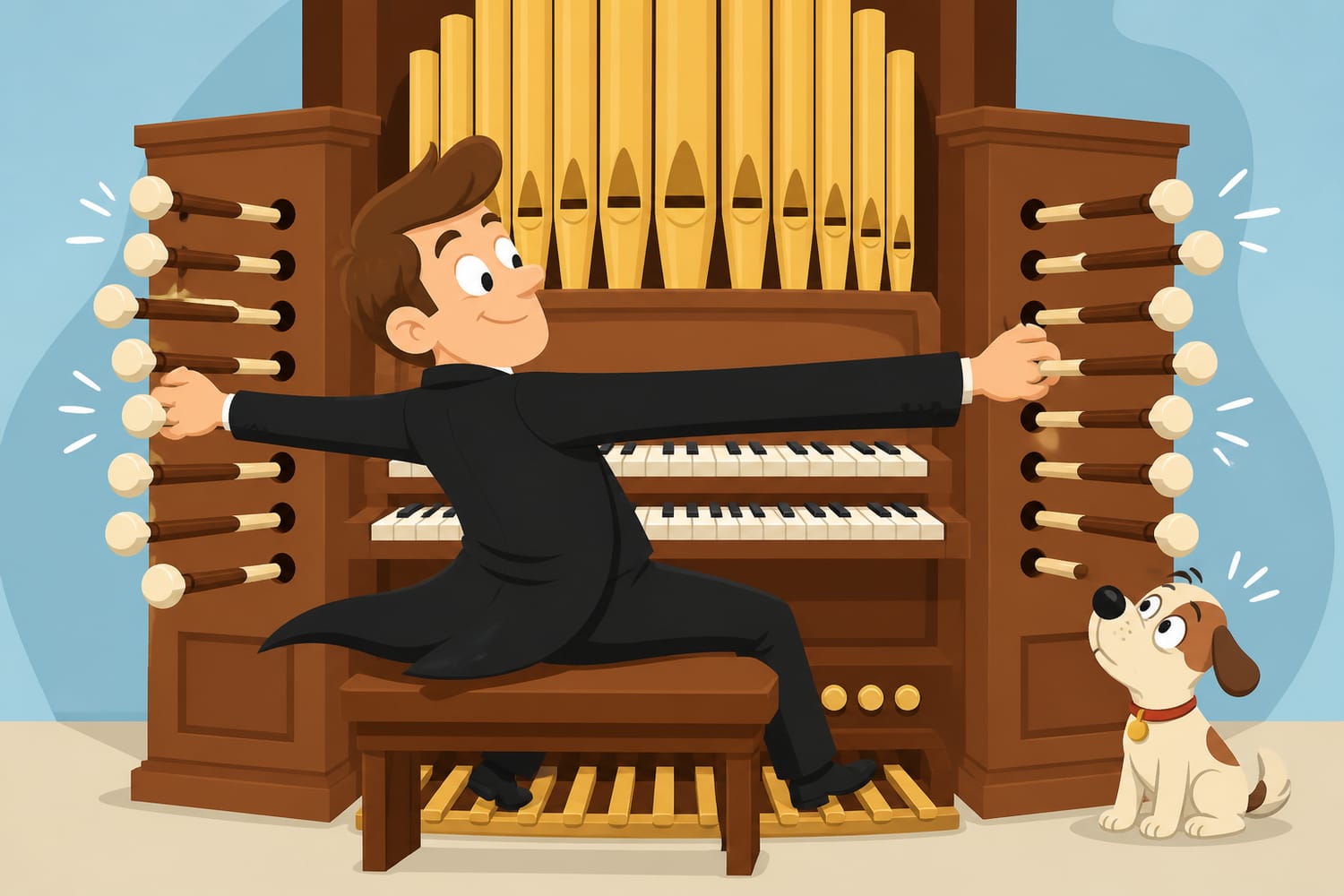
To “pull out all the stops” means to use every available resource and make the greatest possible effort. The expression comes from pipe organs, whose stops control which sets of pipes can sound. Pulling out many stops gives the organist access to a larger, fuller, and potentially thunderous range of sound.
What Does “Pull Out All the Stops” Mean Today?
Imagine you are organizing a birthday party. You could put out a bowl of chips, play music from your phone, and call it a celebration. Or you could hire a band, order an enormous cake, decorate every available surface, and arrange for fireworks shaped like the birthday person’s face.
The second option is pulling out all the stops.
The phrase means doing everything possible to achieve a result, often by using every resource, idea, or advantage available. It suggests maximum effort with very little held back.
You might hear it in sentences such as:
- “The restaurant pulled out all the stops for its grand opening.”
- “She pulled out all the stops to impress the interview panel.”
- “The team will need to pull out all the stops in the final.”
- “They pulled out all the stops for their wedding reception.”
The expression can describe hard work, elaborate planning, lavish spending, clever tactics, or some combination of all four. Like “the whole nine yards,” it conveys a sense of completeness: nothing important has been left unused.
The “Stops” Belong to a Pipe Organ
Despite how it sounds, the phrase has nothing to do with removing barriers, ignoring stop signs, or disabling a machine’s emergency brakes. The stops are controls on a pipe organ.
A pipe organ produces sound by sending pressurized air—traditionally called wind—through pipes. Those pipes are organized into groups known as ranks, generally according to their tone and pitch. One rank might produce the instrument’s characteristic principal sound, while another may sound more like a flute, string instrument, or trumpet.
An organ’s keyboards do not automatically play every pipe available. The organist chooses which ranks will sound by operating controls called stops. On many organs, these controls take the form of knobs that are pulled outward, although other instruments use tabs or switches.
As the American Guild of Organists explains in its guide to the pipe organ, bringing a rank of pipes into play traditionally involves pulling a stop knob. Some stops even control multiple ranks blended together to create a particular tone color.
That makes an organ console less like a piano with extra furniture and more like an orchestra controlled by one extremely busy person.
What Happens When You Pull Out a Stop?
Suppose an organist presses a key while only one stop is selected. A pipe—or, with certain stops, more than one pipe—sounds from the rank connected to that stop.
Pull another stop, press the same key, and additional pipes join in. The note may become richer, brighter, deeper, sharper, or more colorful, depending on the stops chosen.
In simplified form, the process looks like this:
- A stop is pulled, selecting a rank or combination of ranks.
- The organist presses a key or pedal.
- Valves open beneath the appropriate pipes.
- Wind enters the selected pipes.
- The pipes sound together until the key or pedal is released.
Pulling out many stops gives the player access to many different voices at once. The result can be a grand, room-filling sound—the musical equivalent of arriving with a brass band when everyone else brought a kazoo.
That is the literal picture behind the idiom: every available voice has been brought into action. Merriam-Webster’s history of the phrase likewise traces the expression to the stop knobs used to select which ranks of organ pipes can sound.
Does Pulling Every Stop Simply Make the Organ Louder?
Not quite. That is the basic idea behind the metaphor, but an organ stop is not merely an on-off volume switch.
Different stops provide different pitches and tonal qualities. Some create strong foundational sounds; others add brilliance, depth, warmth, or unusual harmonies. An organist combines them through a process called registration, choosing sounds that suit the music, the room, and the desired effect.
Pulling every stop indiscriminately would not necessarily produce the most beautiful result. Some combinations may be poorly balanced or inappropriate for a particular passage. Skilled organists do not normally treat the stop knobs like contestants in a “pull everything immediately” competition.
Still, “all the stops” suggests the organ at its fullest and most powerful. The metaphor works because it evokes abundance: more pipes, more tonal possibilities, more force, and nothing being deliberately withheld.
Why Are They Called “Stops” If Pulling Them Starts Something?
This is the wonderfully confusing part.
In everyday language, a stop ends an action. On a traditional organ, however, pulling out a stop allows certain pipes to speak. Push it back in, and those pipes are prevented—or “stopped”—from sounding.
The name therefore makes sense from the other direction. The control is called a stop because it can stop a group of pipes from receiving wind and joining the music. Pulling it out removes that restriction.
English is full of expressions whose literal machinery is now hidden from most speakers. We happily “throw in the towel” without standing near a boxing ring, and we “break the ice” without carrying so much as a teaspoon, let alone an ice pick. “Pull out all the stops” belongs to the same family: a once-literal action that became a portable metaphor.
When Did the Phrase Become Figurative?
Pipe organs are ancient instruments, but organs with independently selectable stops developed much later. Merriam-Webster places the incorporation of stops into organ design in the late 15th century. Over time, the physical act of drawing stops supplied English speakers with an irresistible image for bringing additional power or variety into play.
One of the earliest known figurative examples appeared in 1865, in the preface to British poet and critic Matthew Arnold’s Essays in Criticism. Arnold compared “the modern Englishman” to a powerful but somewhat limited organ and wrote of trying to “pull out a few more stops.”
The complete passage can be read in the Project Gutenberg edition of Essays in Criticism. Arnold was not yet using the exact modern wording about pulling out all the stops, but the metaphor was clearly in place: activating more organ stops represented widening someone’s range or possibilities.
As the expression developed, “a few more stops” became “all the stops,” and the meaning intensified. It no longer suggested merely expanding one’s range. It meant using absolutely everything available.
When Should You Use the Expression?
“Pull out all the stops” is most natural when an effort is unusually ambitious, elaborate, or determined. It often implies that ordinary measures are not enough.
Good situations for the phrase include:
- An important event: “The hotel pulled out all the stops for the awards ceremony.”
- A difficult competition: “The candidate pulled out all the stops during the final week of the campaign.”
- An urgent problem: “Engineers pulled out all the stops to restore the system.”
- A major celebration: “We’re pulling out all the stops for Grandma’s 100th birthday.”
- An attempt to persuade someone: “He pulled out all the stops to win the client’s business.”
The phrase can be approving, suggesting admirable commitment. It can also be mildly critical if someone’s effort seems excessive, extravagant, or desperate.
If a company hires celebrities, covers a city in advertisements, and sends promotional blimps into the sky to launch a new brand of toothpaste, you might say it pulled out all the stops—with either admiration or concern.
Why Has the Saying Lasted?
The best idioms pack a complete scene into a few words. “Pull out all the stops” gives us an image of a musician summoning every available voice from a huge instrument until the building seems to vibrate.
Even people who have never sat at an organ console can understand the emotional shape of that action. Something quiet becomes grand. Something limited becomes expansive. Restraint gives way to maximum effort.
That is why the phrase still feels energetic rather than dusty. It does more than say, “try hard.” It suggests opening every channel, using every advantage, and making enough noise—literal or otherwise—to get the job done.
So, the next time you pull out all the stops, picture an organist surrounded by keyboards, pedals, pipes, and rows of knobs, preparing to unleash the full power of the instrument.
Just be grateful that your big presentation probably requires fewer foot pedals.