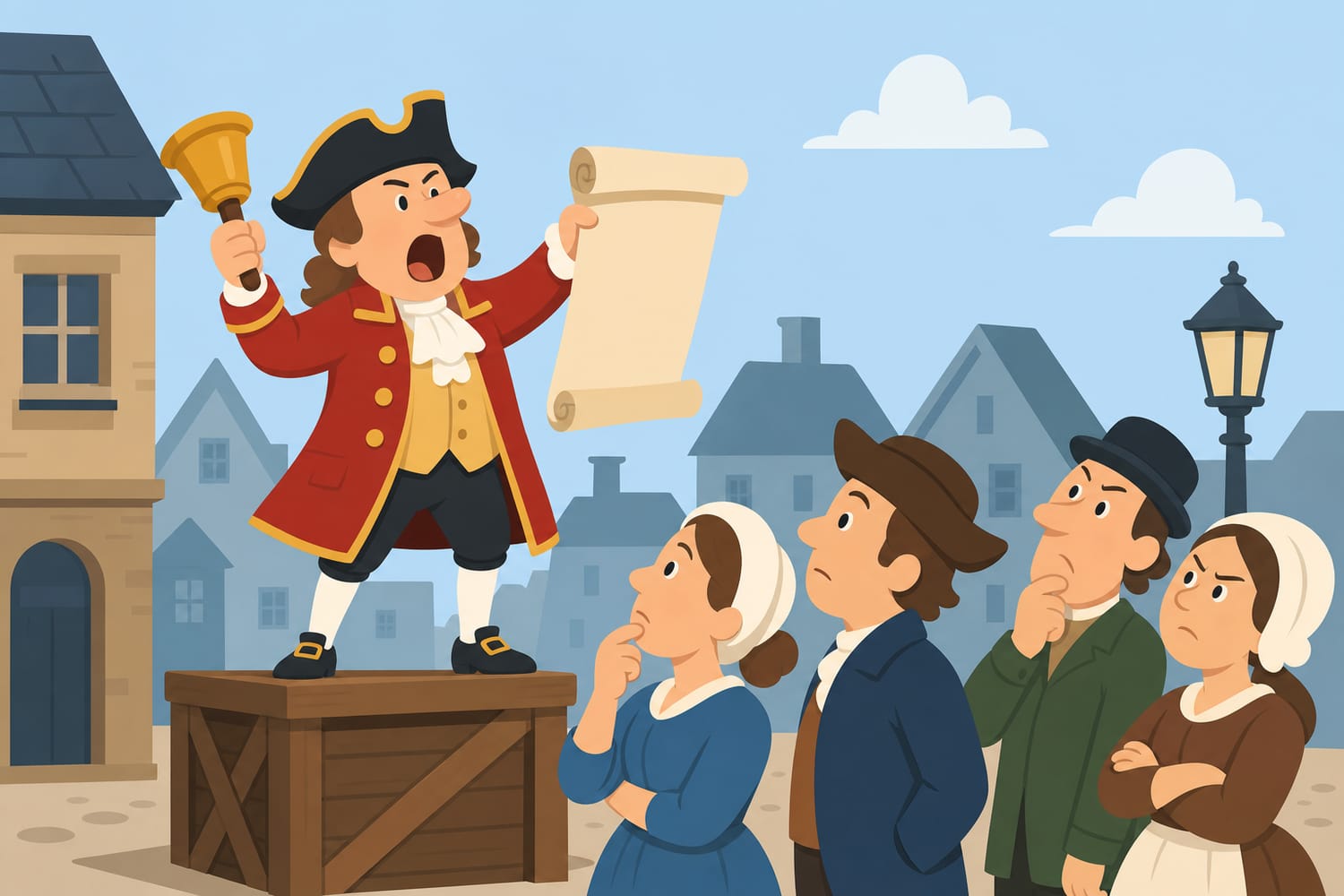
The Short Answer: It Means “Consider Yourself Warned”
To “read someone the Riot Act” means to give them a serious scolding or stern warning—usually after they’ve misbehaved, ignored instructions, or generally behaved like a small but determined tornado.
You might hear it in everyday situations like:
- “After the team missed the deadline again, the manager read them the Riot Act.”
- “My dad read me the Riot Act when I came home two hours late.”
- “The coach read the players the Riot Act at halftime.”
Today, the phrase is almost always figurative. Nobody is usually holding parchment, wearing a powdered wig, or threatening legal consequences. But the expression comes from a very real law in British history—one that was quite literally read aloud to crowds.
And unlike a modern telling-off, the original Riot Act was no mild “please calm down.” It was more like: “Go home within the hour, or you may be committing a serious crime punishable by death.”
So yes, as warnings go, it had a bit of bite.
The Real Riot Act Was an Actual Law
The phrase comes from the British Riot Act of 1714, passed during the reign of King George I. Its formal title was much longer, because old laws had a habit of sounding like they were being paid by the syllable. The act was designed to deal with “tumultuous” public gatherings—what authorities considered riots, rebellions, or dangerous assemblies.
At the time, Britain was politically tense. George I had only recently taken the throne, and not everyone was thrilled about it. There were supporters of the exiled Stuart line, known as Jacobites, who wanted a different monarch. Public disorder, protests, religious tensions, and fears of rebellion made the government nervous.
The Riot Act gave local officials a legal tool to break up crowds before they turned into something more serious. If twelve or more people were “unlawfully, riotously, and tumultuously assembled,” an authorized official could read a proclamation ordering them to disperse.
That reading was not just symbolic. It started a legal countdown.
Once the proclamation had been read, the crowd had one hour to leave. Anyone who remained after that could be charged with a felony. In the 18th century, that was terrifyingly serious: the punishment could be death.
So when we say someone “read the Riot Act,” we’re borrowing from a moment that was meant to be unmistakably severe.
What Did the Riot Act Actually Say?
The wording of the proclamation was set out in the act itself. It began:
“Our sovereign lord the King chargeth and commandeth all persons, being assembled, immediately to disperse themselves…”
It continued by ordering people to go home or return to their lawful business, and it ended with the familiar patriotic flourish:
“God save the King.”
In other words: “The King says go home. Now.”
The proclamation had to be read aloud by someone with legal authority, such as a justice of the peace, sheriff, mayor, or other designated official. This mattered because the legal consequences depended on the reading.
The whole thing must have been rather theatrical: an official standing before an angry or excited crowd, trying to make themselves heard over shouting, confusion, and possibly the occasional flying object.
One imagines the official clearing his throat and thinking, “I do hope everyone can hear the bit about the felony.”
The One-Hour Rule
One of the most important features of the Riot Act was the one-hour grace period. After the official reading, the crowd had sixty minutes to disperse.
This is where the law gets especially interesting. The reading itself did not instantly make everyone guilty of a felony. It gave them a chance to leave. But if they stuck around after the hour had passed, they were in far greater danger under the law.
That one-hour window is part of why the phrase became so powerful. To be “read the Riot Act” was not merely to be criticized. It meant: “You have been officially warned, and consequences are coming if you don’t change course.”
That sense survives in modern usage. If your boss reads you the Riot Act, the message is not simply “I am annoyed.” It is closer to: “This is the last warning before something unpleasant happens.”
Hopefully not 18th-century unpleasant. But still unpleasant.
Why Was the Law Created?
The early 1700s were not exactly a golden age of calm public meetings with clipboards and agenda items.
Crowds could gather for many reasons: political unrest, food shortages, religious conflict, labor disputes, celebrations that went sideways, or anger at local officials. Without modern policing as we know it, authorities often relied on local officials, militias, or soldiers to control disorder.
The government wanted a clearer legal process for declaring a gathering unlawful and authorizing force if people refused to disperse. The Riot Act created that process.
It also reflected the priorities of the age. Public order was considered essential, and large gatherings could be seen as threats to royal authority. The law was meant to discourage people from joining mobs and to give officials a way to say, in effect, “This is no longer a crowd. This is now a riot in the eyes of the law.”
Of course, what counted as a “riot” could depend heavily on who was doing the judging. Peaceful protest, noisy celebration, and genuine violence did not always fit neatly into separate boxes, especially when viewed by anxious authorities.
Was the Riot Act Really Used?
Yes, the Riot Act was used in real disturbances for more than two centuries. It was invoked during various episodes of unrest in Britain, including riots, protests, and public disturbances.
One well-known historical example connected with the Riot Act is the Peterloo Massacre of 1819. A large crowd gathered in Manchester to demand parliamentary reform. Local magistrates considered the meeting dangerous and ordered action against the crowd. The Riot Act was reportedly read, though many in the enormous gathering likely could not hear it. The situation ended in violence when cavalry charged into the crowd, killing and injuring many people.
Peterloo became a symbol of the conflict between public protest and government authority. It also shows one of the practical problems with the Riot Act: reading a proclamation aloud to a large, noisy, possibly panicked crowd was not always a reliable way to communicate.
The law required words. Real life supplied shouting, horses, drums, fear, confusion, and chaos.
From Legal Command to Everyday Scolding
So how did this very serious legal procedure become a phrase parents use when someone has left muddy footprints across the carpet?
Like many idioms, “read the Riot Act” moved from literal use into figurative speech. By the 19th century, people were using it to mean giving someone a severe reprimand or warning. The idea was easy to understand: just as officials read the Riot Act before punishment could follow, a person in authority might “read the Riot Act” before handing out consequences.
The expression survived because it is vivid. “I gave him a warning” sounds ordinary. “I read him the Riot Act” sounds dramatic, stern, and slightly grand—as if the kitchen table has become a courtroom.
It also has a satisfying rhythm. Read. The. Riot. Act. Four punchy words, all doing their job.
And unlike some idioms whose origins have become obscure, this one still carries a trace of its original meaning. A “riot” suggests disorder. An “act” suggests law. To “read” it suggests formal warning. Even if you know nothing about 18th-century Britain, the phrase feels official and severe.
Why “Read” the Riot Act?
The word “read” is important because the original law required the proclamation to be read aloud. It was not enough for an official to wave vaguely at a crowd and shout, “You know what I mean!”
The legal power came from the public declaration. The announcement had to be made so the assembled people were formally commanded to disperse.
That is why the phrase is not “quote the Riot Act” or “mention the Riot Act.” It is “read” the Riot Act because reading it was the action that transformed the situation.
There is a small historical twist here: officials did not normally read the entire act of Parliament from beginning to end. They read the specific proclamation required by the act. But in popular language, that became “reading the Riot Act,” and the phrase stuck.
Language often prefers a neat expression over a technically perfect one. “Read the statutory proclamation authorized by the Riot Act” never had much chance as an idiom.
Is the Riot Act Still Around?
The original Riot Act is no longer in force in Britain. Modern legal systems have different laws and procedures for dealing with riots, unlawful assemblies, and public disorder. Police powers, protest laws, and public order legislation have replaced the old ritual of an official proclamation followed by a one-hour countdown.
But the phrase lives on, safely removed from its harsher legal consequences.
Today, when someone says they were “read the Riot Act,” they usually mean they were firmly told off. The tone can range from serious to playful:
- A teacher might read a class the Riot Act after repeated disruptions.
- A landlord might read tenants the Riot Act over noise complaints.
- A friend might jokingly say, “My dentist read me the Riot Act about flossing.”
In all cases, the phrase suggests more than a casual reminder. It implies authority, seriousness, and a strong expectation that behavior will change.
A Phrase With a Surprisingly Dramatic Past
“Read the Riot Act” is one of those expressions that sounds colorful even before you know its history. But once you do know the story, it becomes even better.
Behind the modern idiom is an 18th-century law, nervous governments, unruly crowds, official proclamations, and a ticking one-hour clock. What now means “getting a stern talking-to” once meant a legally significant warning that could lead to severe punishment.
So the next time someone says, “She read them the Riot Act,” picture an official in old Britain trying to shout legal language over a disorderly crowd.
Then picture your mother doing basically the same thing because someone tracked mud through the hallway.
The stakes, thankfully, have changed. The drama remains.