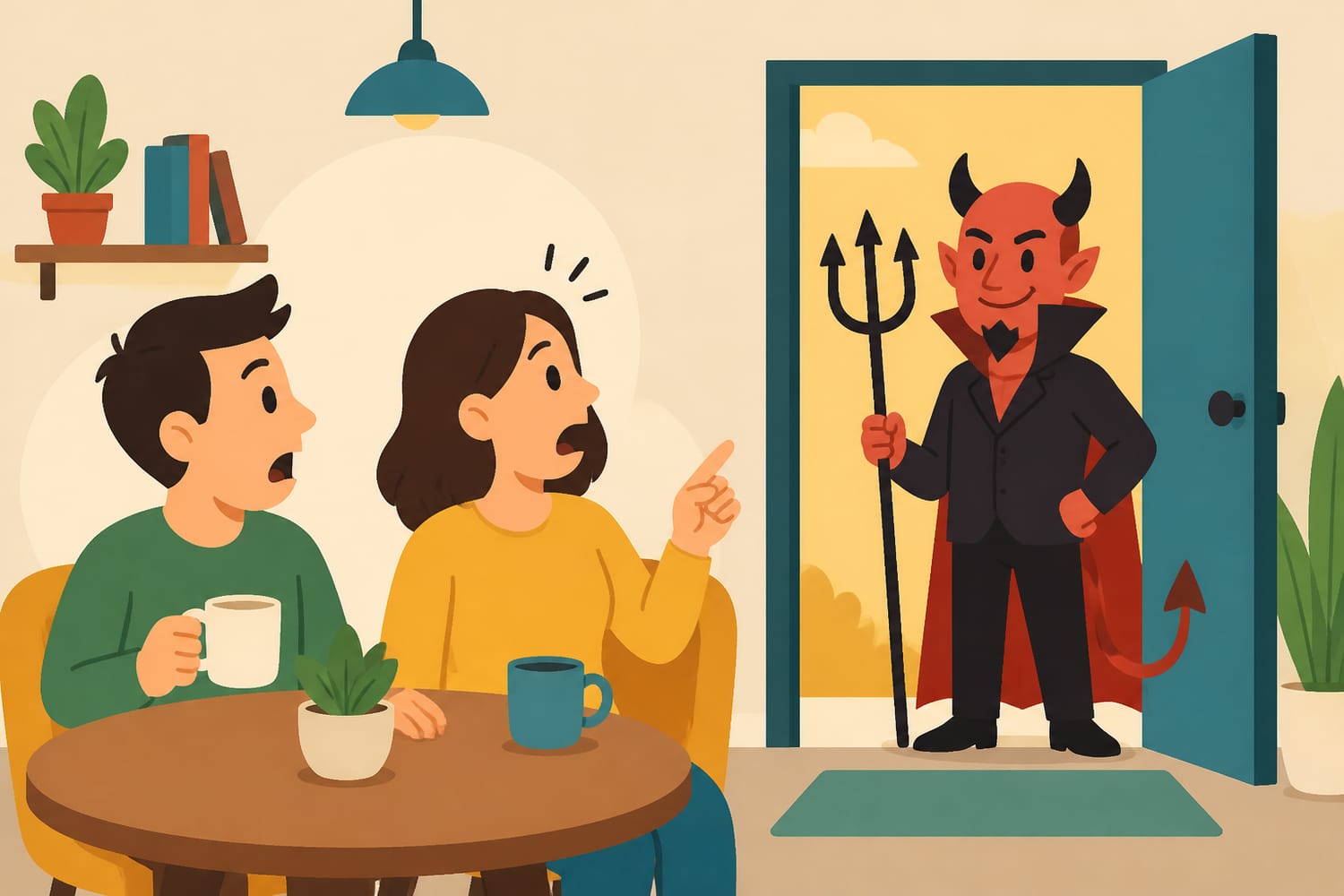
“Speak of the devil” is what we say when someone appears just as we’re talking about them. It’s a playful shortcut for an older saying: “Speak of the devil, and he will appear.” The words once echoed a superstition about naming the Devil; today, they usually mean, “Well, that’s surprisingly good timing.”
Imagine you’re telling a friend that Maya always brings enough snacks for everyone. Right on cue, Maya walks through the door carrying a bag of popcorn. “Speak of the devil!” you say. Maya is not being accused of anything more serious than impeccable snack timing.
That gap between the phrase’s ominous wording and its harmless modern meaning is what makes it interesting. How did a warning about the Devil turn into something we say at a party?
The Missing Half Explains the Joke
On its own, “speak of the devil” can sound puzzling. Are you telling someone to speak about him? Is the person who just arrived supposed to be the Devil?
The older, longer proverb clears things up: “Speak of the devil, and he will appear.” It imagines a direct connection between mentioning someone and having that someone turn up. Modern speakers usually leave off the second half because the arrival has already supplied the punch line.
It works like this:
“Has anyone asked Jordan if they can join us?”
Jordan enters the room.
“Speak of the devil!”
Nobody needs to finish the proverb. Jordan’s entrance has done it for them.
This sort of verbal shorthand is one reason old expressions can survive long after their original stories become unfamiliar. If you enjoy following the history tucked inside everyday phrases, Uncover Words also explores why we say “in a nutshell”.
Where Did the Devil Come In?
The proverb draws on an old fear: saying the Devil’s name might attract his attention—or even bring him near. Whether every person who repeated the warning believed that would literally happen is another matter. The important point is that the saying gave a memorable shape to the idea that some things were safer left unmentioned.
That makes its modern use a remarkable change of mood. The figure who once represented a frightening possibility became a stand-in for your neighbor, coworker, or friend arriving at just the right moment. The warning turned into a joke.
It also explains why “devil” doesn’t normally describe the person who appears. If you say it when your beloved grandmother comes in with a cake, you’re commenting on the coincidence, not secretly reviewing her character. Still, as with any joke, tone and context matter. We’ll come back to that.
How Old Is “Speak of the Devil”?
A recorded English version dates to 1666. In a collection of proverbs, the writer Giovanni Torriano reported an existing English saying: “Talk of the Devil, and he’s presently at your elbow.” That is wonderfully vivid. Forget a dramatic cloud of smoke; in this version, the Devil is suddenly close enough to share your armrest.
Notice two details. Torriano wrote “talk,” not “speak,” and “at your elbow,” not “he will appear.” Proverbs are passed around, so their wording can vary. The familiar modern version preserves the same basic idea without being the exact wording of that 1666 record.
And 1666 is a recorded appearance, not the phrase’s birthday. Torriano introduced it as something “the English say,” which tells us he was documenting a proverb rather than announcing one he had just invented. We cannot pinpoint the first person to use it in conversation.
Other early versions played with the image, too. A form recorded in 1672 ends, “and see his horns.” Whichever ending you choose, the scene is the same: someone mentions a feared figure, then realizes he may be nearer than expected.
How Did a Warning Become a Friendly Remark?
A proverb need not keep the same emotional charge forever. As “speak of the devil” became an established way to remark on someone’s arrival, the coincidence became more important than the supernatural warning behind it. The phrase now works as a bit of conversational theater: we pretend that saying a person’s name brought them into the room.
That little performance is useful. “We were talking about you and now you’re here” is accurate, but not especially lively. “Speak of the devil!” delivers surprise, recognition, and a gentle joke in four words.
It can also bring a newcomer into the conversation. If a friend arrives while you’re discussing the dinner they’re planning, the phrase gives everyone an easy opening: “Speak of the devil—we were just wondering what time to come over.” What follows can be pleasantly ordinary. No horns required.
The history resembles that of many familiar idioms: an old image remains vivid even as people use it for an everyday purpose. You can see a different kind of journey from image to conversation in the story of “break the ice”.
Is It Rude to Say It About Someone?
Usually, no. Said with a smile to someone you know, “Speak of the devil” is generally understood as a comment on their timing. The Dictionary.com definition describes it as something said when the person just mentioned appears—not as an accusation about that person’s behavior.
But the scene matters. Suppose you have been complaining about a coworker, and that coworker walks up halfway through. “Speak of the devil” might sound less like a charming coincidence and more like a hint that they were the subject of the complaint. The phrase can draw attention to a conversation you would rather handle more carefully.
For a warm, neutral alternative, try “We were just talking about you!” It says exactly what happened without the mock-villainous label. If the person has only popped up in a message rather than through the door, that version works nicely there, too.
Does Every Language Bring in the Devil?
No—and that is part of the fun. French has a similar saying involving a wolf. The Usito dictionary from the Université de Sherbrooke gives Quand on parle du loup (on en voit la queue) for a person appearing while others are talking about them. Loosely, it means, “When you speak of the wolf, you see its tail.”
The animal changes, but the comic timing does not. Someone absent becomes the topic of conversation, then suddenly becomes present. The speakers act as though their words issued an invitation.
English even has a “talk of the devil” version alongside “speak of the devil.” The choice of verb is less important than the moment it marks: a name has barely left your mouth when its owner appears.
The Next Time Someone Walks In
The answer, then, is simple but surprisingly old. We say “speak of the devil” because it is the surviving first half of a proverb about mentioning the Devil and finding him suddenly nearby. Centuries later, the fear has largely faded from ordinary use, leaving a lighthearted way to celebrate improbable timing.
So when the person you’ve just mentioned appears, you have options. You can greet them plainly. You can say, “We were just talking about you.” Or, if the mood is right, you can borrow a centuries-old warning and turn it into a smile: “Speak of the devil!”