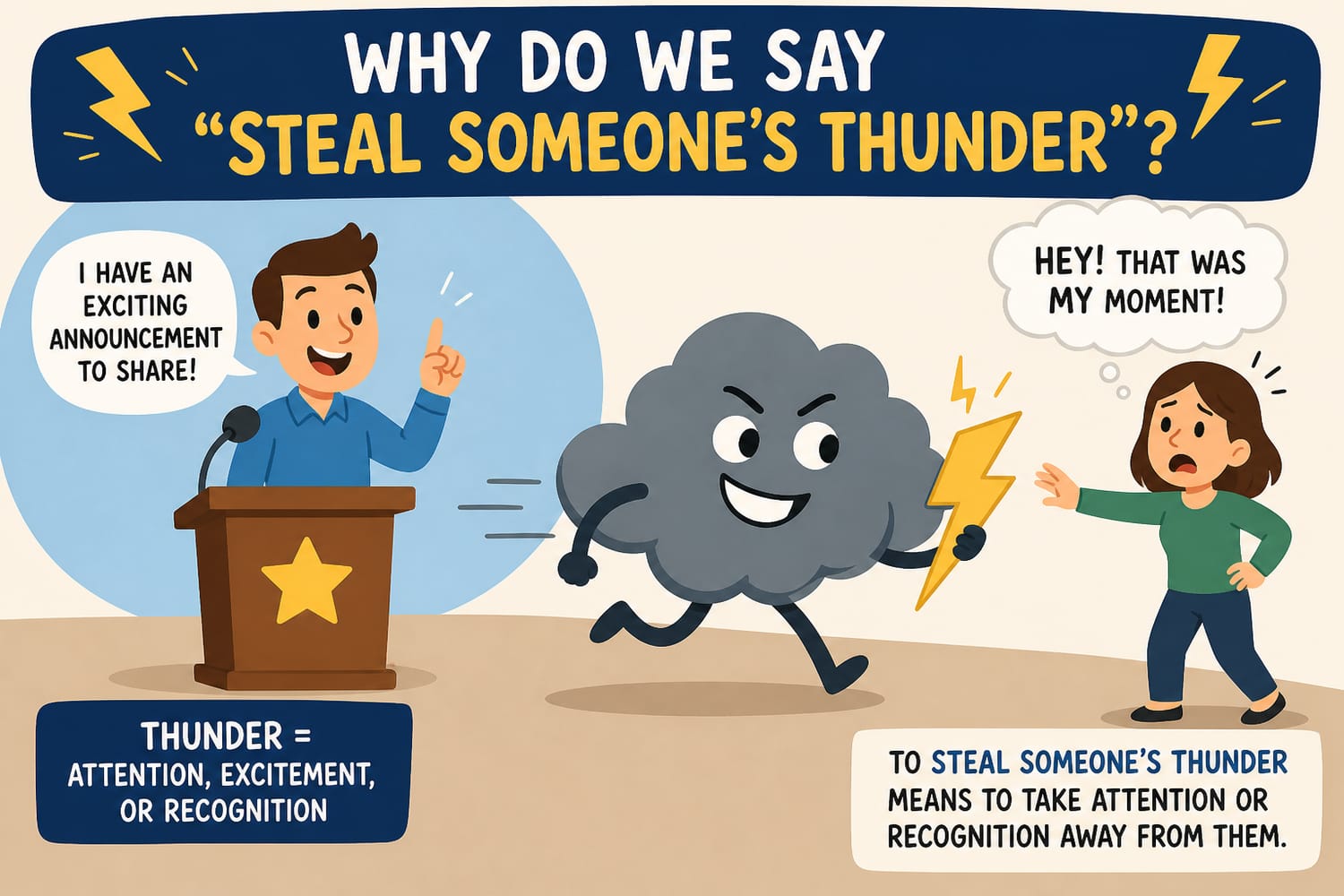
What Does “Steal Someone’s Thunder” Mean?
To steal someone’s thunder means to take attention, praise, or credit away from another person—usually by doing something first, doing it better, or making a bigger splash at just the wrong moment.
If your friend announces their engagement at your birthday party, they may have stolen your thunder. If a coworker presents your idea in a meeting before you get the chance, they have definitely stolen your thunder. If your dog learns to skateboard on the same day you planned to show everyone your new haircut… well, the dog has stolen your thunder, and honestly, fair enough.
The phrase is common in everyday English because it captures a very specific social feeling: I was about to have my moment, and then someone else took the spotlight.
But the best part? This expression didn’t begin as a metaphor. It began with actual thunder—or at least theatrical thunder, which is close enough.
The Meaning Behind the Metaphor
Today, “thunder” in the phrase represents attention, impact, or dramatic effect. Thunder is loud. It demands notice. You cannot politely ignore thunder while sipping tea and pretending nothing happened.
So, when someone “steals your thunder,” they take away the dramatic force of your moment.
Here are a few examples:
- “I was going to announce my promotion at dinner, but my brother stole my thunder by revealing he was moving to Paris.”
- “The startup stole its competitor’s thunder by releasing a similar product a week earlier.”
- “Please don’t tell everyone the surprise ending—I don’t want you to steal my thunder.”
The idiom can be used seriously or playfully. It might describe real frustration, professional rivalry, social awkwardness, or just a mildly dramatic family dinner.
What makes the expression especially memorable is that it suggests not merely taking someone’s idea, but taking the effect of that idea—the applause, the gasp, the dramatic boom.
And that leads us directly to the stage.
The Gloriously Theatrical Origin
The phrase “steal someone’s thunder” comes from the world of early 18th-century English theatre. Its origin is usually credited to John Dennis, an English critic, playwright, and poet who lived from 1658 to 1734.
Dennis was a serious literary figure in his day, though he is now remembered less for his plays and more for one spectacular complaint. In 1709, his tragedy Appius and Virginia was performed at the Drury Lane Theatre in London. The play itself was not a great success. Audiences were apparently not thunderstruck by the drama.
However, Dennis had devised a new and more convincing method of creating the sound of thunder for the stage. This was important because theatre in the 1700s relied on practical effects—machines, painted scenery, trapdoors, candlelight, and plenty of ingenuity. If a storm appeared in a play, someone backstage had to make the storm happen.
Before modern sound systems, theatrical thunder could be produced in various ways: rolling cannonballs, shaking sheets of metal, beating drums, or using specially built wooden or metal devices to create a rumbling noise. Dennis’s invention was reportedly more realistic than what theatres had used before.
Unfortunately for Dennis, his play failed to stay on stage for long. The thunder effect, however, seems to have been rather more successful than the play itself.
According to the famous story, Dennis later attended a production of Shakespeare’s Macbeth at the same theatre. During the performance, he heard his thunder effect being used. His play had been rejected, but his sound effect had survived.
Dennis was not pleased.
He is said to have exclaimed something along the lines of: “They will not let my play run, but they steal my thunder!”
Like many famous historical quotations, the exact wording varies depending on the source. One popular version has him saying, “See how the rascals use me! They will not let my play run, and yet they steal my thunder.” Another gives the sharper “Damn them! They will not let my play run, but they steal my thunder.”
Whichever version is closest to the truth, the meaning is beautifully clear: Dennis felt that the theatre had rejected his art while borrowing his invention.
And thus, a phrase was born.
John Dennis: More Than a One-Line Complaint
It is tempting to imagine John Dennis as simply a grumpy playwright shouting in a theatre, but he was more interesting than that.
Dennis was a critic, translator, and dramatist who participated in the lively literary culture of late 17th- and early 18th-century England. He wrote essays on poetry and drama, engaged in critical debates, and commented on the works of major writers of his time.
He also had a reputation for being irritable and quarrelsome, which may be one reason the thunder anecdote stuck so firmly to him. A brilliant complaint is much easier to remember when it fits the personality of the person who supposedly made it.
Dennis lived in an age when theatre was a competitive business. Playwrights wanted applause, actors wanted fame, managers wanted ticket sales, and critics wanted to be taken seriously. In that environment, a stolen stage effect could feel like a real insult.
His thunder machine may not have made him rich or famous in the way he hoped, but his frustration gave English one of its most enduring idioms. Not bad for a man whose play did not exactly bring the house down.
Why Thunder Mattered on the 18th-Century Stage
To modern audiences, stage thunder might sound like a small thing. Today, a theatre can produce thunder with speakers, recordings, digital cues, and surround sound. Film and television can summon entire hurricanes with a few clicks.
But in Dennis’s time, theatrical effects were physical. A storm scene required backstage machinery and skilled timing. Thunder had to be manufactured, not downloaded.
Audiences loved spectacle. They wanted ghosts, battles, storms, gods descending from above, witches appearing in smoke, and dramatic weather that matched the emotional temperature of the scene. A convincing thunder effect could make a performance feel grander, darker, and more exciting.
This is especially relevant to Macbeth, a play full of supernatural atmosphere. It opens with thunder and lightning as the witches enter. The sound of a storm helps establish a world of chaos, ambition, and dread. If Dennis’s thunder effect was used in Macbeth, it would have been a perfect fit.
That must have made the situation even more painful for him. His invention may have sounded better in Shakespeare’s masterpiece than in his own failed tragedy. History can be cruel—but it can also be very funny.
From Literal Theft to Everyday Idiom
At first, the phrase referred quite literally to theatrical thunder. Someone had allegedly taken Dennis’s special stage effect without giving him the satisfaction of a successful play.
Over time, however, the phrase became figurative. By the 18th and 19th centuries, people were using “steal my thunder” to mean stealing someone’s idea, advantage, or moment of glory.
This kind of change happens often in language. A phrase begins in a specific event, trade, or joke, then expands into general use. The original context fades, but the image remains.
That is why we can now use “steal someone’s thunder” in situations that have nothing to do with theatres, storms, or angry playwrights. The phrase has become a portable little drama. It brings with it the feeling of a spotlight being snatched away.
And because the original story is so vivid, the idiom still feels fresh. You can almost hear John Dennis muttering in the audience as the thunder rolls.
Is It Always a Bad Thing?
Usually, to “steal someone’s thunder” suggests selfishness, poor timing, or unfairness. But it does not always have to be malicious.
Sometimes people steal thunder by accident.
Imagine someone plans to reveal they are expecting a baby at a family gathering. Before they speak, a cousin announces they have just been accepted into medical school. The cousin did not know. The timing is simply unfortunate. Thunder stolen, but not intentionally.
Other times, thunder is stolen strategically. In business or politics, organizations may deliberately make announcements to overshadow rivals. A company might launch news on the same day as a competitor’s product release. A politician might make a major statement to dominate the news cycle. That is thunder theft with a calendar invite.
And then there is social thunder theft: proposing at someone else’s wedding, sharing major personal news during someone else’s celebration, or hijacking a meeting with an unrelated achievement. These are the moments that keep etiquette columns alive.
The key idea is not just that someone gets attention. It is that the attention was expected to belong to someone else.
Similar Expressions and Related Ideas
English has plenty of expressions about attention, credit, and glory. Some overlap with “steal someone’s thunder,” but each has its own flavor.
“Steal the spotlight” is very close. It means to become the center of attention, especially when someone else was expected to be.
“Take the credit” is more direct and often more serious. If someone presents your work as their own, they are taking credit. If they do it in a dramatic or attention-grabbing way, they may also be stealing your thunder.
“Upstage someone” comes from theatre too. On a stage, an actor who moves “upstage” can force another actor to turn away from the audience, making themselves more prominent. Figuratively, to upstage someone is to outshine or draw attention away from them.
“Rain on someone’s parade” is different but related. It means to spoil someone’s happiness or celebration. If you steal someone’s thunder, you take their attention; if you rain on their parade, you dampen their mood.
Together, these phrases show how much English loves performance metaphors. Life, apparently, is one long theatre production, and everyone is worried someone else will get the better lighting.
Why the Phrase Still Works
“Steal someone’s thunder” has lasted for more than three centuries because it is dramatic, visual, and emotionally precise.
We all understand the feeling. You prepare for a big announcement. You hope for a moment of recognition. You imagine the reaction. Then—boom—someone else gets there first, says it louder, or makes a bigger impact.
The phrase also carries just enough humor. Calling attention “thunder” makes ordinary social rivalry feel like Shakespearean weather. It turns a workplace interruption or awkward dinner announcement into a tiny stage tragedy.
And the origin story gives it extra charm. Many idioms have uncertain beginnings, but this one comes with a memorable character, a failed play, a clever invention, and a wonderfully bitter complaint. It is almost too perfect.
The Final Rumble
So, why do we say “steal someone’s thunder”?
Because an 18th-century playwright named John Dennis supposedly invented a better way to make thunder for the stage, only to hear it used later in another production after his own play had flopped. Feeling that his idea had been taken while his work was ignored, he complained that they had stolen his thunder.
From that theatrical grievance came a phrase we still use whenever someone takes attention, credit, or impact that seemed meant for someone else.
It is a reminder that language often preserves the most human moments: pride, annoyance, invention, competition, and the eternal desire to have one’s big moment uninterrupted.
In other words, if you ever feel someone has stolen your thunder, take comfort. You are part of a long tradition—one that began with a playwright, a storm effect, and a very loud complaint.