The Short Answer: A Promise After a Rainout
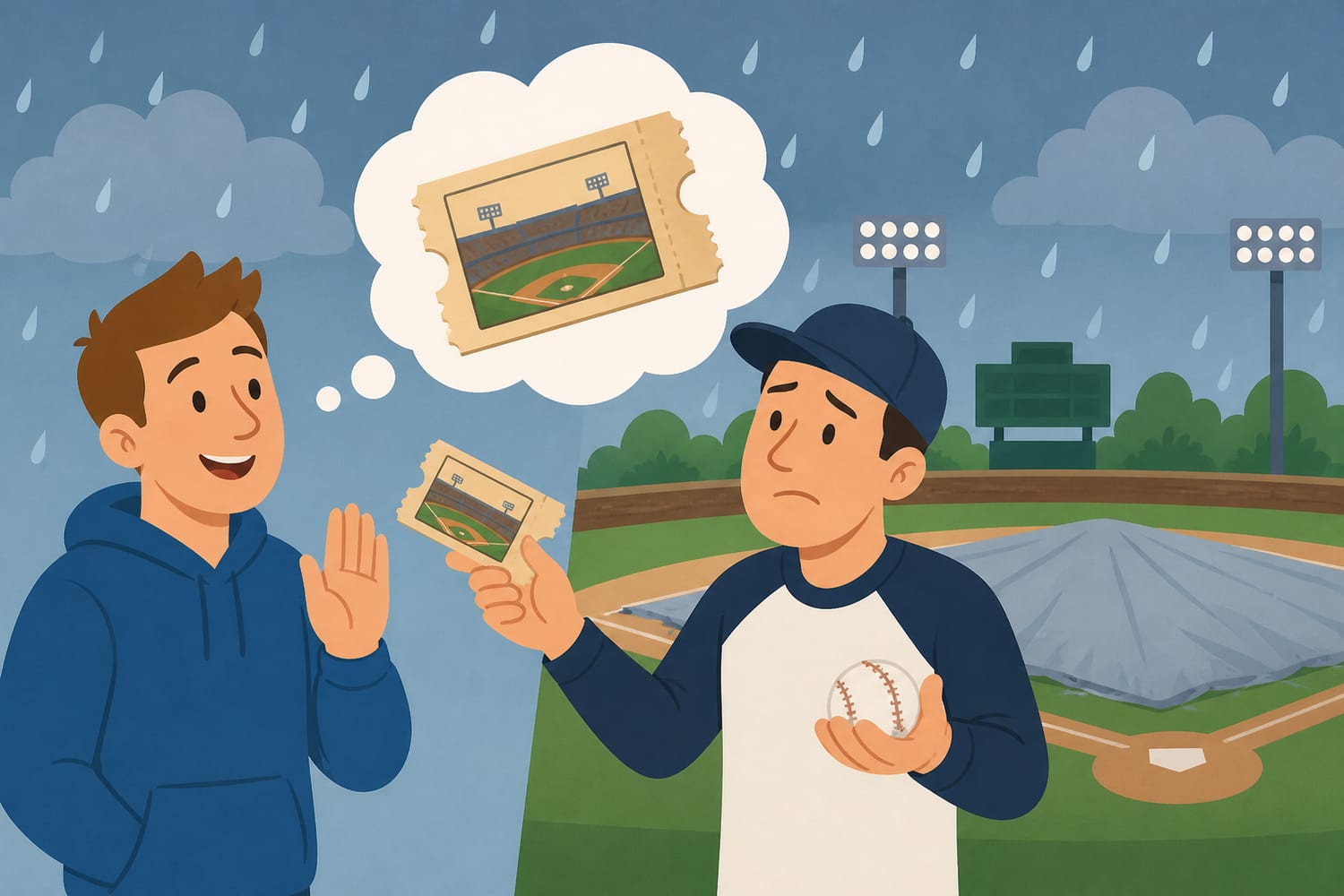
To “take a rain check” means you cannot accept an invitation now, but would like another chance later. The phrase comes from baseball: when rain prevented spectators from seeing the game they had paid for, a rain check gave them admission to a future one. The weather disappeared from the expression; the promise of “another time” stayed.
Picture a Ballpark with No Roof
Imagine you have bought a ticket to a baseball game in the 1880s. You find your place, settle in, and wait for the first pitch. Then the clouds open. The field becomes too wet for play, and the game is called off before you have seen much baseball at all.
You have paid for an afternoon’s entertainment and received an afternoon’s soaking. A rain check offered a solution: proof that you could come back for a future game without paying again. Depending on the arrangement, it might be a separate check or part of the original ticket. It was not a forecast, and it was not a check mark beside the word rain. It was a practical way to make good on a spoiled outing.
That arrangement contains the meaning we use today. When a friend invites you to dinner and you ask for a rain check, you are not requesting a little cardboard pass. You are asking them to keep the offer open.
How Far Back Does the Phrase Go?
The phrase was in baseball’s vocabulary by the 1880s. One particularly useful piece of evidence comes from a June 21, 1883, St. Louis Post-Dispatch report. After spectators objected to paying for a game cut short by rain, the St. Louis club’s president said the team would give rain checks when fewer than five innings were played. The checks would admit paying fans to a later game.
That report tells us more than a dictionary date can. It shows an actual disagreement over what ticket buyers were owed—and a club responding with a policy. The rain check was not just a picturesque name for a scrap of paper. It answered a question any disappointed fan could understand: “If the game doesn’t happen, what happens to my ticket?”
It does not tell us the exact day someone first uttered the words rain check. Newspaper evidence establishes that people were using the term by 1883; it does not prove that they invented it that year. In phrase history, the earliest example we can find is a clue, not a birth certificate. That is a useful distinction to remember whenever an old expression arrives with an unusually precise origin story—advice worth taking with a grain of salt.
Did One Man Invent the Rain Check?
Abner Powell, associated with the New Orleans Pelicans, often appears in stories about the rain check. There is a good reason for his name to come up—but the popular version gives him too much credit.
Older arrangements could require people to line up for a replacement ticket after a rainout. According to the history in The Dickson Baseball Dictionary, Powell described a problem with that system: people who had entered without paying could join the line too. He is credited with improving the process by using a detachable part of the original ticket, making it easier to identify customers entitled to return.
Accounts disagree on exactly when Powell introduced his version in the late 1880s. More importantly, rain check already appeared in the 1883 St. Louis report. So Powell may deserve credit for a smarter kind of rain check, but not for inventing the phrase or the basic idea all by himself. A good origin story can still have room for more than one contributor.
How Did It Leave the Ballpark?
A rain check did not have to stay attached to baseball for long. Its underlying promise—you missed out this time, but you can have another chance—was useful almost anywhere.
In fact, word historian David Wilton’s research points to an 1887 newspaper example involving a shoeshine. With rain threatening to ruin a customer’s freshly polished boots, the person doing the polishing offers a rain check for another shine. There is still actual rain in the story, but no baseball. The expression had already found a way out of the stadium.
The idea also fits retail. A store rain check is a promise to let a customer buy an unavailable sale item later at the advertised price. Unlike a social rain check, that one may be a real piece of paperwork, with details that matter. In both cases, the immediate opportunity is gone, but the offer is meant to survive.
Then came the everyday figurative use: no storm, no ticket window, no merchandise—just a person who cannot say yes yet. That is a familiar journey for an idiom. Another sports phrase, “the ball is in your court,” works perfectly well in conversation even when everyone involved is sitting at a kitchen table. The original setting supplies the picture; ordinary life gives the phrase somewhere new to play.
What Does “Take a Rain Check” Mean Today?
Usually, it is a friendly way to decline an offer while leaving open the possibility of accepting another time. If someone says, “Want to see a movie Friday?” you might answer, “I can’t Friday, but could I take a rain check?” You are saying no to Friday, not necessarily no to the movie—or the person asking.
The phrase works best when you genuinely would welcome a later invitation. If you already know you do not want to go, “rain check” can sound more hopeful than you mean. And if you do want to go, a specific suggestion is even clearer:
“I can’t make it Friday, but could I take a rain check? How about next Tuesday?”
That little follow-up does what the original baseball ticket did: it makes “another time” feel less like a polite escape route and more like a real plan.
You may also hear someone offer a rain check: “The picnic’s off because of the storm, but I owe you a rain check.” One person asks to keep an invitation open; the other promises another chance. Either way, the heart of the expression is the same.
Do Baseball Fans Still Get Rain Checks?
Yes—the literal term has not retired from baseball. The San Diego Padres’ rainout policy, for example, says that a ticket for a postponed or rained-out game becomes a rain check. Teams’ specific ticket arrangements can differ, so an actual ticket holder should follow the policy for that game rather than assume the phrase guarantees admission to any future matchup.
A brief delay is not necessarily a rainout, either. Play may resume when the weather clears. Whether a stopped game counts as official also matters to ticket policies. Those details belong to baseball; fortunately, nobody asks how many innings of dinner you completed before granting a social rain check.
A Little Ticket with a Long Afterlife
“Take a rain check” survives because it softens a disappointing moment without pretending the moment did not happen. The original fan could not watch the game that day. The check said the chance to watch one had not vanished altogether.
The next time you ask for a rain check on coffee, lunch, or a trip to the movies, you are carrying a small bit of ballpark history into the conversation. No soggy grandstand required—just the hope that next time, things will work out.