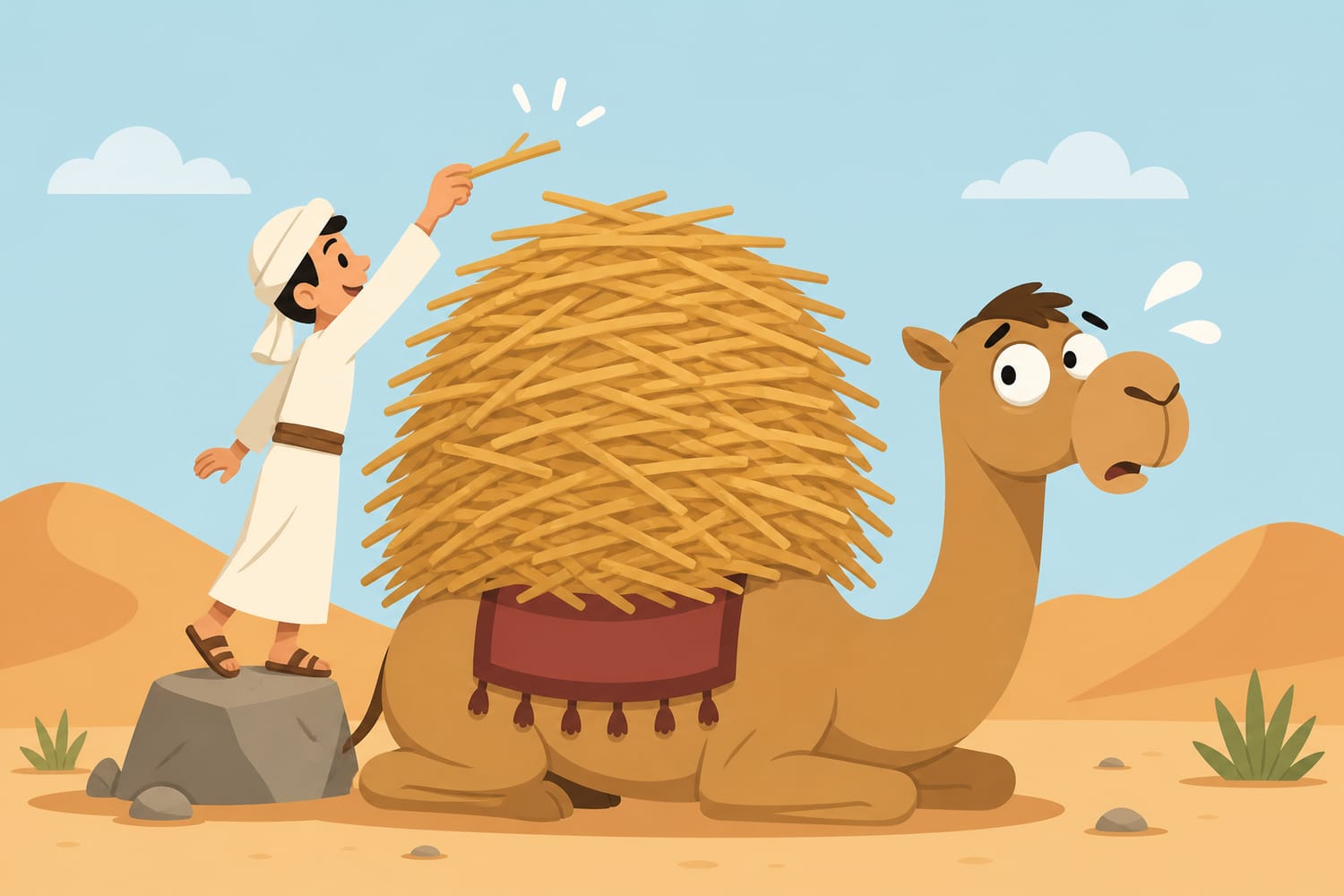
“The last straw” is a small final problem that makes an already difficult situation impossible to tolerate. The phrase comes from a longer image: a camel carrying such a heavy load that one more piece of straw tips it past its limit. The important part isn’t the weight of that final straw. It’s everything the camel was carrying before it.
Suppose your train is delayed, your phone battery is dying, and you arrive home to discover that the groceries have leaked across your bag. Then the bag’s handle snaps. You might call the broken handle “the last straw,” even though a stronger handle wouldn’t have fixed the rest of your day.
That’s the phrase’s quiet insight: a reaction that looks out of proportion to one event can make perfect sense once you know what came before it.
A Camel, a Load, and One Very Unlucky Straw
The full saying is often given as “the straw that broke the camel’s back.” Picture a pack animal loaded bit by bit. Each addition seems manageable on its own. Eventually, though, the load reaches a point where even the smallest extra weight is too much.
The camel gives the proverb a familiar beast of burden; the straw gives it a comically tiny final addition. If the last object were a boulder, there would be no puzzle. Of course a boulder could cause trouble. A straw makes us ask why that addition mattered, and the answer is that it wasn’t acting alone.
No particular camel has been identified as the inspiration, and the saying is not a report of an actual back-breaking incident. It’s a metaphor for accumulation: many pressures building until one more becomes unbearable.
Wait—Was the Camel Always There?
Here’s the surprise: the basic idea appears in English with a horse and a feather before the familiar camel and straw take center stage.
In a seventeenth-century debate about human action, the theologian John Bramhall referred to the last feather breaking a horse’s back after many others had already been placed on it. The comparison appears in a reply published in 1655. Different animal, different lightweight object, same point: the final addition gets the attention, but the earlier additions made it decisive.
That doesn’t mean we can name the moment somebody swapped the horse for a camel. Proverbs travel through speech as well as writing, and their details can change along the way. The horse-and-feather example shows that the image existed earlier in English; it does not provide a tidy, documented handoff between the two versions.
English has room for more than one memorable horse expression. If you’re curious about another, Uncover Words also explores why we say “hold your horses”. That horse asks you to slow down. This one would probably appreciate a lighter load.
When Did Straw Meet Camel?
By the late eighteenth century, the camel version was in print. A passage in The Scots Magazine from April 1799 uses the idea while discussing taxation: one more small addition, it argues, can push an existing burden too far. Its writer calls the saying an “Oriental proverb,” but that description alone does not establish where the expression first arose.
That distinction matters. We have evidence that an English-language writer used the camel image in 1799. We do not have the same level of evidence for a specific ancient tale, named inventor, or exact route by which the image entered English. A colorful label in an old publication is a clue to how its author presented the saying, not proof of its birthplace.
The expression was certainly familiar enough by the nineteenth century for Charles Dickens to use it without pausing to explain it. In Dombey and Son, published in 1848, he compares another piece of bad news to the final straw on a laden camel. You can see the passage in the text of Dombey and Son. Dickens gave the image a prominent literary outing, but the 1799 example shows that he did not invent it.
Is It a Bible Story?
It can sound like one. There are camels in the Bible, and straw is hardly out of place in an ancient setting. But the overloaded camel and its final straw are not a biblical story. The proverb’s atmosphere may suggest scripture to a modern reader; its wording does not come from a passage about a camel whose back breaks.
That makes it a useful contrast with an expression such as “by the skin of your teeth”, which does have a biblical textual source. Similar-sounding origin stories deserve different answers when the evidence is different.
How Did the Camel Disappear?
Like many long sayings, this one can be shortened once listeners know the image. Saying “That was the last straw” is enough; nobody needs to bring the entire camel into the conversation every time a roommate leaves dishes in the sink.
Etymology reference Online Etymology Dictionary’s entry for straw dates the standalone expression “the last straw” to 1836, while noting earlier use of the broader image. Today, Cambridge Dictionary treats “the final straw,” “the last straw,” and “the straw that breaks the camel’s back” as forms of the same idiom.
The shortened version is handy because it puts the emphasis where speakers usually want it: on the event that finally prompted a response. The camel is still there in the background, doing a remarkable amount of metaphorical work.
What Counts as a “Last Straw” Today?
A last straw is usually a final difficulty in a series, not simply the worst thing that happened. It may even be minor compared with what came before. That contrast is what gives the expression its force.
Imagine a colleague who repeatedly misses deadlines, leaving you to finish shared work. One morning they borrow your pen and fail to return it. If you say, “The pen was the last straw,” you are probably not declaring it the most valuable pen in the world. You’re saying it arrived after a long run of frustrations.
The phrase also works for decisions, not just flashes of anger. A string of unexplained fees might make one more charge the last straw that leads you to change banks. Several disappointing repairs might make a fresh breakdown the last straw before you replace an appliance. In each case, the final event helps explain when the decision happened, while the accumulated problems explain why.
There is one small caution when using the idiom: without the earlier context, your listener may think you’re making a huge fuss over a tiny thing. “The pen was the last straw” becomes much clearer once you mention the missed deadlines. The proverb assumes there was already a load on the camel.
The Point of the Proverb
The last straw didn’t create the whole burden. It revealed that the burden had become too much.
That is why a saying involving a camel and a nearly weightless stalk has lasted so well. It gives us a quick way to describe a complicated human moment: the instant when one more thing is no longer just one more thing.