A Message You Really Don’t Want to Receive
If someone says, “The writing is on the wall,” they usually do not mean that someone has been vandalizing the paintwork.
The phrase means that a bad outcome is clearly coming. The signs are obvious. The result may not have happened yet, but it is becoming hard to avoid. A company losing money every quarter may see “the writing on the wall.” A sports team trailing by 30 points with two minutes left can probably read it too. And if your houseplant has turned brown, crunchy, and faintly judgmental, the writing may also be on the wall for your gardening career.
But where did this dramatic expression come from? Why a wall? Why writing? And why does it sound so ominous?
The answer takes us back more than two thousand years to an ancient royal banquet, a mysterious hand, and one of the Bible’s most memorable “well, this can’t be good” moments.
The Short Meaning of “The Writing on the Wall”
Today, “the writing on the wall” refers to a warning or sign that something unfortunate is about to happen.
It often suggests that the outcome is already predictable, even if people are pretending otherwise. For example:
- “After the third round of layoffs, employees could see the writing on the wall.”
- “When ticket sales collapsed, the writing was on the wall for the tour.”
- “Once the restaurant started serving soup in coffee mugs because all the bowls were gone, the writing was on the wall.”
The phrase is usually used for negative developments: failure, defeat, closure, dismissal, collapse, or some other unpleasant result. It is not commonly used for cheerful predictions. You probably would not say, “The writing is on the wall: I’m about to receive cake,” unless you enjoy making dessert sound like a prophecy of doom.
The Biblical Origin: A Feast, a King, and a Floating Hand
The expression comes from the Book of Daniel in the Hebrew Bible and the Christian Old Testament, specifically Daniel chapter 5.
The story takes place in Babylon, during the reign of King Belshazzar. Historically, Belshazzar was not the sole king in the modern sense but the son of Nabonidus, the last king of the Neo-Babylonian Empire. He acted as a ruler or regent in Babylon while his father was away. In the biblical story, however, he is presented as the king hosting a grand feast.
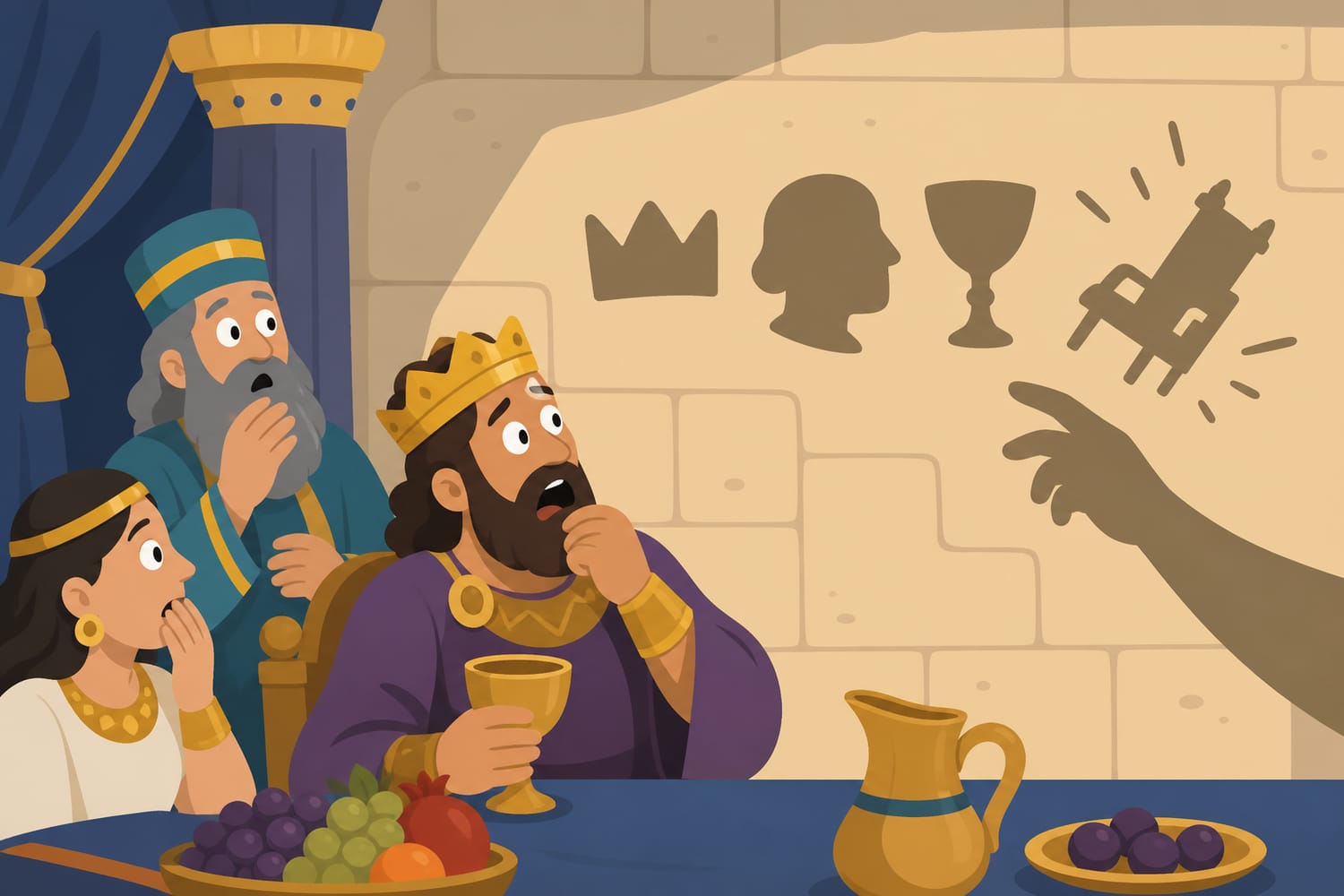
And what a feast it is. Belshazzar throws a banquet for a thousand of his nobles. There is drinking, revelry, and royal showmanship. Then Belshazzar makes a very bad decision: he orders that sacred gold and silver vessels, taken from the temple in Jerusalem, be brought out so his guests can drink from them.
This is not just poor manners. In the biblical context, it is an act of arrogance and sacrilege. Belshazzar and his guests drink wine from the temple vessels while praising gods of gold, silver, bronze, iron, wood, and stone.
Then things get strange.
According to the story, the fingers of a human hand appear and write a message on the plaster wall of the palace. Just the fingers. No body. No explanation. Not the kind of entertainment you want at dinner.
Belshazzar is terrified. The text says his face turns pale, his thoughts alarm him, his limbs give way, and his knees knock together. In other words, the king goes from banquet host to absolute jelly in a matter of seconds.
What Did the Writing Say?
The mysterious words written on the wall are:
Mene, Mene, Tekel, Upharsin
In Aramaic, the language of much of this part of Daniel, these words are connected with units of weight or money. Their exact sense is layered, because the words sound like terms that can also be interpreted as verbs.
Belshazzar summons his wise men, astrologers, and enchanters to read and interpret the message, but they cannot do it. Finally, Daniel is brought in. Daniel, known for interpreting dreams and divine messages, explains the meaning.
In the biblical account, Daniel interprets the words like this:
- Mene: God has numbered the days of Belshazzar’s kingdom and brought it to an end.
- Tekel: Belshazzar has been weighed in the balance and found wanting.
- Peres/Upharsin: His kingdom is divided and given to the Medes and Persians.
The word Upharsin is related to Peres, and the interpretation plays on the idea of division and the Persians. This is one reason the phrase is so memorable: it is not simply a translation but a prophetic interpretation filled with wordplay.
The message is not exactly subtle. It is basically: “Your reign has been measured, judged, and finished.”
That very night, according to Daniel 5, Belshazzar is killed, and Darius the Mede receives the kingdom. The writing on the wall turns out to be not just a warning but an announcement of imminent doom.
Why a Wall?
The wall matters because the biblical scene is so vivid. A hand appears and writes directly on the palace wall during a royal feast. There is no private whisper, no sealed letter, no cryptic dream that can be ignored until morning. The message is public, visible, and terrifying.
That image gives the expression its power. “The writing on the wall” suggests that the evidence is right there in front of everyone. You may not like it. You may not understand it at first. You may call in consultants, analysts, or ancient Babylonian wise men. But the sign is visible.
It also carries a sense of inevitability. In the story, once the words appear, Belshazzar’s downfall is already underway. The warning does not lead to a long period of reform or negotiation. The judgment has been delivered.
So when we use the phrase today, we are borrowing that sense of visible, unavoidable warning. The “wall” is not always literal, but the message is clear.
From Ancient Scripture to Everyday English
The phrase entered English through biblical translation and religious familiarity. For centuries, the Bible was one of the most widely read and quoted texts in English-speaking cultures, especially after the publication of influential translations such as the King James Version in 1611.
In the King James Version, Daniel 5:5 says:
“In the same hour came forth fingers of a man’s hand, and wrote over against the candlestick upon the plaister of the wall of the king’s palace…”
The phrase “handwriting on the wall” became associated with divine judgment and approaching disaster. Over time, it moved beyond strictly religious contexts and became a general idiom.
By the eighteenth and nineteenth centuries, English speakers were using “the writing on the wall” or “the handwriting on the wall” to describe signs of impending misfortune. The phrase appeared in political writing, sermons, journalism, and literature. Eventually, it became common enough that speakers no longer needed to know the story of Belshazzar to understand the meaning.
That is how many idioms work. They begin in a specific story or cultural moment, then gradually become verbal shorthand. Today, someone can say “the writing is on the wall” in a boardroom, a football commentary, or a family discussion about replacing the ancient washing machine, and everyone knows what it means.
“Writing” or “Handwriting”?
You may hear two versions of the expression:
- The writing on the wall
- The handwriting on the wall
Both are correct, and both refer to the same biblical episode.
“Handwriting on the wall” is closer to the older biblical image of a mysterious hand writing the message. “Writing on the wall” is the more common modern form and sounds a little less formal.
There is a slight difference in flavor. “Handwriting on the wall” can feel more dramatic, literary, or old-fashioned. “Writing on the wall” is more likely to turn up in everyday speech.
For example:
- “With sales falling and debts rising, the writing was on the wall.”
- “The scandal was the handwriting on the wall for his political career.”
Either way, the meaning is the same: the signs point to trouble ahead.
Why We Still Use It
One reason the phrase has lasted so long is that it describes a very common human experience: seeing the evidence before the event.
We often know something is coming before it arrives. The clues pile up. The mood changes. The numbers worsen. The emails get shorter and more formal. The dog hides before bath time.
The phrase also captures another very human habit: denial. Belshazzar is surrounded by signs of arrogance, excess, and danger, but he does not understand the seriousness of his situation until the message appears in supernatural ink, so to speak. Even then, he needs Daniel to explain it.
Modern “writing on the wall” moments often work the same way. People ignore signs because the truth is inconvenient. A business ignores changing markets. A leader ignores public anger. A student ignores five unread reminders about an essay deadline and then acts personally betrayed by the calendar.
The idiom remains useful because it combines warning, clarity, and a touch of drama. It lets us say, “This was predictable,” but with the added flair of an ancient royal catastrophe.
Common Examples of the Phrase
Here are some ways the expression is used today:
In business:
“After the merger was announced, the writing was on the wall for several regional offices.”
Meaning: the offices were likely to close.
In politics:
“When the minister lost the support of key allies, the writing was on the wall.”
Meaning: resignation or removal was probably coming.
In sports:
“By halftime, with the team down 4–0, the writing was on the wall.”
Meaning: defeat looked almost certain.
In personal life:
“When they stopped making plans together, the writing was on the wall for the relationship.”
Meaning: the relationship was likely ending.
In technology:
“Once smartphones became popular, the writing was on the wall for many standalone GPS devices.”
Meaning: their decline was predictable.
The phrase is flexible, but it almost always points to an approaching negative outcome.
A Phrase with Built-In Drama
“The writing on the wall” is more than just a handy idiom. It is a tiny piece of ancient storytelling preserved in everyday language.
Every time we use it, we echo the story of Belshazzar’s feast: the lavish banquet, the sacred vessels, the sudden hand, the cryptic words, and Daniel’s grim interpretation. Even if we are talking about a failing coffee shop or a doomed television series, the phrase brings a bit of biblical thunder with it.
That is the charm of idioms. They let ordinary speech carry extraordinary history. A few simple words can smuggle in kings, empires, prophecies, and ghostly handwriting.
So the next time someone says, “The writing is on the wall,” you will know exactly why it sounds so serious. It comes from a story where the message on the wall did not mean “Please clean up after the party.”
It meant the party was over.