The Short Answer
To turn the tables means to reverse a situation, usually by transforming a disadvantage into an advantage. The expression comes from board games once known collectively as “tables.” These included medieval games related to modern backgammon, in which a reversal of positions provided a natural image for a dramatic change in fortune.
What Does “Turn the Tables” Mean Today?
When someone turns the tables, the balance of power shifts—often unexpectedly and usually in favor of the person who had been losing.
Imagine a detective following a suspect, only to discover that the suspect has been watching the detective all along. The suspect has turned the tables. Or picture a last-place team scoring three times in the final few minutes and winning the game. Again, tables successfully turned.
Merriam-Webster defines the expression as bringing about a reversal in the relative fortunes or circumstances of two competing sides.
The phrase usually involves three ingredients:
- Two people or groups are in some kind of contest or conflict.
- One side begins with an advantage.
- The weaker side reverses the situation and comes out on top.
That is why we rarely say someone “turned the tables” after a calm, predictable victory. The expression needs a reversal. Without one, the tables are apparently quite happy where they are.
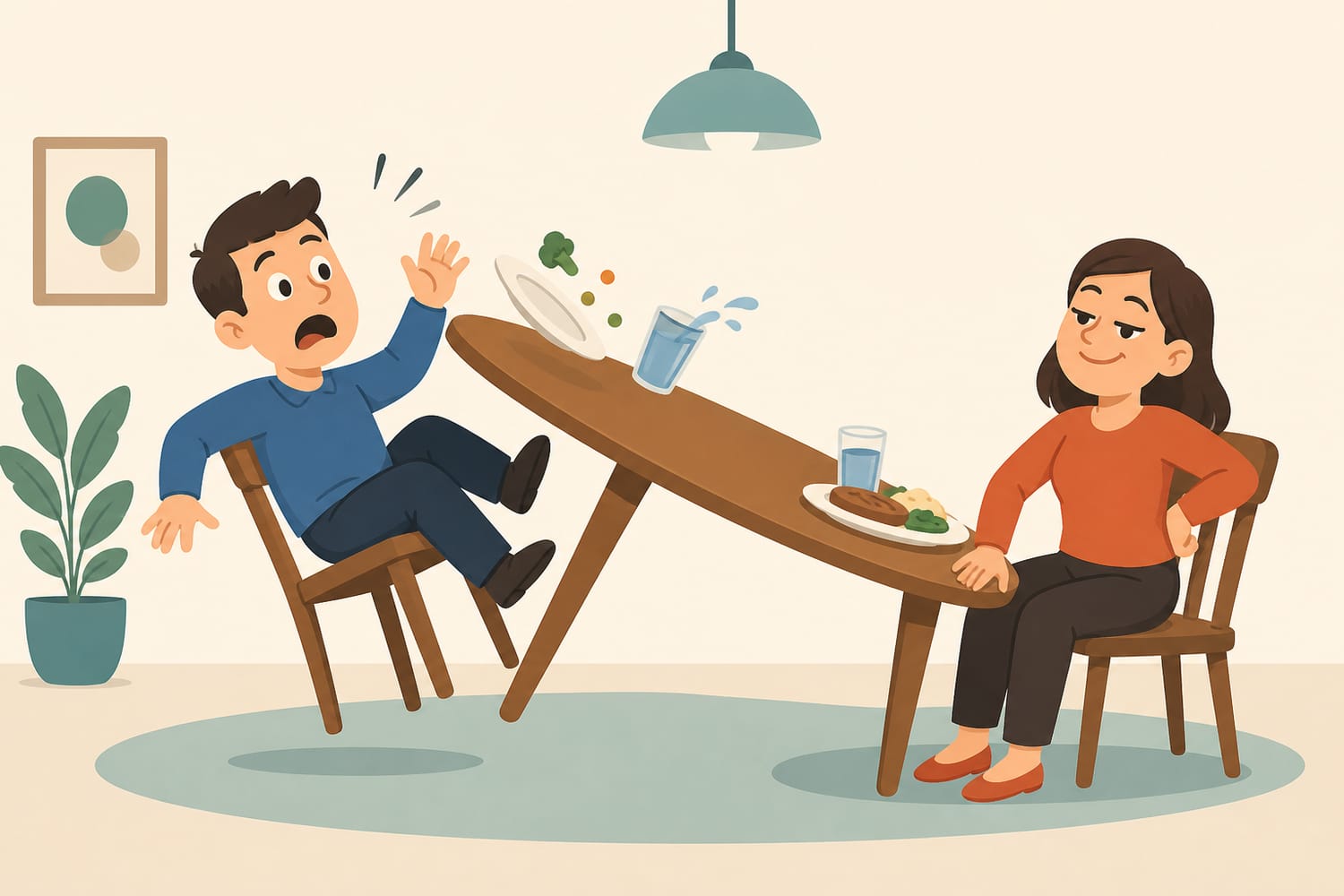
No, It Is Not About Dining-Room Furniture
The modern wording makes it tempting to picture somebody grabbing a kitchen table and spinning it around. Perhaps the victor ends up with the bread basket while the loser is left staring sadly at the salt.
Entertaining as that image may be, the “tables” in this expression were not primarily pieces of dining-room furniture. They were gaming boards.
The word table has long had more meanings than the four-legged object in your kitchen. It came into English through Old French and ultimately derives from the Latin tabula, meaning a board, plank or flat surface. Such surfaces could be used for writing, displaying information or playing games—which helps explain both a “table of contents” and a gaming table. The Online Etymology Dictionary traces “turn the tables” to the 1630s and connects it with backgammon-style play.
So, despite what the phrase appears to say, no antique furniture had to be rotated, flipped or dramatically shoved across a room.
The Games Once Called “Tables”
During the Middle Ages and early modern period, English speakers used tables as a general name for a family of board games. These games typically involved dice and counters moving around a divided board.
Modern backgammon belongs to this family, although it is more accurate to say the phrase arose from tables games than to assume it came from the exact version of backgammon played today. Backgammon did not become established under its familiar English name until the 17th century, while related games had already existed for centuries.
Even a backgammon board is traditionally divided into four sections called tables. Players move their pieces through these sections in opposite directions, making the board a fitting setting for sudden reversals. A player who appears trapped can escape; someone comfortably ahead can be knocked backward; and a few fortunate throws of the dice can change everything.
In other words, these games offered plenty of opportunities for the gaming equivalent of “Well, this is awkward.”
The history is similar to other expressions whose original setting is easy to overlook. For example, “the ball is in your court” comes from the back-and-forth action of a court game, while “break the ice” has a more complicated history than simply smashing a frozen puddle.
When Did the Expression First Appear?
The earliest known written example identified by the Oxford English Dictionary appears in George Chapman’s 1612 comedy The Widdowes Teares, now usually titled The Widow’s Tears. A character warns another that he “may turne tables” with him before long.
That early example is important because it is already figurative. The speaker is not asking to rotate a game board. He is warning that their positions may soon be reversed.
The expression appeared again during the 17th century. In a sermon, the English clergyman Robert Sanderson asked wrongdoers to “turn the tables” and imagine themselves playing another person’s game. The point was essentially: put yourself in the other person’s position and see how you like it.
These examples show that the phrase was doing metaphorical work more than 400 years ago. Grammarphobia’s discussion of the expression notes both the 1612 example and its connection with board games.
Did Players Literally Turn the Board?
This is where the history becomes slightly less tidy.
Some explanations say that players physically turned the gaming board so that each person faced the other’s position. That provides a wonderfully neat origin story: turn the board, exchange the positions and reverse everyone’s fortunes.
However, there is no strong evidence that tables players routinely rotated the entire board during a game. One historical account from the editors of Merriam-Webster specifically notes that we cannot be certain the boards were literally turned or that players were forced to exchange sides.
The safest conclusion is that the expression grew from the idea of reversing positions in a tables game, whether that involved physically turning a board, viewing the game from the opponent’s side or simply imagining that the players’ circumstances had been exchanged.
Idioms often develop this way. The general image survives even when the precise custom behind it becomes uncertain. Language keeps the memorable part and misplaces the instruction manual.
How the Gaming Metaphor Escaped into Everyday Life
The expression proved useful because life is full of competitions that do not involve dice or counters.
People compete for jobs, votes, customers, attention and the last slice of pizza. Relationships can contain shifting balances of power. Stories become exciting when a seemingly helpless character gains control. Sporting events are memorable when the underdog suddenly dominates.
“Turn the tables” captures all of those situations in three words. It suggests movement, conflict and surprise without requiring a lengthy explanation.
Consider the difference:
After struggling throughout the first half, the team adjusted its strategy and eventually gained a decisive advantage over its opponent.
That sentence is perfectly clear, but slightly formal.
Now compare:
After halftime, the team turned the tables.
The second version immediately communicates reversal. It also leaves room for the reader to imagine the speed and drama of the comeback.
How to Use “Turn the Tables” Correctly
The most common construction is turn the tables on someone:
- “The journalist turned the tables on the interviewer.”
- “The prey turned the tables on its pursuer.”
- “The small company turned the tables on its larger competitor.”
- “After years of losing to her brother, Maya finally turned the tables.”
You can also describe the reversal after it has happened:
- “The tables have turned.”
- “By the end of the debate, the tables had turned.”
- “How quickly the tables can turn!”
Although the phrase often describes a welcome victory for an underdog, it can also refer to an unpleasant reversal. A person who once had power may observe that the tables have turned when they suddenly become vulnerable.
For a related expression involving a much less cheerful fate, explore why we say “kick the bucket”. English has never been shy about turning ordinary objects into dramatic metaphors.
Why Has the Phrase Lasted So Long?
“Turn the tables” has survived because its basic image remains easy to understand, even for people who have never played a medieval tables game—or any backgammon at all.
A table has sides. Turning something changes its orientation. Put those ideas together, and the sense of reversal feels almost automatic.
The phrase also appeals to our love of comeback stories. We enjoy watching the underestimated character outsmart the expert, the tiny team defeat the favorite and the hunted become the hunter. Those moments are satisfying because they overturn expectations.
That is exactly what the expression promises: the game is not over, the current advantage may not last and the person who appears to be losing could soon be calling the shots.
A Four-Century-Old Comeback
“Turn the tables” began with the language of board games, particularly the medieval and early modern games known as tables. By the early 17th century, writers were already using it figuratively to describe people exchanging positions or reversing their fortunes.
We may not know whether players regularly spun their boards around, but the central image is clear. One side has the advantage—until suddenly it does not.
So the next time an underdog stages a comeback, a clever character outwits a rival or your cat somehow makes you apologize for moving its chair, you will know exactly what happened.
The tables have turned.