-
In astronomy, an arrangement in which three celestial bodies lie in a straight or nearly straight line, especially the Sun, Earth, and Moon at new moon or full moon.
synonyms:celestial alignmentastronomical alignment -
A pair of connected or corresponding things, sometimes things that are opposites.
synonyms:paircoupling -
In classical poetry, the combination of two metrical feet—units of poetic rhythm—into a single larger unit.
synonyms:dipodypaired metrical feet
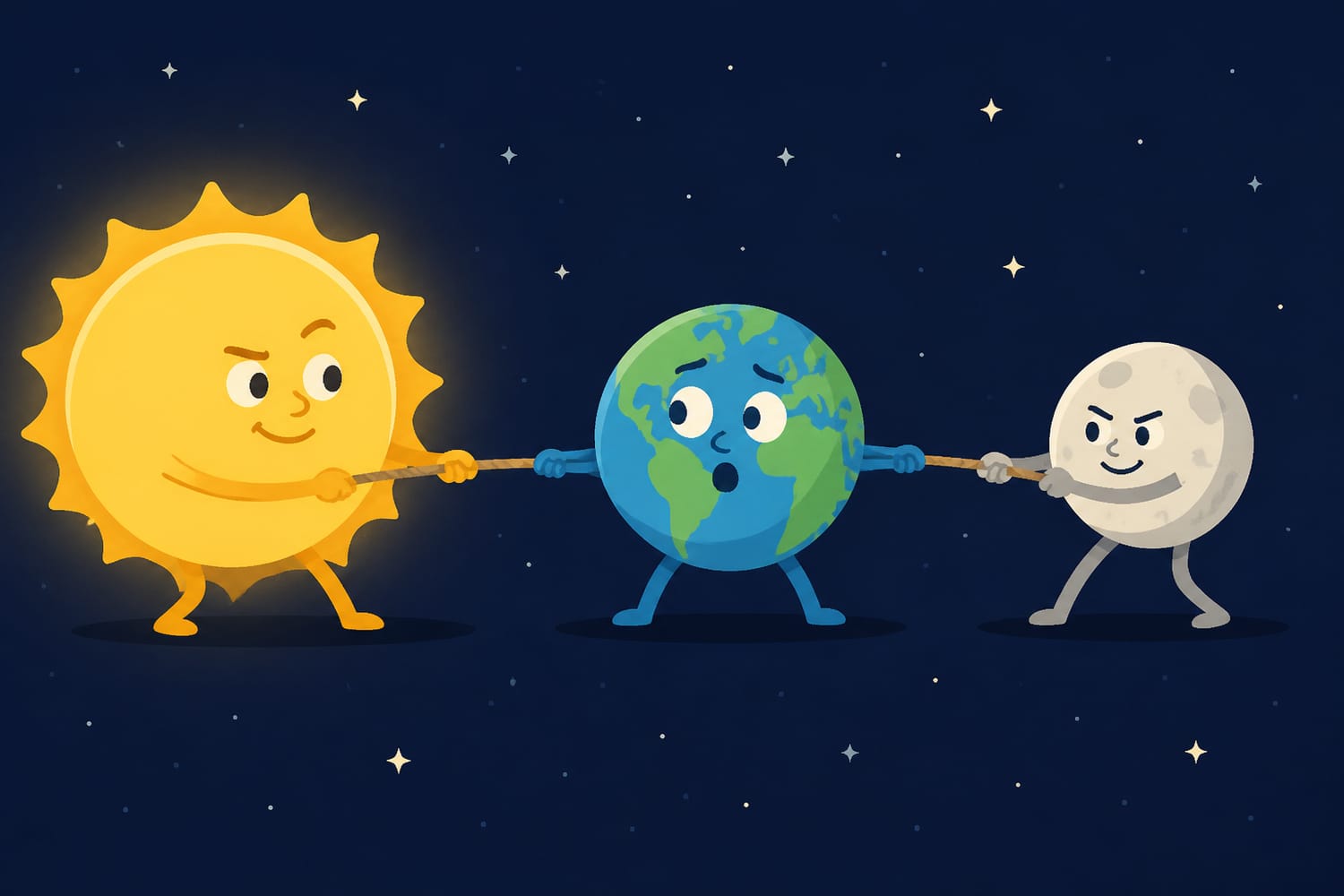
Syzygy entered English in the mid-17th century through Late Latin syzygia, from Greek syzygia, meaning a union or pairing. Its Greek roots combine the idea of 'together' with zygon, meaning 'yoke': the underlying image is of things joined together.
Primarily a technical astronomy term, especially in discussions of lunar phases and celestial alignments. It also appears in classical poetry studies and, more rarely, in writing about connected or opposing pairs.
An editorial estimate rather than a measured frequency statistic: syzygy belongs mainly to specialist vocabulary, not everyday conversation. Dictionaries identify its principal uses as astronomical, literary, or rare.
The astronomy teacher used three balls to demonstrate a syzygy of the Sun, Earth, and Moon.
The critic described the novel's rival siblings as a syzygy of ambition and restraint.
In our lesson on classical verse, we grouped two metrical feet into a syzygy.
Syzygy looks like a keyboard puzzle, but its central idea is simple: things coming together. Its Greek ancestry evokes a yoke joining a pair, an earthy beginning for a word now associated with the heavens. In astronomy, it describes the straight or nearly straight arrangement familiar from the Sun, Earth, and Moon at new moon and full moon. Poetry scholars give it a smaller stage, using it for two rhythmic feet joined into one unit. Whether you are discussing moons or meters, this six-letter word makes togetherness sound wonderfully elaborate.