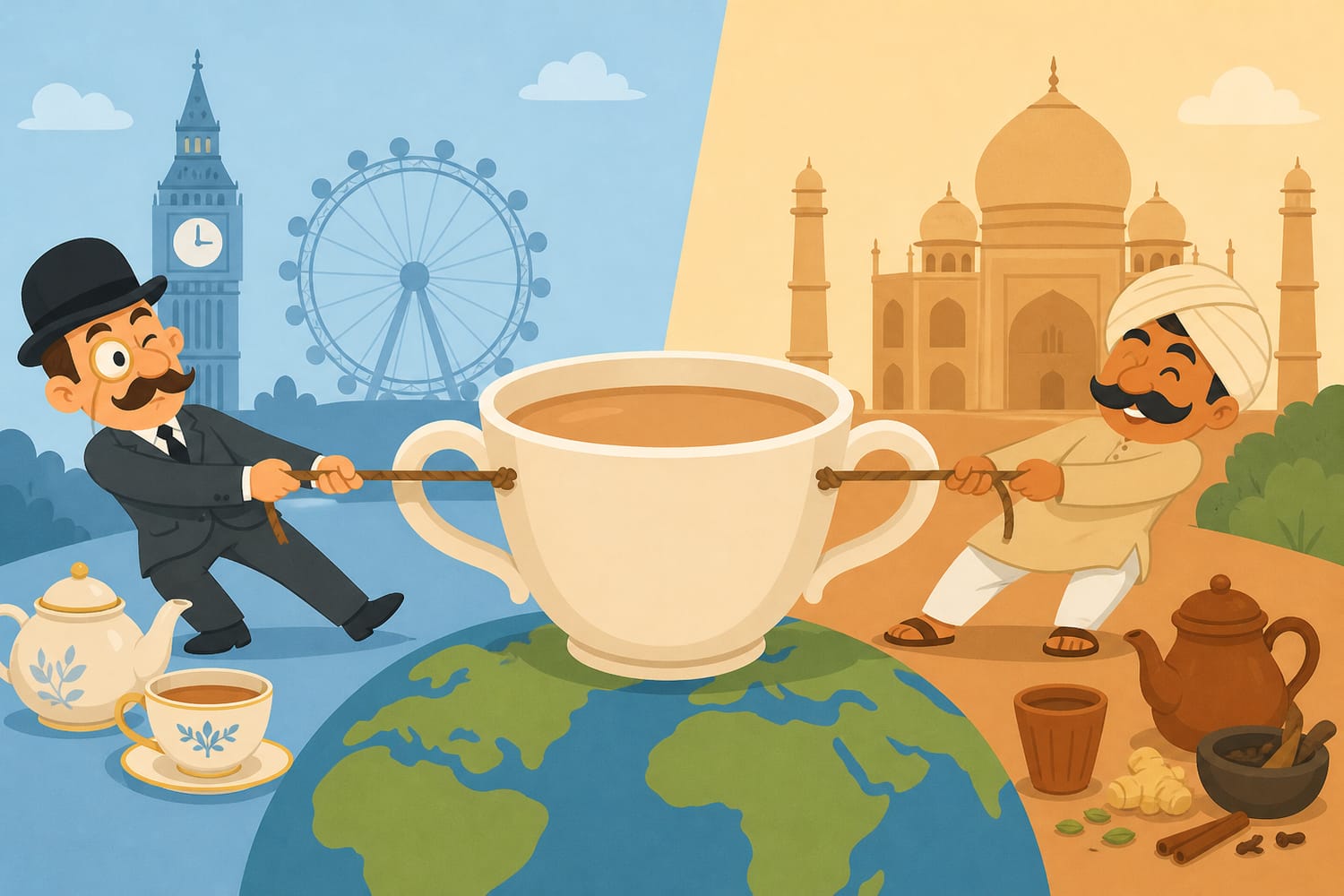
Two Names, One Cup
Why does an English speaker ask for tea while a Hindi speaker asks for chai? The two words trace back to different pronunciations of the Chinese character 茶. As tea traveled, traders and drinkers borrowed the version they heard. The result is a drink whose names preserve clues about centuries of contact between languages.
You can hear those clues in a few familiar words: English tea, French thé, Portuguese chá, Russian chai, and Turkish çay. They are not random labels for unrelated beverages. Most belong to two sprawling families, one sounding roughly like te and the other like cha. The fun part is finding out how both families ended up on the same menu.
The Split Began in China
Imagine two people looking at the same written character, 茶, and saying it differently. That is the starting point. In Mandarin it is pronounced chá; in Southern Min varieties spoken in parts of southeastern China, it has a form closer to te. Chinese is not a single spoken variety with one pronunciation for every character, and the differences mattered when visitors learned the name of the drink.
Tea comes from the leaves of Camellia sinensis. Its long history in China stretches back well before the drink became familiar in Europe. By the time tea and its name traveled widely, the pronunciation a newcomer encountered depended in part on whom they encountered.
That is a handy lesson in how words travel: people usually do not borrow a spelling from a distant language and then decide how to say it. They hear a word from other people, adapt its sounds, and pass it on. A small difference at one point of contact can become a large difference on a world map.
How Te Became Tea
In the early 1600s, Dutch traders acquired tea through trading networks linked to southeastern China and Southeast Asia. Southern Min-speaking communities used a te-like form, while Malay and Indonesian have teh. Historians cannot say with certainty whether Dutch traders learned the word directly in China, through communities in Southeast Asia, or through both. What is clear is that Dutch thee helped carry the t-form into western Europe.
From there, the family resemblance is easy to spot: English has tea, French thé, Spanish té, and Italian tè. Their spellings differ, but the opening t gives away their shared naming route. English even seems to have pronounced tea more like “tay” before its modern “tee” pronunciation settled in.
None of this means the Dutch invented tea, or that every European language got its word directly from Dutch. It means trade created opportunities for a particular pronunciation to spread. The leaves were the product; the name traveled alongside them, changing a little as each language made it its own.
How Cha Became Chai
Meanwhile, pronunciations closer to cha spread through other networks of contact, including routes across Asia. The resemblance appears in Hindi and Urdu chai, Persian chāy, Russian chai, and Turkish çay. In these languages, a chai-like word is generally the ordinary word for tea—not automatically a request for spices or milk.
The final -i or -y in many of these forms has its own history. Linguist Dan Jurafsky notes that Persian is a likely source of the ending in chai. So even within one word family, you can hear another stage of its journey.
It is tempting to picture a single tea caravan setting off from China and delivering the same word, unchanged, to every stop. Real trade and language contact were messier. People passed goods and names through neighboring languages, and each new speaker could reshape what they heard. For more on that habit, Uncover Words explores the words we borrowed—and never gave back.
Does “Tea by Sea, Chai by Land” Hold Up?
Mostly—as a memory aid, not a law. Tea and te-type words often spread along maritime trade routes associated with southeastern China and the Dutch. Cha-type words often followed connections across Asia. The Horniman Museum’s account of chá, chai, and tea uses that contrast to explain the broad pattern.
Then Portuguese enters the room and cheerfully ruins the neat rule. Portuguese uses chá, even though Portuguese traders reached China by sea. Their trading connections ran through Macao, where they encountered a cha-type pronunciation rather than the te-type form associated with the Dutch route. The useful question is not simply “Land or sea?” but “Which speakers supplied the name?”
The pattern also has limits beyond Portugal. An analysis in the World Atlas of Language Structures’ chapter on tea sorts many languages into the cha and te families, but it has an “others” category too. Not every word for tea fits tidily into a two-color map.
Why Does “Chai” Mean Something Different at an English-Speaking Café?
Suppose you order chai in an English-speaking café. You will probably receive a sweet, milky, spiced drink rather than an unadorned cup of tea. In North American English, chai often refers specifically to masala chai. Across many other languages, however, the word simply means tea. Context has narrowed the word’s meaning in English.
Masala refers to a spice mixture. A masala chai may contain black tea, milk, sugar, and spices such as ginger, cardamom, or cinnamon, but there is no need to imagine one recipe that every household follows. Compare two cups and you may find they share a name while tasting quite different.
That is why “chai tea” gets a playful objection: taken across languages, it amounts to something like “tea tea.” Yet in English it serves a practical purpose. A customer may use chai tea to distinguish a spiced drink from the other teas on a menu. It is not proof that the customer does not know what chai means elsewhere; it is an example of a borrowed word acquiring a more specific job.
English has made room for both members of the family. Its everyday word tea follows the te route, while chai arrived with a different cultural association. The same drink can come with several layers of meaning, depending on who is speaking and where. Food and drink often carry that social weight: even a greeting such as “Have you eaten?” can mean more than its literal words suggest.
What Your Cup Can—and Cannot—Tell You
A word for tea can hint at historical relationships, but it cannot give you a complete itinerary. It does not prove that every cup in a country arrived by one route, or that people everywhere prepare it the same way. Trade, migration, and colonial expansion brought languages and food cultures into contact, often under unequal conditions; the names that remain are traces of that larger history. Uncover Words looks more closely at how colonialism shaped everyday vocabulary.
Still, the next time you see tea and chai on the same menu, pause for a second. Those four- and three-letter words began with pronunciations linked to the same Chinese character. One became English’s general name for the drink; the other took on a narrower meaning there, while remaining an everyday word for tea elsewhere. It is a remarkable amount of history to fit beside a teaspoon.