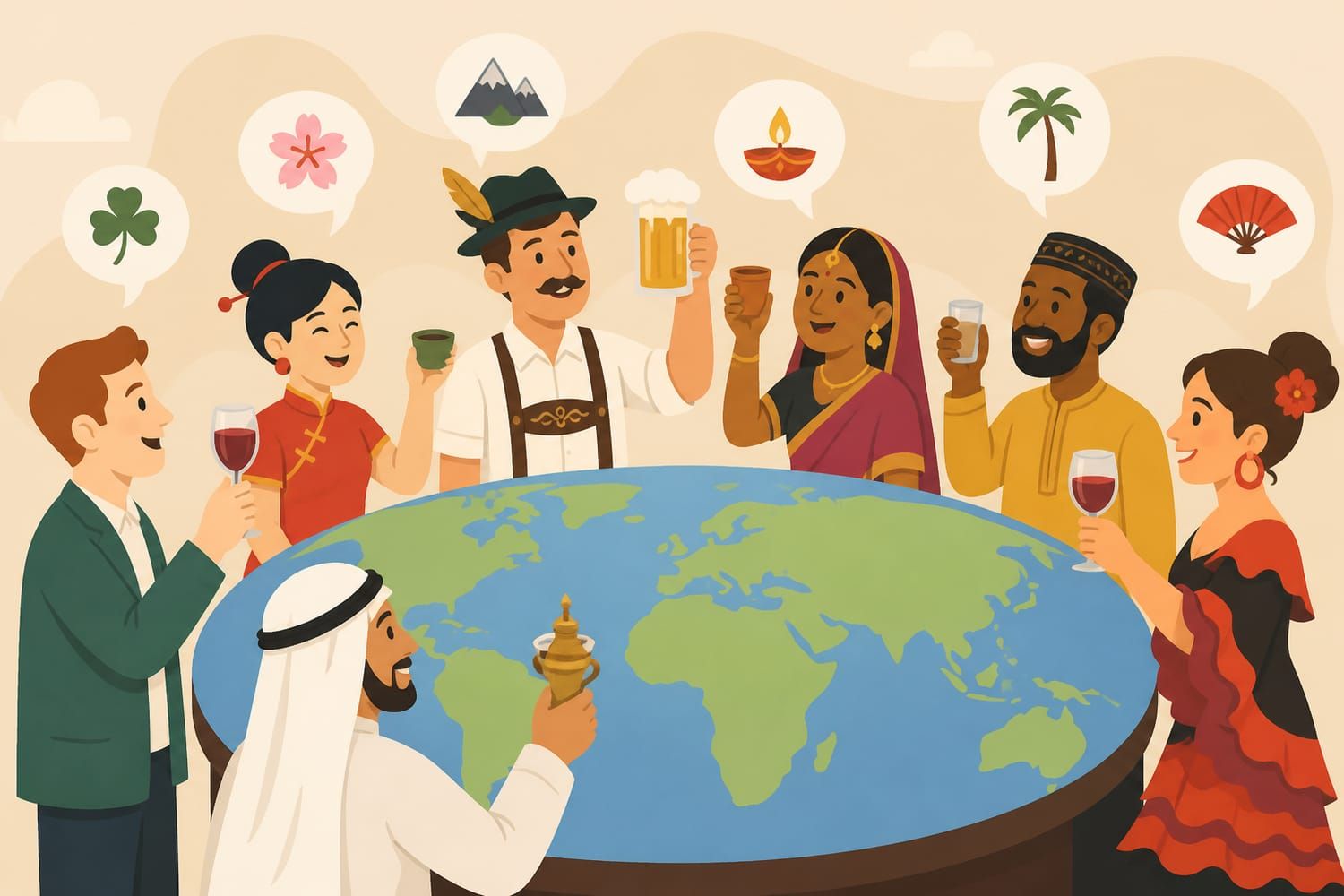
What People Say Before the First Sip: Toasts Around the World
One Small Word, a Whole Table of Meaning
What do people say before the first sip? Depending on where you are, the answer might mean “health,” “life,” or “empty your cup.” A toast can be a single cheerful word or a speech long enough for dinner to cool. Either way, it briefly turns a drink into a shared occasion.
Picture a table just before everyone begins. Glasses rise. Someone looks around to make sure nobody has been left out. Then comes a word—cheers, salud, kanpai—and the moment moves from waiting to celebrating.
That is what makes toasts so interesting to language lovers. The words are short, but they carry wishes, social cues, and sometimes instructions. Learning what they mean is useful; noticing when people say them is even better.
To Your Health: A Wish That Travels Well
If you collected toasts by meaning rather than by country, you would soon have a crowded “health” section. Spanish speakers may say ¡Salud!; French speakers, Santé !; Portuguese speakers, Saúde! The words look and sound different, but each can turn a raised glass into a wish for well-being.
Irish Sláinte! belongs in that company, too: it means “health.” Its spelling may give an English speaker pause, but the wish is wonderfully direct. You do not need a poetic speech to tell the people beside you that you hope they stay well.
A toast is not a medical prediction, of course. It works more like a greeting: its social purpose matters as much as its literal meaning. In that sense, it has something in common with asking someone “Have you eaten?” as a greeting. The question is not always a request for a meal report, just as salud is not a request for your latest checkup.
To Life, Goodwill, and the People in Front of You
Not every toast names health. In Jewish celebrations, l’chaim means “to life.” It is both compact and expansive: two words in English can point toward all the ordinary and extraordinary things worth celebrating. At a gathering, it can simply be a warm blessing shared among friends.
English cheers is looser. It does not tell you exactly what to wish for; it supplies a little burst of goodwill and lets the occasion fill in the details. A birthday, a new job, a reunion after years apart—or the arrival of pizza—can all receive the same word.
German Prost! and Scandinavian Skål! are similarly handy sounds to recognize when glasses go up. Skål is used in Swedish, Danish, and Norwegian; it is a useful reminder that a language guide is not a neat list of one toast per country. Languages cross borders, and one table may bring together people who know several ways to say the same thing.
That variety is part of the fun. As with greeting styles around the world, the phrase is only one piece of the exchange. The company, the occasion, and the way everyone responds help give it meaning.
“Dry Cup”: When a Translation Needs Context
Two famous East Asian toasts offer a particularly good lesson in why literal translations need care. Japanese kanpai (乾杯) and Mandarin Chinese gānbēi (干杯) use characters that convey the idea of a “dry cup.” Both are familiar words for raising a drink. But knowing that literal sense does not, by itself, tell you how much to drink.
In Japan, the timing can matter more than the quantity. At a group gathering, people commonly wait for the opening toast before drinking. A work event may begin with speeches; among friends, a simple kanpai may be all the ceremony required. The Japan National Tourism Organization’s guide to drinking etiquette puts the first instruction plainly: wait for the toast.
In Chinese banquet settings, gānbēi can more strongly suggest “bottoms up.” That distinction is worth knowing before cheerfully calling it across a table. China Daily’s explanation of gānbēi and suíyì notes that suíyì—“as one pleases”—can instead signal that people should drink as much as they wish.
Neither word is a universal command governing every gathering. The practical lesson is to listen to the host, watch what the group is doing, and avoid assuming that a phrase’s dictionary meaning gives you the whole etiquette manual.
When “Cheers” Becomes a Speech
Some tables give the toast much more room. At a Georgian supra, or feast, a tamada leads the toasts. Rather than offering one quick word before everyone drinks, the tamada may speak about love, health, peace, or the people gathered together. The order and themes can vary by region and occasion.
That changes the role of the first sip. Waiting is not merely a matter of catching the right cue; it gives the speaker time to say why everyone has gathered. Georgia’s tourism authority describes the tamada as someone who guides the atmosphere with stories and thoughtful words—not someone whose job is to drink the most. Its guide to the Georgian supra offers a fuller look at the tradition.
The contrast with a one-word toast is striking, but the purpose is familiar. Both forms draw attention away from the glass for a moment and toward the people holding the others.
How to Join In Without Making It Awkward
You do not need to memorize dozens of pronunciations to be a considerate guest. A little attention will usually serve you better than a perfectly delivered word at the wrong moment.
- Wait a beat. If everyone is holding a drink but nobody has sipped, an opening toast may be coming.
- Follow the person leading. A quick word calls for a quick response; a heartfelt speech deserves your attention.
- Use a word you understand. Salud is easier to say sincerely when you know you are wishing people health.
- Let others choose their drink and pace. Joining the good wishes need not mean matching what is in anyone else’s glass—or how quickly they empty it.
These are habits, not a claim that every table follows identical rules. Just as people can answer a phone in different ways within the same language, a family gathering and a formal dinner can have different rhythms. The best guide is often the group in front of you.
The First Sip Is Really About What Comes Before It
A toast can wish you health, celebrate life, invite a sip, or open the floor to a story. Its words may last a second; its meaning depends on everyone taking part.
So the next time glasses rise, listen before you drink. You might hear a new word. More importantly, you will hear what the people at the table have chosen, for that brief moment, to celebrate together.