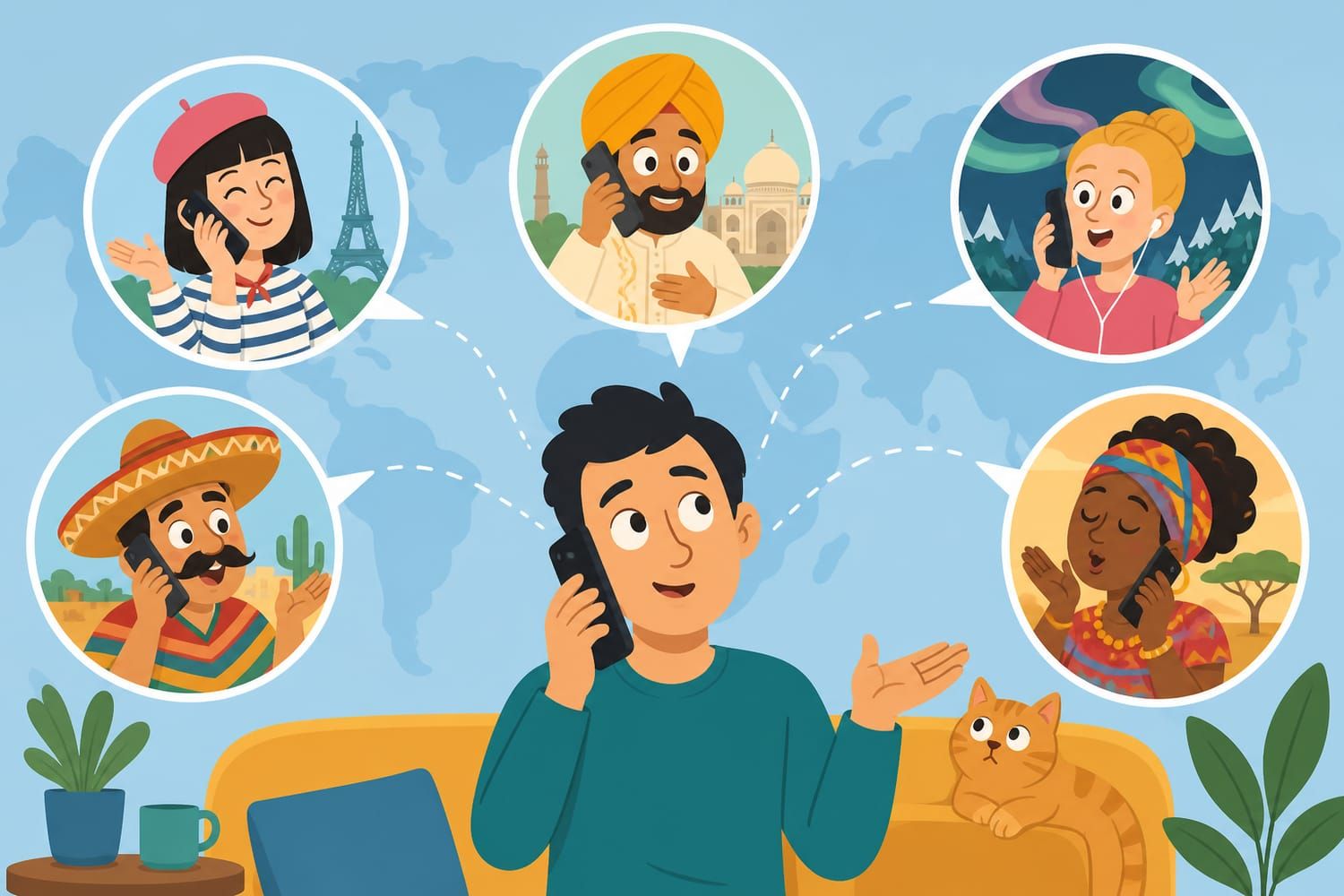
The Short Answer: Every Call Begins With a Tiny Sound Check
“Hello?” sounds different around the world because languages developed their own ways to solve the same telephone problem: how do you begin a conversation with someone you cannot see? Some people announce that they are listening. Others say they are ready, invite the caller to speak, identify themselves, or simply check that the connection works.
That first word may be brief, but it performs several jobs at once. It tells the caller, “I answered,” “I can hear you,” and “It is now your turn to explain why my phone is ringing.”
Before the Telephone, “Hello” Wasn’t Quite So Friendly
Today, English speakers use hello everywhere: in shops, emails, meetings, awkward elevator encounters, and conversations with pets who are ignoring them. Before the telephone became widespread, however, forms such as hallo, hullo, and hollo were often used to attract attention or express surprise.
In other words, hello was closer to “Hey, you!” or “What’s this?” than to a warm social greeting.
The telephone gave the word a major career change. According to the Thomas Edison Papers at Rutgers University, Edison proposed Hello! for telephone use in an August 1877 letter. He liked the fact that it could be heard from a distance. Alexander Graham Bell, meanwhile, reportedly favored the distinctly saltier Ahoy!
Edison did not invent the word hello. Versions of it had appeared in English decades earlier. What he helped do was promote it as a practical way to open a telephone connection. Telephone operators soon became associated so closely with the expression that they were nicknamed “hello girls.”
Had Bell’s preference won, we might now answer calls from the dentist with a cheerful “Ahoy!” The world would be slightly more nautical, although probably no less anxious about unknown numbers.
A Phone Greeting Is Not Always a Greeting
Face-to-face greetings and telephone openings may look similar, but they do not always serve the same purpose.
When you meet someone in person, you already know that contact has been established. You can see them standing there. A phone call removes that certainty, so its opening words often behave like a verbal handshake combined with a microphone test.
A telephone opener can:
- confirm that someone has answered;
- check whether the sound is clear;
- identify the person or organization;
- show whether the situation is formal or casual;
- invite the caller to begin speaking.
Linguists often describe socially useful expressions such as greetings as phatic communication. Their main purpose is not necessarily to exchange important facts but to establish and maintain human contact. “How are you?” often performs this role, as can food-based greetings explored in why some cultures ask “Have you eaten?”.
On the phone, this contact-building function becomes especially obvious. Before discussing dinner plans, quarterly earnings, or why someone has been trying to reach you about your car’s warranty, both speakers must first confirm that a conversation exists.
Ready, Listening, or Waiting: Phone Openers Around the World
A comparison of telephone greetings in different languages reveals that people do not all begin calls with a direct equivalent of English hello. Some expressions describe what the answering person is doing, while others hand the conversational floor to the caller.
| Language or region | Common telephone opener | Basic sense | |---|---|---| | English | Hello? | A greeting and contact check | | Italian | Pronto? | “Ready?” | | French | Allô? | A telephone-specific contact word | | Spanish in Spain | ¿Diga? or ¿Dígame? | “Speak” or “Tell me” | | Spanish in Mexico | ¿Bueno? | Literally “Good?” | | Polish | Tak, słucham? | “Yes, I’m listening” | | Dutch | Met + name | “With [name]” | | Danish | Det er + name | “It is [name]” | | Japanese, casually | Moshi moshi | A telephone attention signal |
These are common patterns, not unbreakable national laws. A French speaker may answer with a name, an Italian business may announce the company, and an English speaker who recognizes the caller might begin with “Hey!” or “What did you do?”
Age, region, relationship, setting, and caller identification all affect the choice.
Italy Is Ready
Italian pronto literally means “ready.” It is an admirably efficient telephone word: the receiver is lifted, the person announces readiness, and the caller may proceed.
It does not mean Italians spend their lives waiting beside telephones in a permanent state of preparedness. It is simply a conventional opening. Once an expression becomes attached to a situation, speakers rarely stop to examine its literal meaning.
English works the same way. We say “goodbye” without thinking about its history as a shortened form of “God be with ye,” and we say “hello” without imagining Edison enthusiastically testing early telephone equipment.
Spanish Lets the Caller Speak
In Spain, ¿Diga? or the more formal ¿Dígame? comes from the verb decir, meaning “to say” or “to tell.” As a telephone expression, it works like “Go ahead” or “I’m listening.”
Spanish also demonstrates why language guides must be careful with phrases such as “Spanish speakers say…” The Spanish-speaking world is enormous. ¿Bueno? is strongly associated with Mexico, while ¿Aló?, hola, sí, and other openings are heard in different countries and contexts.
A phone greeting can therefore reveal not only a language but sometimes a region within that language.
Some Speakers Simply Identify Themselves
Dutch speakers may answer with met followed by a name—effectively, “with Maria.” Danish speakers can use a construction meaning “it is Maria.”
This approach makes practical sense, especially on traditional household landlines. Before caller ID and personal mobile phones, callers could not always be certain who had answered. Stating a name immediately removed one layer of mystery.
Businesses still follow this logic around the world. “Good morning, Green Street Dental, this is Priya” is longer than “Hello?” but far more useful when several people could have picked up.
Why Japanese Says It Twice
Japanese moshi moshi may be one of the world’s most recognizable phone expressions. Moshi is connected to mōsu, a humble form of the verb “to say.” The repeated form became closely associated with telephone conversations, although it is not simply the everyday Japanese equivalent of hello.
Repetition also makes the expression easy to recognize across an uncertain connection. Early telephone lines were hardly famous for crystal-clear sound, so a distinctive repeated phrase had obvious practical value.
Importantly, moshi moshi is mainly casual. As Tofugu’s guide to Japanese telephone language explains, business calls generally require more formal openings, often beginning with hai (“yes”) followed by the company and speaker’s name.
So answering every Japanese call with moshi moshi because you heard it in a movie is a little like beginning every English business call with “Hey there!” It might work—but perhaps not during a conversation with the bank manager.
Why English “Hello?” Rises at the End
Even when the word stays the same, telephone intonation can change its meaning.
Compare these three versions:
- “Hello!” — warm, definite, and greeting-like.
- “Hello?” — cautious, questioning, and checking for contact.
- “Hellooo?” — either the connection has failed or someone is becoming impatient.
The rising pitch of telephone Hello? makes sense because the speaker is not merely greeting the caller. They are also asking an unspoken question: “Are you there?” The answerer has opened the channel but does not yet know who is speaking or what will happen next.
That tiny upward movement turns a familiar greeting into a request for confirmation.
Technology Changes, but the Ritual Survives
Modern phones have removed much of the uncertainty that shaped traditional telephone language. Caller ID may tell us who is calling. Video calls let us see the other person. Messaging apps can display a profile photograph, name, typing indicator, and perhaps far more information than anyone requested.
Yet the opening ritual remains.
Even when both people know exactly who is on the line, they often begin with hello, allô, pronto, or moshi moshi. The practical sound check has become a social convention. It marks the boundary between silence and conversation.
Phone habits are evolving, of course. Friends may answer with a joke. Younger speakers may use greetings borrowed from global media. In professional settings, scripted introductions are increasingly common. Greeting customs have always adapted as cultures meet and technologies change, a broader pattern seen in how greeting styles reflect social expectations.
One Ring, Many Ways to Say “I’m Here”
Telephone greetings differ because languages do more than label objects. They create little social routines for handling unfamiliar situations.
English calls for attention. Italian announces readiness. Polish says, “I’m listening.” Spanish may invite the caller to speak. Japanese repeats a carefully specialized expression. Dutch and Danish can identify the answerer immediately.
Different words, same basic message: the connection is open, another human being is present, and the conversation may begin.
That is a remarkable amount of work for one tiny word—especially when half the time the next sentence is, “Sorry, I think you have the wrong number.”