The Short Answer: Family Trees Do Not Look the Same in Every Language
Some languages use separate words for maternal and paternal grandparents because their kinship vocabularies track the exact route through a family tree. These distinctions may reflect historical family organization, inheritance, household roles, or simply patterns inherited from earlier generations of speakers. In other words, vocabulary turns genealogy into a convenient verbal map.
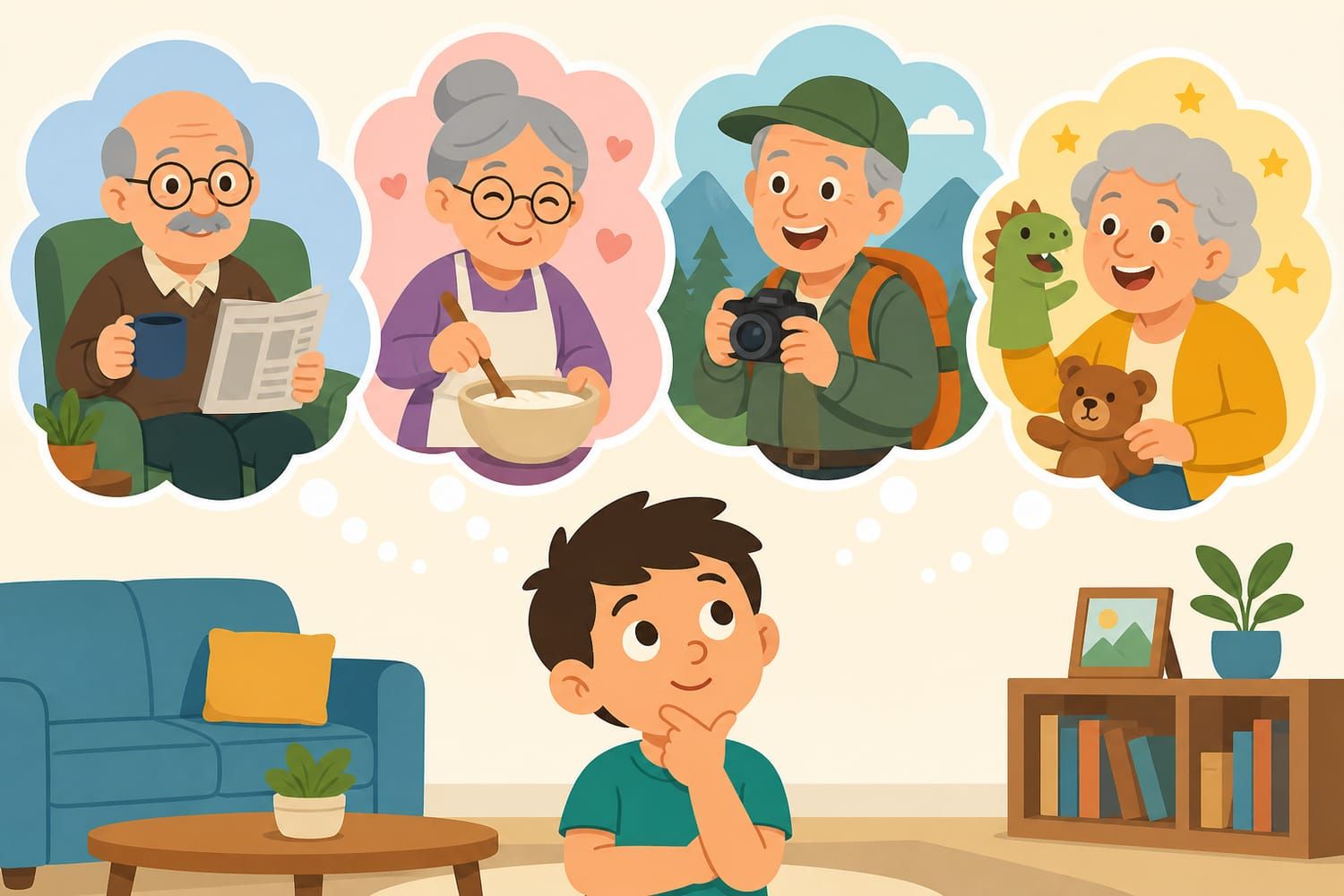
English Puts Four People Into Two Boxes
In English, grandmother can mean either your mother’s mother or your father’s mother. Grandfather works the same way. If the distinction matters, we add an adjective or explanation:
- Maternal grandmother
- Paternal grandmother
- Mother’s father
- Dad’s mom
Most of the time, context does the work. “My grandfather taught me to fish” is usually clear enough, even if the listener does not know which branch of the family supplied the fishing lessons.
English-speaking families also create their own solutions. One grandmother may be Grandma, another Nana, and a third bonus grandparent might be Gran, Mimi, Gigi, or a completely original name invented by a toddler. These nicknames distinguish individuals, but they do not automatically explain the relationship.
Other languages build that information directly into their everyday vocabulary.
Swedish Grandparents Come With Directions
Swedish offers a wonderfully transparent example. Its common grandparent terms are compounds made from words for mother and father:
| Swedish word | Literal structure | Meaning | |---|---|---| | mormor | mother-mother | Mother’s mother | | morfar | mother-father | Mother’s father | | farmor | father-mother | Father’s mother | | farfar | father-father | Father’s father |
The first part tells you which parent connects you to the grandparent. The second tells you whether the grandparent is a woman or man. Cambridge Dictionary’s Swedish translations of “grandfather” consequently include both morfar and farfar.
This system is precise without being complicated. If someone says, “My morfar lived by the sea,” a Swedish listener immediately knows the speaker means their mother’s father. No follow-up family-tree interrogation is required.
The same building-block approach extends to other relatives in Swedish. Different terms can identify a mother’s brother, a father’s brother, a sister’s son, or a brother’s daughter. To English speakers, that may initially resemble a genealogy exam. To Swedish speakers, it is simply family vocabulary.
Mandarin Also Maps the Two Sides of a Family
Common Standard Mandarin terms similarly distinguish paternal and maternal grandparents. A father’s father is often yéye (爷爷), while a father’s mother is nǎinai (奶奶). A mother’s father may be wàigōng (外公), and a mother’s mother wàipó (外婆). Collins, for example, lists separate maternal and paternal translations for “grandfather” in Chinese.
The character wài (外) literally carries a sense of “outside” or “external.” Historically, this distinction was connected to patrilineal family organization, in which descent, surnames, property, and ritual responsibilities were frequently associated with the father’s line.
That history should not be turned into a sweeping claim about modern families. A word’s origin does not tell us how affectionate someone is toward a particular grandparent today. Language can preserve an old social map long after households and attitudes have changed.
Chinese kinship vocabulary also varies considerably by region and language variety. In northern Mandarin, maternal grandparents may be called lǎoye and lǎolao, while families elsewhere use other forms. A study of Chinese dialects examined grandparent terminology across hundreds of locations, demonstrating just how much diversity can exist within what outsiders casually call “Chinese.”
Hindi Makes the Same Distinction With Different Roots
Many Hindi-speaking families use four familiar terms:
- Dada — father’s father
- Dadi — father’s mother
- Nana — mother’s father
- Nani — mother’s mother
Unlike the Swedish compounds, these words do not present learners with an immediately visible “mother-father” formula. They must be learned as separate vocabulary. Once learned, however, they deliver the same useful information.
Imagine hearing, “My nani makes the best mango pickle.” A person familiar with the terms knows not only that the speaker means a grandmother, but specifically their mother’s mother. English needs at least two words—“maternal grandmother”—to communicate what nani handles alone.
Similar distinctions appear in numerous languages, although the particular categories and terms differ. Some systems also mark whether an aunt is older or younger than a parent, whether an uncle is related by birth or marriage, or whether a cousin belongs to the maternal or paternal side.
Why Do Languages Choose Different Family Categories?
Linguists and anthropologists call these systems kinship terminologies: the sets of words people use to identify and address relatives. They are not merely lists of biological relationships. They are culturally and historically developed ways of grouping people.
The International Encyclopedia of Anthropology’s overview of kinship terminology describes these vocabularies as culturally specific ways of representing genealogical connections. Meanwhile, the open-access Kinbank global database shows the remarkable variety of family categories found across languages.
Several forces can help shape these systems.
Family Organization
Where extended families regularly share homes, work, childcare, property, or ceremonial responsibilities, knowing exactly how someone is related may be practically important.
Descent and Inheritance
Some societies have historically emphasized descent through the father’s line, the mother’s line, or both. Kinship words may preserve those distinctions even after inheritance laws and household arrangements change.
Social Roles
Two people whom English calls “uncles” may have different expected duties in another community. Separate words make those roles immediately recognizable.
Linguistic History
Not every distinction exists because speakers consciously decided it was culturally important. Languages inherit words, lose them, borrow alternatives, and change their meanings. A modern pattern may be the surviving result of centuries of ordinary language change.
This is one reason we should avoid treating vocabulary as a perfect X-ray of a culture. It offers clues, not a complete diagnosis.
More Words Do Not Necessarily Mean More Love
It is tempting to assume that a language with four grandparent terms must value grandparents more than English does. That conclusion would be too simple.
Vocabulary measures conventional distinctions, not emotional intensity. English has one everyday word for cousin, but English speakers can still be extremely close to their cousins. Swedish distinguishes four kinds of grandparents, but that does not guarantee that every Swedish family is close-knit.
The same caution applies when exploring what the word “home” reveals about cultural values. Words can reflect shared histories and habits, but individuals do not all live according to a single cultural script.
Sometimes actions carry more emotional information than labels. As seen in cultures where people may ask “Have you eaten?” instead of “How are you?”, ordinary language can express care in ways that are easy for outsiders to miss.
Addressing a Grandparent Is Different From Describing One
Kinship vocabulary becomes even more interesting when we separate terms of reference from terms of address.
A term of reference describes someone: “She is my paternal grandmother.” A term of address is what you call that person directly: “Hi, Grandma!”
A language may have an exact formal term for a relationship while families use affectionate names at home. Migration and multilingualism add further possibilities. A child might describe someone as their maternal grandmother in English, call her nani at home, and refer to her by a family nickname when speaking directly to her.
Age, region, formality, and personal preference can all affect the chosen word. Kinship language often communicates respect as well as genealogy, connecting it to the broader question of how languages express respect across societies.
Every Kinship System Gains and Loses Something
English makes some family relationships pleasantly simple. You do not need to know exactly how an aunt is connected before calling her your aunt. The word sibling is also conveniently gender-neutral, while newer terms such as grandparent can work well in families whose members do not identify as male or female.
More detailed systems offer a different advantage: precision. They can place a relative on the family tree with a single word, avoiding repeated explanations about whose mother’s father is visiting for dinner.
Neither approach is inherently better. Each language compresses information in its own way. One packs four grandparents into two broad categories; another gives each a clearly labeled seat at the table.
The charming result is that family vocabulary does more than name relatives. It reveals how languages organize one of humanity’s oldest and most important networks—while reminding us that even something as familiar as “Grandma” can look surprisingly different from another branch of the linguistic family tree.