Why Is a Group of Crows Called a Murder?
A group of crows can be called a murder. It’s one of many colorful animal group names, or collective nouns, that English has collected over the centuries. Some, like flock and herd, are ordinary workhorses. Others, like a parliament of owls, sound as though the animals have scheduled a meeting.
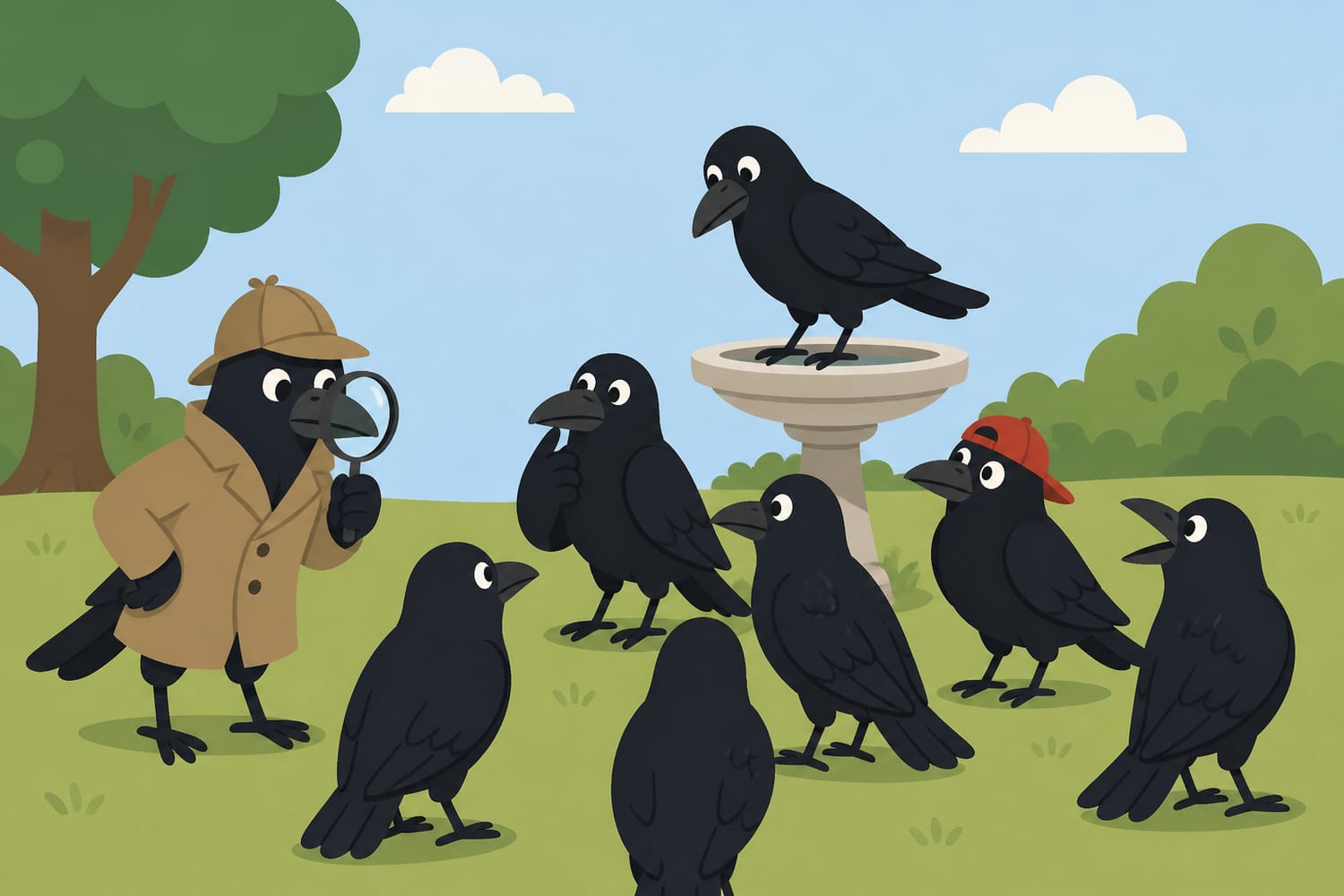
Picture several crows gathering in a tree. “A flock of crows” tells you what you’re seeing. “A murder of crows” gives the scene a soundtrack, a thundercloud, and possibly a detective. Why does English offer both—and do you actually have to say murder?
From Hunting Vocabulary to Wordplay
Many unusual animal group names belong to a tradition called terms of venery. Venery refers to hunting, an activity with its own specialized vocabulary in medieval England. Knowing an impressive assortment of terms could make a person sound well acquainted with the sport.
One famous collection appeared in The Book of Saint Albans, printed in 1486. Its list mixed useful expressions, such as a herd of deer, with much more playful ones. It even included names for groups of people. Apparently, once you start naming gatherings creatively, it’s difficult to stop at animals. Language researcher Michael Quinion offers a lively account of the distinction between everyday animal group names and their more fanciful cousins.
There’s a historical trap here, though: not every famous group name appears in that book. Neither a murder of crows nor a parliament of owls is in its 1486 list. The book is an important chapter in the story, not the source of every phrase people now call “medieval.”
Crows, Owls, and Other Birds with Excellent Publicists
A murder of crows
Why such a grim name? Crows’ historical association with death offers a plausible explanation. As scavengers, crows and other members of their family could gather where animals—or people—had died. People supplied the sinister interpretation; the birds were looking for food, not plotting a crime. The precise reason this particular phrase caught on, however, isn’t certain.
That distinction makes murder more interesting, not less. The word tells us something about how humans once regarded crows. It doesn’t tell us that crows are unusually wicked.
A parliament of owls
A parliament of owls invites an irresistible mental picture: solemn birds on branches, each waiting for its turn to speak. Owls have a reputation for wisdom in art and stories, which makes the phrase feel wonderfully apt. But it’s a poetic label, not evidence that owls hold meetings. You can say a group of owls and leave the legislative business to humans.
A murmuration of starlings
Some group names capture a sight as well as an animal. Murmuration is a name for a group of starlings, especially familiar from the sight of large flocks wheeling through the sky. Cornell’s bird experts describe how starlings coordinate with nearby flockmates to produce those shifting shapes. It can look like one enormous creature changing its mind midair, though it’s many birds responding to one another.
Bird names also show English’s taste for drama and sound: an exaltation of larks seems to lift off the page, while an unkindness of ravens gives another dark bird a rather unfair character assessment. If it’s the noise of a gathering you want to describe, our look at cacophony and euphony explores two more words that can change the feel of a scene.
When the Name Fits the Picture
Birds don’t have a monopoly on memorable group names. A pride of lions is familiar enough to sound perfectly normal—until you pause to notice that pride is also a human feeling. A swarm of bees, meanwhile, is so useful that its poetry is easy to miss. Both expressions were recorded in the Book of Saint Albans, yet they feel far more at home in everyday conversation than most names in that old list.
Then there’s a flamboyance of flamingos. It’s hard to imagine a more fitting word for a gathering of long-legged pink birds. The Smithsonian’s National Zoo notes that stand and colony are other names for a flamingo group. Even the color has a less fanciful explanation than the name: pigments in their food help turn their feathers pink.
A raft of sea otters is pleasingly practical. Monterey Bay Aquarium uses raft for a group of sea otters, including those swimming together among kelp. It’s the sort of term that makes sense the moment you picture its animals.
And if birds have sent you down a word-research rabbit hole, a group of turkeys can be called a rafter—but a single turkey has an odd word of its own. The fleshy appendage above its beak is a snood, which also has meanings connected to clothing. You can meet all of them in our guide to the wonderfully versatile word snood.
Is “Murder” the Correct Word for Crows?
Yes—but “flock of crows” is correct too. These expressions aren’t official titles that must be used whenever the animals appear. Some group names are standard, practical English; others survive mainly because they’re delightful to say.
That difference matters. In an Audubon essay, birder Nicholas Lund makes the case for calling birds flocks rather than reaching for elaborate terms such as murder or parliament. His point isn’t that the playful phrases don’t exist. It’s that they’re rarely needed to describe birds clearly.
Think of the unusual names as options, not rules. Writing a wildlife report? A flock of crows gathered in the trees gets the job done. Telling a spooky story? A murder of crows gathered in the trees gives you atmosphere before anything else happens.
The Best Way to Use a Strange Animal Group Name
Choose the word that helps your reader see what you mean. Herd, flock, school, pack, and group are reliable when clarity comes first. Save a more theatrical name for a moment when its sound, history, or humor adds something.
It’s also worth being cautious with any long list that promises the “one correct name” for every creature. These terms come from different times and traditions; some are widely used, while others are chiefly literary curiosities. A charming phrase can be worth sharing without pretending it’s a rule of zoology.
So the next time you spot crows overhead, you have a choice. Tell a friend you saw a flock, and they’ll know exactly what you mean. Tell them you saw a murder, and they may look up a little faster.