A Snood Is Two Things You Probably Weren’t Expecting
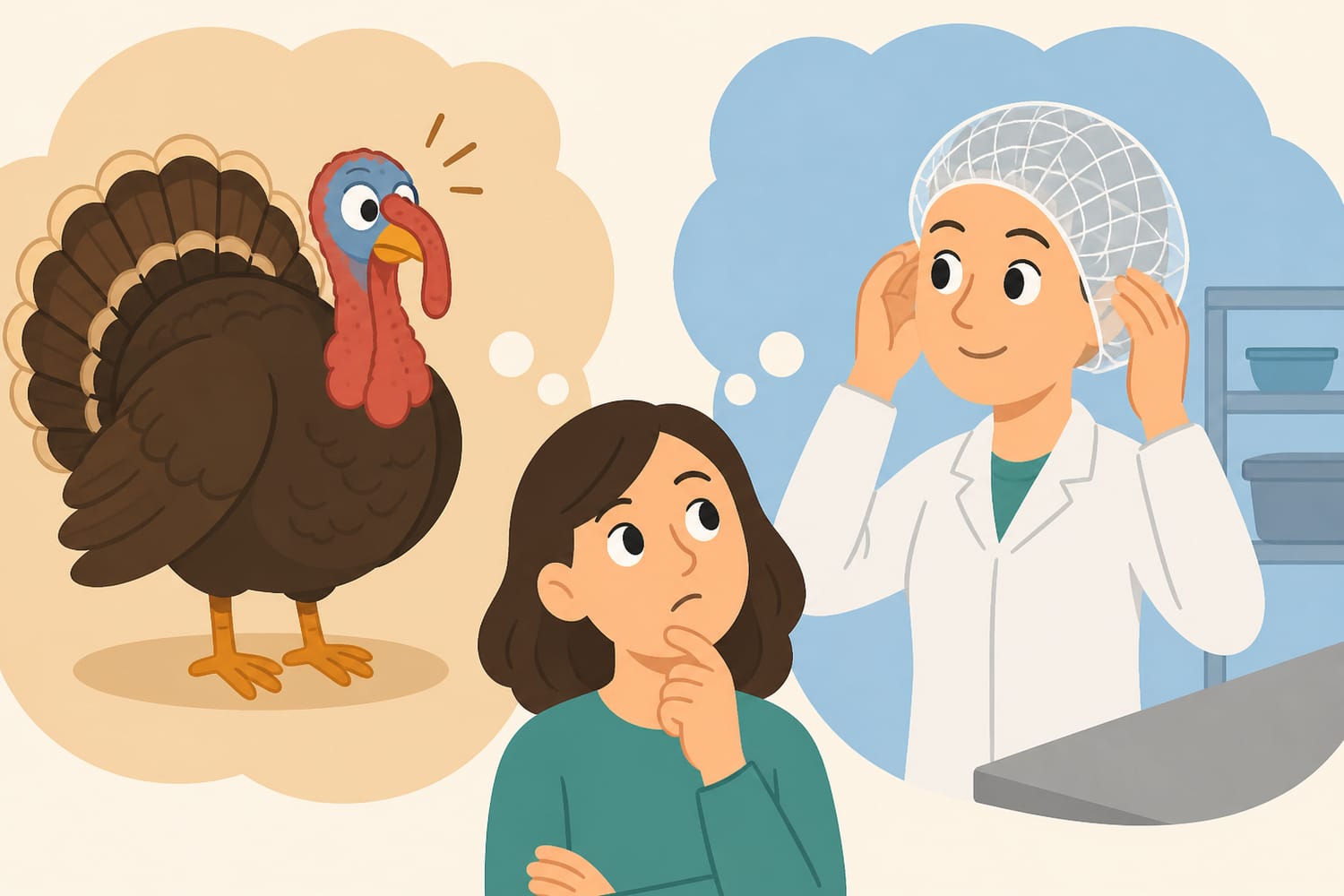
A snood (pronounced snood, rhyming with food) can be a netlike covering that holds hair at the back of the head. It can also be the fleshy appendage that hangs over a turkey’s beak. Those meanings sound like they belong in different dictionaries, but they share one wonderfully odd word.
Picture the scene: Someone says, “Look at that snood,” and you have to work out whether you’re admiring a hairstyle or staring at a turkey. Fortunately, the turkey rarely wears a hairnet, so context usually clears things up.
The Turkey Snood: Which Dangly Bit Is It?
A turkey has enough unusual features to make naming them a team effort. To find the snood, look above the beak. It grows from the bird’s forehead near the base of the beak and, especially on a male, can hang down over it. Female turkeys have snoods too, but the appendage is generally more prominent on males.
It is easy to mistake the snood for another piece of turkey anatomy. Here is the quick identification guide:
- Snood: The fleshy appendage attached above the beak.
- Wattle: The loose skin beneath the beak and throat.
- Caruncles: The fleshy bumps on the head and neck.
- Beard: The bristle-like tuft projecting from the chest.
That last one is particularly unfair to anyone trying to memorize the parts. The bird has something called a beard, but it does not grow on its chin. The University of Kentucky’s guide to turkey anatomy includes labeled pictures if you want to settle a Thanksgiving-table argument without drawing a turkey on a napkin.
A useful memory trick: the snood starts up top; the wattle hangs below. Once you know where to look, a turkey’s face becomes less of a collection of mysterious flaps.
Does a Turkey’s Snood Actually Do Anything?
It does more than give the bird a memorable profile. A male turkey’s snood can lengthen during a courtship display. Its appearance is part of the visual performance that includes other conspicuous head features and, of course, that impressive fanned tail. The appendage is living tissue, not a stray feather or a piece of skin that happens to be in the way.
Researchers have also tested whether snood length matters to other turkeys. In a study of wild turkeys and mate choice, females preferred males with longer snoods. Among the wild males examined, longer snoods were associated with lower levels of a particular intestinal parasite measured in their droppings. That makes the snood a possible signal of a male’s condition—not a foolproof health certificate dangling from his forehead.
That distinction is worth keeping. A long snood does not mean every turkey hen will choose that bird, and looking at a snood alone cannot tell you everything about its owner’s health. Still, it is a good reminder that a feature humans might describe as “that funny thing on its nose” can carry information to another animal. Also, it is not on the turkey’s nose.
From Turkey Heads to Human Hair
The other familiar snood is a hair covering: typically a netlike bag worn over hair gathered at the back of the head. Think of it as something that contains a hairstyle rather than a tiny hat balanced on top of one. A snood might be decorative as well as practical, with the gathered hair visible through the net.
But the word did not begin with the modern bag-shaped hairnet. Its older meanings referred to a ribbon or band used to bind hair. The American Heritage Dictionary’s entry for snood traces the word through Middle English to Old English snōd. In some historical settings, particularly in Scotland, a hair ribbon called a snood was associated with young unmarried women.
That gives the word a longer and more varied wardrobe than “old-fashioned hairnet” suggests. An early snood might be a band securing hair; a later one might be a net holding it. The modern baglike hairnet meaning was in use by the 1930s, according to the Online Etymology Dictionary. Calling every old hairnet a “snood” can therefore blur the difference between an old object and a newer name for a particular style.
If you enjoy discovering that everyday things have unexpectedly specific names, meet the tittle above a lowercase i or j. Unlike a snood, it is unlikely to appear on a turkey.
So How Did a Hair Word End Up on a Turkey?
It is tempting to invent a tidy story: someone looked at a turkey, thought its appendage resembled a hair ribbon, and declared, “Snood!” That might sound plausible, but without a clear record of the naming moment, it remains a guess.
What we can say is that the human hair-related sense is old, while dictionaries also record snood as the name of the turkey appendage. The resemblance between a dangling strip and a ribbon makes the pairing easy to remember, but we should not mistake a helpful mental picture for a proven account of how the bird acquired the name.
English is full of such encounters between specialized and everyday language. One conversation takes place at a hairdresser’s, another in a field full of strutting birds, and the same word turns up in both. If you like names for parts you have seen but never thought to label, the glabella—the space between your eyebrows—is another good one. It has considerably less competition from poultry.
Wait—Isn’t a Snood a Scarf?
Sometimes, yes. In clothing, snood can also mean a broad loop of fabric worn around the neck and pulled up over the head. Cambridge Dictionary lists that scarf meaning alongside the hair-covering meaning. So if someone says they forgot their snood on a cold day, a neck warmer may be what they mean—not a hairnet, and certainly not a turkey.
The safest approach is to let the sentence do the work. “She tucked her hair into a snood” points to a hair covering. “He pulled his snood over his ears” suggests a scarf. “The turkey’s snood drooped over its beak” is your cue to look for the bird.
And yes, snoods is the plural in each case. You could theoretically discuss three snoods in one sentence while referring to a hair covering, a neck warmer, and a turkey appendage. Whether you should is a question for whoever has to edit the sentence afterward.
A Small Word With Excellent Range
Snood is the sort of word that rewards a second glance. On a turkey, it names a conspicuous bit of anatomy involved in display. On a person, it can hold hair or warm a neck. Its older history reaches back to bands and ribbons for hair.
The next time a turkey struts past—or a puzzling clothing description catches your eye—you will know exactly what to ask: “Which kind of snood?” That may not be a question you need every day, but it is a delightful one to have ready.