Meet the Pilcrow: That Little 
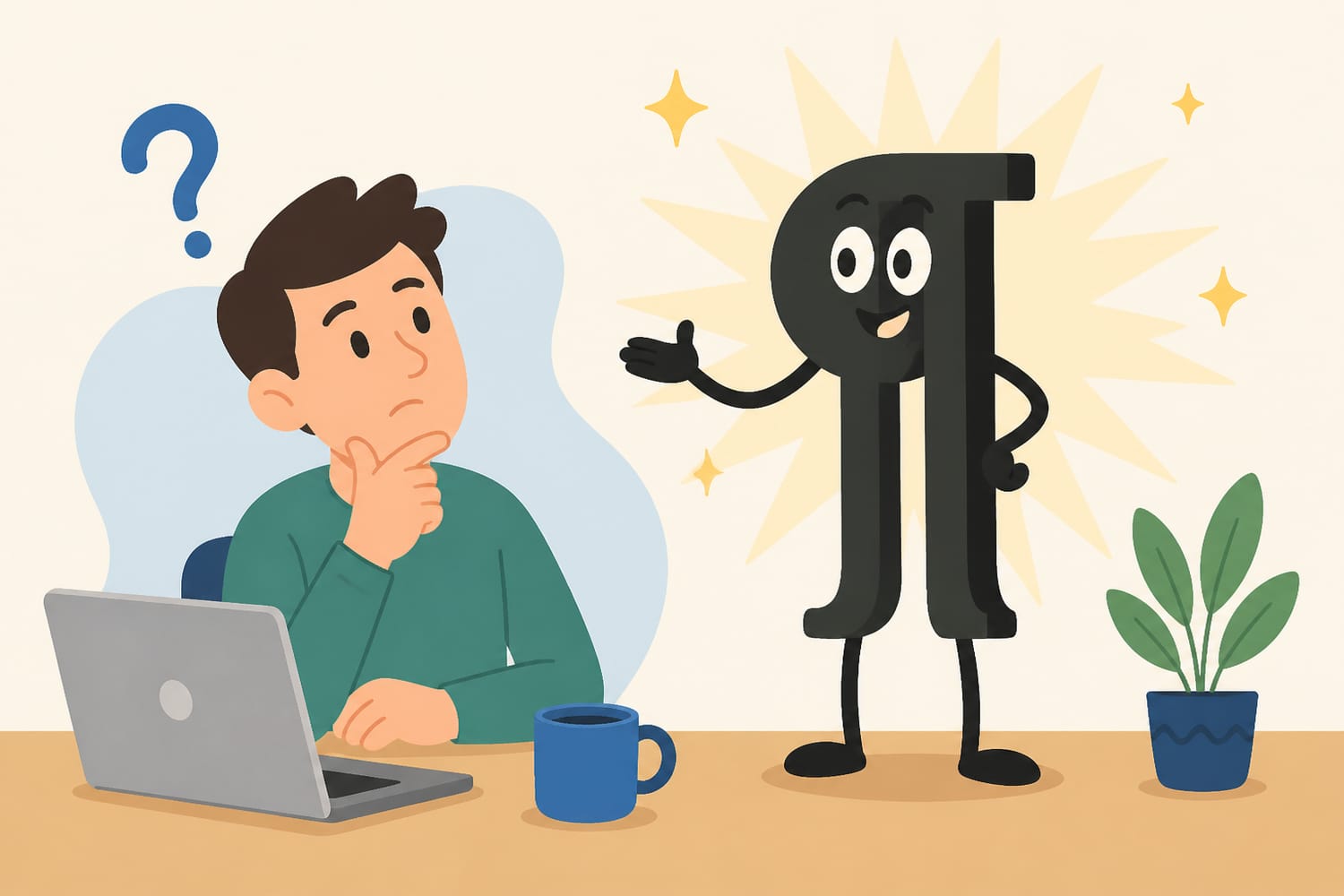
A pilcrow is the symbol ¶, also called a paragraph mark or paragraph sign. It signals a paragraph break. You might spot it on an editor’s marked-up page or at the end of a paragraph in a word processor when formatting marks are visible. Say its name PIL-kroh—a wonderfully grand name for a tiny sign doing a useful job.
Picture a capital P that got dressed in a hurry: its rounded part is filled in, and its stem appears doubled. Once you know what to look for, it’s hard to mistake. Once you know its name, it’s hard not to say it aloud at least once.
The oddest part? You’ve probably made thousands of paragraph breaks without realizing that this little character has spent centuries helping readers find them.
What Does a Pilcrow Actually Do?
Its basic message is simple: a new paragraph starts here. On a marked-up draft, an editor might place a pilcrow where a long block of text needs a break:
We searched the house for the missing key. ¶ Then we found it in the front door.
The mark tells the writer to start “Then” as a new paragraph. In the finished version, you’d normally see a line break, an indent, or spacing instead of the symbol itself.
A pilcrow can also be a visible part of a design. Used that way, it lets a writer separate thoughts while keeping the text running together. It’s a small sign with a big job: telling your eyes, “Pause here; we’re moving on.”
It isn’t the only typographic mark with a surprisingly specific name. The dot above a lowercase i or j, for example, is a tittle. English apparently looked at a printed page and decided every tiny detail deserved an introduction.
How Did ¶ Get That Shape?
Long before books looked like the neatly spaced pages we know, people still needed ways to show where one idea ended and another began. Different scribes used different signs. Over time, a C associated with the Latin capitulum—“little head,” or chapter—became one way to mark a new section. As people copied and embellished it, that C gained strokes and gradually took on the form we recognize as ¶.
That history explains why the pilcrow doesn’t really look like the letter P, despite its nickname-like appearance. Its shape came through the habits of people making and decorating pages, not through a plan to draw a backwards P.
Medieval manuscripts could feature pilcrows added in contrasting ink after the main text was written. Imagine copying a page by hand, leaving little gaps for another person to add the signs that would guide the reader through it. The pilcrow wasn’t an afterthought: it was part of how a dense page became navigable. For a closer look at that journey, Smithsonian Magazine’s history of the pilcrow follows the mark from manuscripts into early printed books.
Why Is It Called a “Pilcrow”?
No, it doesn’t mean “a crow on a pill.” The name has traveled a long linguistic route, with a few bumps along the way.
The family trail leads back toward words related to paragraph. The Online Etymology Dictionary traces pilcrow through the earlier English pilcraft and an Old French form, pelagraphe. It suggests that the ending may have been influenced by the familiar English word crow. Language took a word connected to “paragraph,” passed it from speaker to speaker, and arrived at something that sounds faintly like a bird with an unusual occupation.
There are two stories here, and they’re easy to mix up. The symbol’s shape developed from an old section-marking C; its English name evolved along a word-history path connected to paragraph. Same destination, different journeys.
Where Did All the Pilcrows Go?
If pilcrows once helped divide text, why aren’t they standing at the start of every paragraph in this article?
In late medieval books, scribes and early printers sometimes left room for decorative marks to be added later. Those additions didn’t always happen. The spaces remained, and the visible pilcrow became less necessary as ways of separating paragraphs on the page took over. In a sense, one of the pilcrow’s lasting contributions was the empty space where it might have gone.
That doesn’t mean the mark vanished. It changed jobs. Rather than greeting readers throughout an ordinary page of prose, it became especially useful behind the scenes: in editing, typesetting, and the menus of writing software.
There’s something charming about that career move. A symbol once bold enough to appear in red ink is now often the thing you see only when you ask your computer to reveal the hidden marks.
Why Is ¶ All Over My Document?
If your document suddenly looks as though a flock of backwards Ps landed on it, you probably turned on formatting marks. In Microsoft Word, the Show/Hide ¶ button displays or hides marks for things such as paragraph breaks, spaces, and tabs. Those visible paragraph marks are editing aids, not surprise characters you’ve accidentally typed into every sentence. Microsoft’s instructions for showing and hiding formatting marks explain the toggle and the settings that can keep particular marks visible.
Why leave them on? Because invisible formatting can cause visible headaches. If a document has an unexpected blank paragraph, a line that won’t sit where you expect, or spacing that seems mysterious, showing the marks can help you see what’s going on. Think of it as switching on the lights in a cluttered room.
If the marks are distracting, switch them off again. You can make the editing guides disappear without removing the paragraph breaks that structure your writing.
Is the Pilcrow a Character You Can Type?
Yes. The pilcrow isn’t merely a picture on a toolbar. It’s a text character in its own right: ¶. Its Unicode designation is U+00B6, officially named PILCROW SIGN. That’s the version you can copy from this sentence and paste into a message, a document, or a design.
There is an important distinction, though. A typed ¶ is a visible character you’ve deliberately inserted. The ¶ marks revealed by a word processor are its way of showing you paragraph breaks already present in the document. Turning those editing marks off hides the display; deleting a paragraph break changes the document.
Pilcrow also has plenty of company in the world of symbols with names worth knowing. The jumble of characters that stands in for a comic-book swear is a grawlix. Unlike a grawlix, though, a pilcrow is unusually practical: it can help you fix a document as well as win a vocabulary round.
A Small Mark With a Long Story
So, what the heck is a pilcrow? It’s ¶, the paragraph mark: a once-prominent guide through written text that still turns up wherever people write, edit, and arrange words.
The next time it appears at the end of every line in your document, don’t panic. You haven’t summoned a typographic infestation. You’ve simply caught a very old, very useful symbol doing its work.