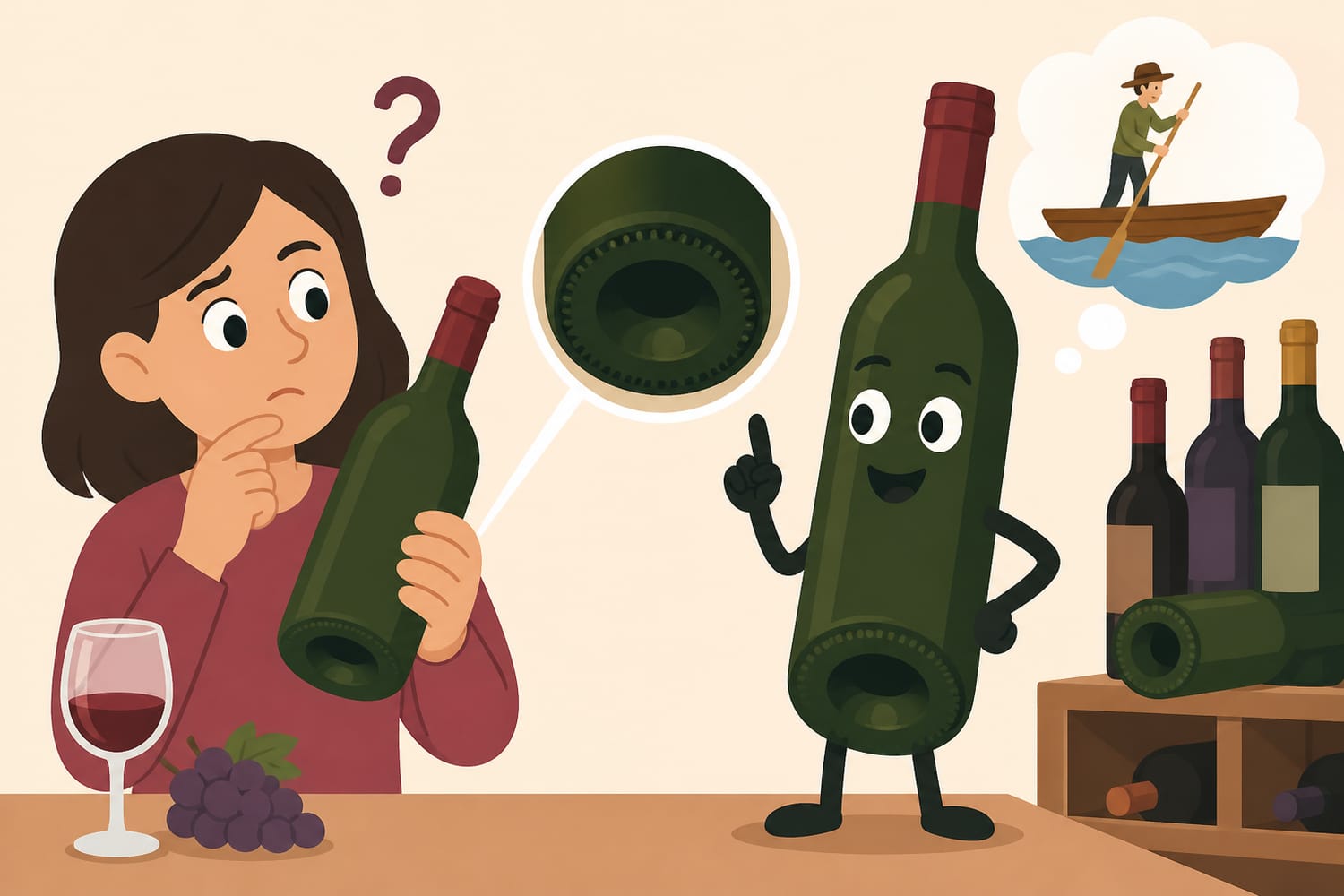
The Short Answer: A Punt Is the Bottle’s “Innie”
The hollow indentation in the bottom of a wine bottle is called a punt. It is partly a holdover from traditional glassmaking, when producing a perfectly flat, stable bottle was difficult. Today, punts may strengthen sparkling-wine bottles, help manage sediment, provide a grip for pouring—and make the packaging look impressively fancy.
Meet the Punt
Turn over almost any traditional wine bottle and you will find a curious feature: instead of a flat bottom, the glass curves inward to form a dome-shaped hollow.
That hollow is the punt, pronounced exactly as it looks: punt, rhyming with front. It is also sometimes called a kick, kick-up, or push-up.
This meaning has nothing to do with kicking a football, propelling a flat-bottomed boat, or abandoning a difficult project because you have decided to “punt” it until next week. English simply has several unrelated meanings packed into the same four-letter word.
The wine-bottle sense is wonderfully specific. Merriam-Webster defines a punt as an indentation at the bottom of a molded glass bottle, placing it among those delightful words for ordinary things you may not have known had names.
It is much like a zarf, the holder wrapped around a hot coffee cup: familiar object, surprisingly unfamiliar name.
Why Do Wine Bottles Have Punts?
Here is where the story gets slightly fizzy: there is no single, universally accepted explanation.
The punt has been around for centuries, and people have proposed numerous purposes for it. Some explanations are historically convincing, some describe useful modern side effects, and others belong in the wine-myth cellar alongside “expensive wine never gives you a headache.”
The most likely starting point is old-fashioned bottle production.
Before modern manufacturing could produce large numbers of nearly identical bottles, glass bottles were made by hand. Creating a completely smooth, level base was difficult. An irregular bump or scar could cause a bottle to wobble, scratch a table, or sit awkwardly.
Pushing the base inward helped move imperfections away from the surface on which the bottle stood. The outer ring of glass could then provide a more stable resting point. In other words, the punt was not originally installed so a sommelier could look dramatic. It helped keep the bottle from behaving like a poorly balanced chair.
Modern machines can make flat-bottomed bottles perfectly well, so punts are no longer essential for ordinary still wine. According to the Oxford Companion to Wine, the feature is optional, although it remains particularly common in sparkling-wine bottles.
The Punt’s Most Convincing Modern Jobs
Although tradition explains much of the punt’s survival, the indentation can still serve practical purposes.
1. It Can Strengthen a Sparkling-Wine Bottle
Sparkling wine contains dissolved carbon dioxide, which creates substantial pressure inside a sealed bottle. That is why sparkling-wine bottles are usually made from thicker, heavier glass than bottles intended for still wine.
A concave base helps distribute stress and makes the bottom more resistant than a broad, completely flat surface would be. This is one reason Champagne and other sparkling-wine bottles commonly have deep punts.
The shape is not working alone, of course. Bottle thickness, glass composition, manufacturing quality, and overall design are also crucial. A deep punt does not magically transform delicate glass into an indestructible bubble fortress.
Still, when it comes to sparkling wine, the punt is more than decorative tradition. Decanter’s guide to wine-bottle punts notes their historical role in strengthening bottles that must withstand internal pressure.
2. It May Help Keep Sediment in Place
Some wines develop sediment as they age. This is especially common in older red wines, vintage port, and wines that have not been heavily filtered.
In a punted bottle, sediment can collect in the narrow channel around the raised center rather than spreading evenly across a flat base. When the wine is poured carefully, that arrangement may make it easier to leave the final cloudy portion behind.
This does not mean the punt acts like a tiny built-in strainer. Tip the bottle abruptly, and the sediment will happily rejoin the wine like guests rushing back onto a dance floor.
For an older bottle, careful handling and decanting remain more reliable than trusting the punt to perform sediment-related heroics.
3. It Offers a Convenient Grip
You may have seen a server pour wine while placing a thumb in the punt and supporting the bottle with the fingers. The indentation can provide a useful gripping point, particularly during formal service.
It certainly looks elegant. It also keeps the hand near the base, allowing the label to remain visible.
However, this is better understood as a convenient use of the punt rather than the definitive reason it exists. You do not need to put your thumb inside it when pouring at home. Holding the lower body of the bottle securely is usually easier—and far less likely to end with Cabernet on the curtains.
4. It Can Assist With Traditional Sparkling-Wine Handling
During traditional sparkling-wine production, bottles may be gradually turned and tilted in a process called riddling. This encourages yeast sediment to move toward the neck so it can eventually be removed.
Historically, the punt gave workers a place to grip and manipulate the bottle. Much riddling is now mechanized, but the bottle shape remains part of the tradition.
Does a Deeper Punt Mean Better Wine?
No. This is the big myth hiding at the bottom of the bottle.
A deep punt can make a bottle taller, heavier, and more substantial in the hand. Those qualities may suggest luxury, which is useful if a producer wants the bottle to stand out on a shelf.
But glass shape cannot improve the grapes, repair poor fermentation, add complexity, or teach a disappointing Merlot to believe in itself. The punt has no direct relationship to the quality of the wine inside.
Premium producers sometimes choose heavy bottles with dramatic punts, so shoppers may notice a loose association between deep punts and high prices. That is a packaging decision, not a dependable quality test. Plenty of excellent wines come in relatively light bottles, while an elaborate bottle can contain thoroughly ordinary wine. Decanter likewise concludes that modern punts are often matters of design and branding rather than evidence of quality.
Also, the indentation does not mean you are receiving less than the amount stated on the label. A standard bottle marked 750 milliliters must contain that volume regardless of its outer shape. The bottle is simply designed with enough height or width to accommodate both the wine and the inward curve.
Do All Wine Bottles Have Punts?
Not at all.
Many bottles have shallow punts, while others are nearly or completely flat-bottomed. Tall, slender bottles traditionally associated with Riesling and similar wines are frequently made without pronounced punts.
Bottle shapes developed differently across wine-producing regions, influenced by local glassmaking methods, customs, storage practices, and visual identity. Over time, certain shapes became associated with particular wine styles.
That is why a bottle’s silhouette may offer clues about what is inside—but these are conventions, not unbreakable laws. Wine packaging enjoys tradition, but it also enjoys confusing everyone occasionally.
If oddly precise vocabulary appeals to you, the punt belongs in the same mental collection as overmorrow, the old word for the day after tomorrow, and other terms that make you wonder why nobody told you about them sooner.
The Environmental Catch Beneath the Bottle
Deep punts often require more glass, especially when they are part of a thick, heavy “prestige” bottle. More glass means more raw material, greater manufacturing energy, and additional weight during transportation.
For that reason, parts of the wine industry are moving toward lighter packaging. The Sustainable Wine Roundtable’s Bottle Weight Accord aims to bring the average weight of 750-milliliter still-wine bottles below 420 grams. The organization notes that glass packaging can account for a substantial share of wine’s total emissions.
This creates an interesting reversal. Once, a weighty bottle and cavernous punt were supposed to whisper, “This is important wine.” Increasingly, a lighter bottle may say, “The producer cared more about the wine—and less about making you lift a decorative dumbbell.”
Sparkling wine remains a special case because its packaging must safely withstand pressure. Still, manufacturers continue to investigate ways to reduce glass weight without sacrificing strength.
How to Use “Punt” in a Sentence
Now that you know the word, you are morally obligated to mention it at the next dinner party. Try one of these:
- “That indentation is called the punt.”
- “A deep punt doesn’t guarantee better wine.”
- “The sediment had settled around the punt.”
- “Please stop putting olives in the punt and calling it bottle decoration.”
You can also use it in a trivia question:
What is the indentation in the bottom of a wine bottle called?
A punt.
It is short, useful, and pleasantly obscure—much easier to deploy than something like quomodocunquize, which may require a warm-up exercise before pronunciation.
The Bottom Line on the Bottom of the Bottle
A punt is the inward curve at the base of a wine bottle. It probably owes its existence largely to historical glassmaking, but it has collected several useful functions over the centuries. It can add strength to sparkling-wine bottles, help manage sediment, and provide a convenient grip.
What it cannot do is guarantee great wine.
So the next time someone studies a bottle’s deep indentation and confidently announces that the wine must be excellent, you can gently correct them. Then use the word punt, explain its history, and enjoy your sudden promotion to Most Interesting Person Near the Corkscrew.