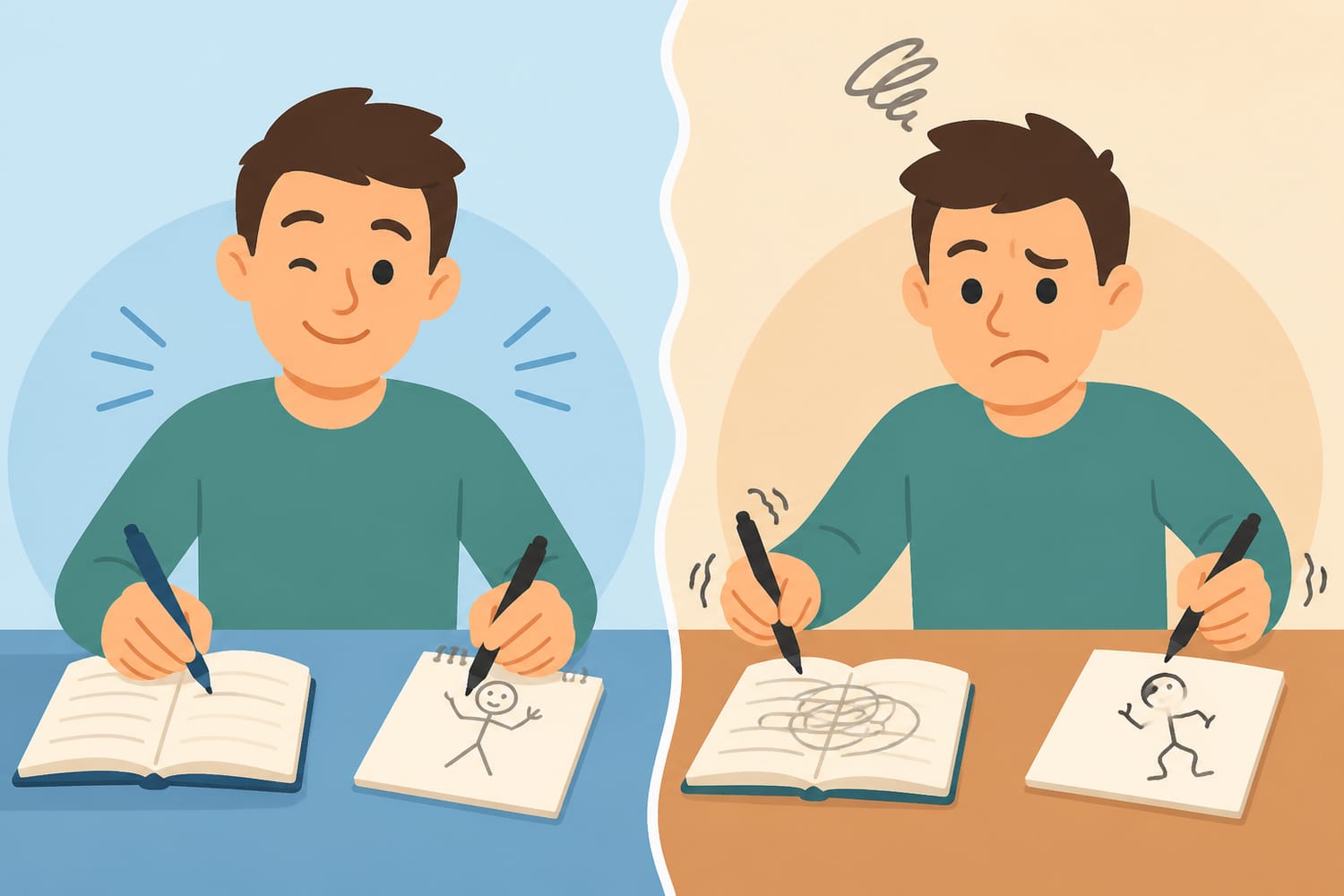
The Short Answer: Ambisinister Means Clumsy With Both Hands
Ambisinister is a rare adjective meaning clumsy or unskillful with both hands. It is often described as the opposite of ambidextrous, which means able to use both hands equally well. In delightfully literal terms, an ambidextrous person has “two right hands,” while an ambisinister person has “two left hands.”
If you have ever tried to hammer a nail and somehow endangered both thumbs, opened a package with scissors only to destroy the package, or attempted to toss something with your non-dominant hand and hit an innocent lamp, you may have felt ambisinister.
The word is pronounced roughly:
am-bi-SIN-uh-ster
It looks like the name of a minor comic-book villain, but it describes a much more ordinary problem: neither hand seems entirely sure what it is doing.
Breaking Down This Two-Handed Oddity
Ambisinister becomes much easier to understand when divided into two parts:
- ambi- means “both” or “on both sides”
- sinister comes from a Latin word meaning “left” or “on the left side”
Put them together, and you get something close to “left-handed on both sides.”
That construction deliberately mirrors ambidextrous. That familiar word comes from Latin elements meaning “both” and “right-handed.” Its literal image is therefore “right-handed on both sides,” which developed into the modern idea of being equally capable with either hand. The Oxford Advanced Learner’s Dictionary entry for ambidextrous traces the English adjective to the mid-17th century and the Late Latin ambidexter.
So the two words form a wonderfully tidy pair:
| Word | Literal idea | Usual meaning | |---|---|---| | Ambidextrous | Two right hands | Skillful with either hand | | Ambisinister | Two left hands | Clumsy with both hands |
It is linguistic symmetry at its finest—and historical prejudice at its most obvious.
Why Does “Sinister” Mean Both “Left” and “Evil”?
Today, sinister usually describes something threatening, wicked, or disturbingly suspicious. A dark figure standing beneath a flickering streetlight has sinister intentions. Your left hand probably does not.
The connection comes from the history of the word. Latin sinister referred to the left side, while dexter referred to the right. Over time, sinister also developed unfavorable associations, eventually giving English its familiar sense of “evil” or “menacing.” The full history is more complicated than a simple “Romans thought left was bad” explanation, because the interpretation of left-sided omens varied with different traditions and orientations. Still, the linguistic contrast between sinister and dexter survived.
That contrast appears in several English words:
- Dexterity means skill or nimbleness, especially with the hands.
- Dextrous or dexterous means skillful.
- Sinistral can mean left-sided or moving toward the left.
- Ambidextrous suggests two skillful “right” hands.
- Ambisinister suggests two supposedly awkward “left” hands.
This does not mean left-handed people are naturally clumsy. It means the vocabulary grew in cultures that frequently treated the right side as normal, favorable, or skillful and the left side as its less fortunate opposite.
In other words, the word reveals an old cultural bias—not a fact about human ability.
Is Ambisinister Really the Opposite of Ambidextrous?
Yes, with a small qualification.
In ordinary dictionary terms, ambisinister works as the humorous opposite of ambidextrous. One person is capable with either hand; the other is awkward with both. Both Collins Dictionary and Dictionary.com define ambisinister as clumsy or unskillful with both hands.
However, real-life handedness is not always a neat choice between these two extremes. Someone may write with the right hand, throw with the left, open jars with either, and become mysteriously useless whenever handed a screwdriver.
People can also be:
- Strongly right-handed or left-handed
- Better with different hands for different tasks
- Trained to perform one activity with the non-dominant hand
- Comfortable using either hand without being equally skilled at everything
- Temporarily awkward because a task is unfamiliar
Calling someone ambisinister is therefore more playful than scientific. It is not a diagnosis, a formal measure of coordination, or proof that every task goes badly. It simply paints a comic picture of someone whose hands appear to be sharing one unreliable instruction manual.
How Old Is the Word?
Ambisinister is not a recent internet invention, although it certainly has the energy of one.
Dictionary.com dates its first recorded use to approximately 1840–1850 and analyzes it as ambi- plus sinister. The alternative adjective ambisinistrous is also recorded.
The word is rare enough that many people assume it was created as a joke after someone noticed the literal roots of ambidextrous. That is understandable because it really does feel like a clever punchline:
“I’m not ambidextrous. I’m ambisinister.”
Yet it has been appearing in English for well over a century. A historical example collected by A.Word.A.Day even describes physicians as “surgically ambisinister”—not exactly the phrase you want to hear while being wheeled toward an operating room.
There is also an older related word, ambilevous, built around Latin laevus, another word associated with the left side. It likewise refers to being, figuratively speaking, left-handed on both sides. Like ambisinister, it is extremely rare.
English apparently decided that one word for “bad with both hands” was not enough.
How to Use “Ambisinister” in a Sentence
Because the word is uncommon, it works best in humorous, informal, literary, or word-loving contexts. You may need to explain it, but that is part of the fun.
Here are a few examples:
“I tried pottery once, but my thoroughly ambisinister hands produced something resembling a frightened potato.”
“Jamie is ambidextrous on the basketball court and ambisinister in the kitchen.”
“After dropping the screwdriver for the fourth time, I accepted that home repair brings out my ambisinister side.”
“The instructions said assembly would take ten minutes, which was an optimistic estimate for the ambisinister.”
You can use it as a gentle joke about yourself, but be cautious when applying it to somebody else. Calling a friend ambisinister after they drop a spoon is playful. Using it to ridicule someone with a disability, injury, or motor difficulty is not.
The word is funniest when it describes an ordinary burst of incompetence—the sort that strikes when you are wrapping a gift, fastening a bracelet, untangling earbuds, or trying to fold a fitted sheet.
Ambisinister Is Not the Same as “Two Left Feet”
The expression two left feet usually describes awkwardness while dancing. An ambisinister person, by contrast, is awkward with the hands.
That gives us an entire imaginary anatomy of incompetence:
- Two left feet: hopeless on the dance floor
- All thumbs: awkward when handling small objects
- Butterfingers: likely to drop things
- Ambisinister: clumsy with both hands
There is considerable overlap, of course. One unfortunate person could theoretically possess two left feet, butterfingers, and an ambisinister approach to assembling furniture.
English loves vivid phrases for physical awkwardness. We rarely say, “I temporarily displayed reduced manual coordination.” We say, “I’m all thumbs,” because imagining a hand made entirely of thumbs is much more entertaining.
If your particular brand of hand trouble produces unreadable notes, you might also enjoy griffonage, the fancy word for terrible handwriting.
Should We Actually Start Using It?
Absolutely—within reason.
Ambisinister is memorable, precise, and satisfyingly strange. It can turn a minor mishap into a much better story. “I dropped the lid” is forgettable. “My ambisinister attempt to close the container launched the lid across the kitchen” has drama.
Good opportunities include:
- Describing your attempts at crafts or home repair
- Explaining why you should not be trusted with juggling equipment
- Making light of an unsuccessful cooking project
- Commenting on your performance in a new sport
- Correcting someone who calls you ambidextrous after watching you fail equally with both hands
Still, clarity matters. In a medical report, workplace safety document, or formal instruction manual, clumsy with both hands will probably communicate more effectively. Save ambisinister for situations where curiosity and comedy are welcome.
Rare words are often most enjoyable when they add something ordinary language cannot. You can find more of these unlikely dictionary residents among the weirdest English words still in use and other words that mean the opposite of what they sound like.
A Word With Two Left Hands and Plenty of Charm
Ambisinister means clumsy or unskillful with both hands—the comic, rarely used opposite of ambidextrous. Its parts literally suggest being “left-handed on both sides,” reflecting an old linguistic association between the right side and skill.
That association is unfair to actual left-handed people, but the resulting word remains delightfully useful when aimed at a moment rather than an identity.
So the next time you drop a spoon with one hand, reach for it with the other, and somehow knock over a glass in the process, take comfort. Your hands may have betrayed you, but at least English has given you the perfect word for it.
You are not merely clumsy.
You are ambisinister.