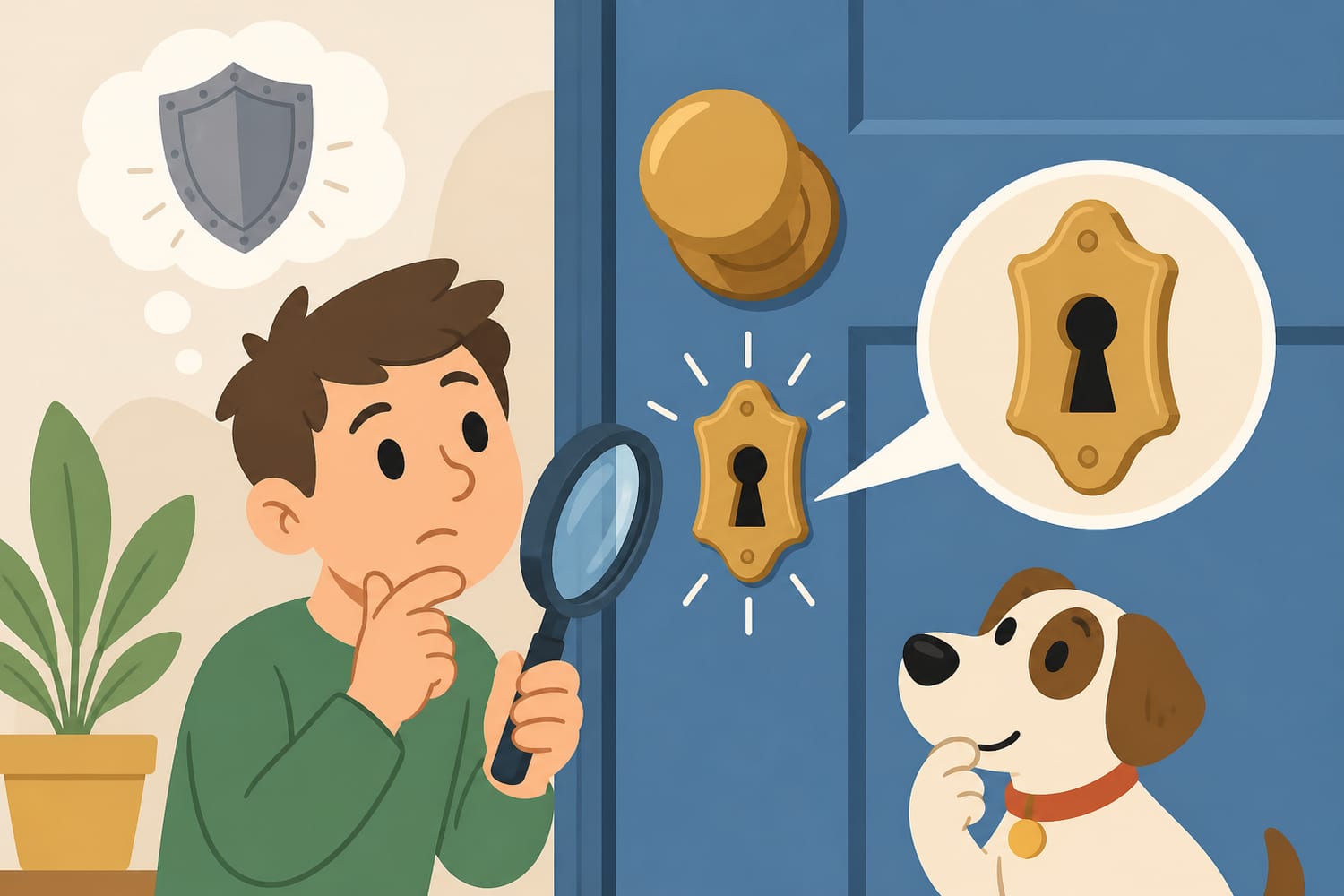
The Short Answer: An Escutcheon Frames a Keyhole
An escutcheon is a protective or decorative plate fitted around a keyhole, lock cylinder, door handle, or similar opening. It covers rough edges, protects the surrounding surface from scratches, and gives the hardware a finished appearance. In its simplest form, it is that little metal plate around an old-fashioned keyhole.
It is pronounced roughly ih-SKUTCH-un.
So yes, the tiny brass shape you have ignored on doors, desks, cabinets, and antique chests has a proper name—and that name sounds considerably grander than the object itself.
What Does an Escutcheon Actually Do?
A basic keyhole would still function without an escutcheon. You could insert the key, turn the lock, and go about your business. The surrounding wood, however, might not fare so well.
Keys miss their target. They scrape, swing, and collide with the surface around the lock. Over time, that can scratch paint, damage veneer, wear away wood, and make a neat keyhole look as though it has survived a sword fight.
An escutcheon helps by:
- Protecting the surface around the keyhole
- Covering rough or uneven edges in the opening
- Giving the lock a cleaner, more finished appearance
- Helping visually align the key with the opening
- Adding decorative detail to a door or piece of furniture
- Providing extra protection around certain lock cylinders
That last point depends heavily on the design. A thin decorative key plate is not serious security equipment. A sturdy security escutcheon, however, may help shield a lock cylinder and make it harder to grip, strike, or drill.
The door-hardware specialists at Schlage explain that an escutcheon can surround a keyhole or lock, protecting both the hardware and the nearby door surface.
Why Does Such a Tiny Plate Have Such a Fancy Name?
The word did not begin with doors. It began with shields.
According to the Merriam-Webster definition and word history, escutcheon entered English through Anglo-French and ultimately traces back to the Latin scutum, meaning “shield.”
Originally, an escutcheon was the shield-shaped surface on which a coat of arms was displayed. If you picture a knight’s shield decorated with lions, stripes, crowns, or other heraldic symbols, you are picturing an escutcheon in its older sense.
The connection to hardware becomes clearer when you look at traditional keyhole plates. Many were shaped like miniature shields. They also protected the surface behind them, just as a shield protected the person holding it.
The word’s journey therefore looks something like this:
- A literal shield
- A shield-shaped field displaying a coat of arms
- A decorative shield-like plate
- A protective plate around a keyhole, lock, or opening
It is an impressively noble family tree for something that spends most of its life being jabbed with a house key.
Escutcheons Can Be Tiny—or Surprisingly Large
When people hear escutcheon, they often imagine a small oval, diamond, or shield-shaped plate directly around a keyhole. That is certainly one kind, but the term can cover several pieces of hardware.
Keyhole Escutcheons
This is the classic variety: a small plate containing a keyhole-shaped opening. It may be made from brass, iron, bronze, steel, wood, bone, or another material.
Some keyhole escutcheons have a hinged or swinging cover. The cover conceals the opening when the lock is not being used and can help keep dust and debris out.
Cylinder Escutcheons
Modern locks often use a round or oval cylinder rather than a traditional keyhole cut directly into the door. The trim surrounding that cylinder may also be called an escutcheon.
Security versions tend to be thick and sturdy. Decorative versions may simply hide the cutout and create a tidy transition between the lock and the door.
Full-Length Escutcheon Plates
On some doors, one long plate sits behind the handle and extends downward around the keyhole or cylinder. This may be described as an escutcheon plate, backplate, or handleset trim, depending on the manufacturer and style.
Hardware terminology is not always perfectly consistent. One company’s escutcheon may be another company’s backplate, especially when the plate surrounds more than the keyhole.
Furniture Escutcheons
Escutcheons are also common on desks, cabinets, clocks, boxes, wardrobes, and chests. Antique furniture makers often treated them as miniature works of art.
They might be engraved, pierced, gilded, cast into floral patterns, or shaped like ribbons, leaves, shells, shields, and mythical creatures. The Metropolitan Museum of Art notes that the escutcheons on fine furniture protected delicate veneer while adding decoration.
In other words, an escutcheon could be both armor and jewelry for a keyhole.
Is an Escutcheon the Same as a Rosette?
Not quite, although the terms can overlap in casual hardware descriptions.
A rosette is usually the round trim plate behind a doorknob or lever. It covers the larger hole through which the handle’s spindle and mechanism pass.
An escutcheon traditionally surrounds the keyhole or lock, although the word is also used for longer plates surrounding handles, cylinders, and other hardware openings.
A useful rule of thumb is:
- Rosette: Usually small and round, positioned behind a knob or lever
- Keyhole escutcheon: Positioned directly around a keyhole
- Escutcheon plate: May be larger and surround both the handle and lock
The exact label may vary, so measurements and photographs are more reliable than vocabulary alone when buying replacement hardware.
Escutcheons Have Escaped the Door
Like many useful technical words, escutcheon has wandered into several trades.
In plumbing, an escutcheon is the decorative plate or flange surrounding a pipe where it passes through a wall, floor, sink, or ceiling. It hides the rough opening and creates a neat finish. The circular metal plate behind a shower arm is a familiar example.
You may also encounter escutcheons around:
- Faucets and valves
- Sprinkler heads
- Electrical fittings
- Marine hardware
- Appliance controls
- Automotive handles or openings
The common idea remains the same: an escutcheon surrounds an opening, conceals the transition, and often offers some protection.
It belongs to the same delightful family of easily overlooked objects as the ferrule, the small band that strengthens or connects parts, and the aglet at the end of a shoelace. These components are everywhere, performing tiny but useful jobs while most of us remain completely unaware of their names.
What Is a “Blot on the Escutcheon”?
The heraldic meaning of escutcheon produced an expression that still occasionally appears today: “a blot on the escutcheon.”
A coat of arms represented a family, institution, or individual. A stain on that shield could therefore symbolize shame, disgrace, or damage to a reputation.
Calling something “a blot on someone’s escutcheon” means it is an embarrassing mark on an otherwise respected record.
For example:
The disastrous office talent show was a blot on the company’s otherwise dignified escutcheon.
The phrase sounds old-fashioned and melodramatic, which is part of its charm. Why call something embarrassing when you can describe it as a stain upon an imaginary ancestral shield?
How to Choose a Replacement Escutcheon
If an old door or cabinet is missing its escutcheon, replacing it can improve the appearance and protect the surface from further wear.
Before buying one, check:
- The lock type: Traditional keyhole, euro cylinder, oval cylinder, or another design
- The opening size: The escutcheon must fit around the keyway or cylinder without blocking it
- The overall dimensions: Make sure it covers existing scratches, holes, or marks
- The screw spacing: Existing holes may not match a new plate
- The material and finish: Brass, bronze, iron, chrome, nickel, and black finishes create very different looks
- The door or drawer thickness: Longer screws may pass through thin furniture panels
- The level of security needed: Decorative trim and reinforced security hardware are not interchangeable
For antique furniture, avoid drilling new holes until you know whether suitable reproduction hardware is available. An escutcheon that is slightly crooked may be annoying; a row of unnecessary holes in a historic cabinet is considerably more permanent.
A Small Shield Hiding in Plain Sight
An escutcheon is a plate surrounding a keyhole, lock, handle, pipe, or similar opening. It protects the nearby surface, conceals rough edges, and adds a finished—or occasionally spectacular—decorative touch.
Its name comes from the language of heraldry, where an escutcheon was a shield displaying a coat of arms. That history still fits the object remarkably well. A keyhole escutcheon is, in effect, a tiny shield standing guard over your door.
The next time you unlock an old cabinet or open a traditional front door, take a closer look at the plate around the keyhole. It may be scratched, tarnished, ornate, plain, shield-shaped, or barely noticeable.
But it is no longer nameless. It is an escutcheon—and it has been waiting very patiently for you to ask.