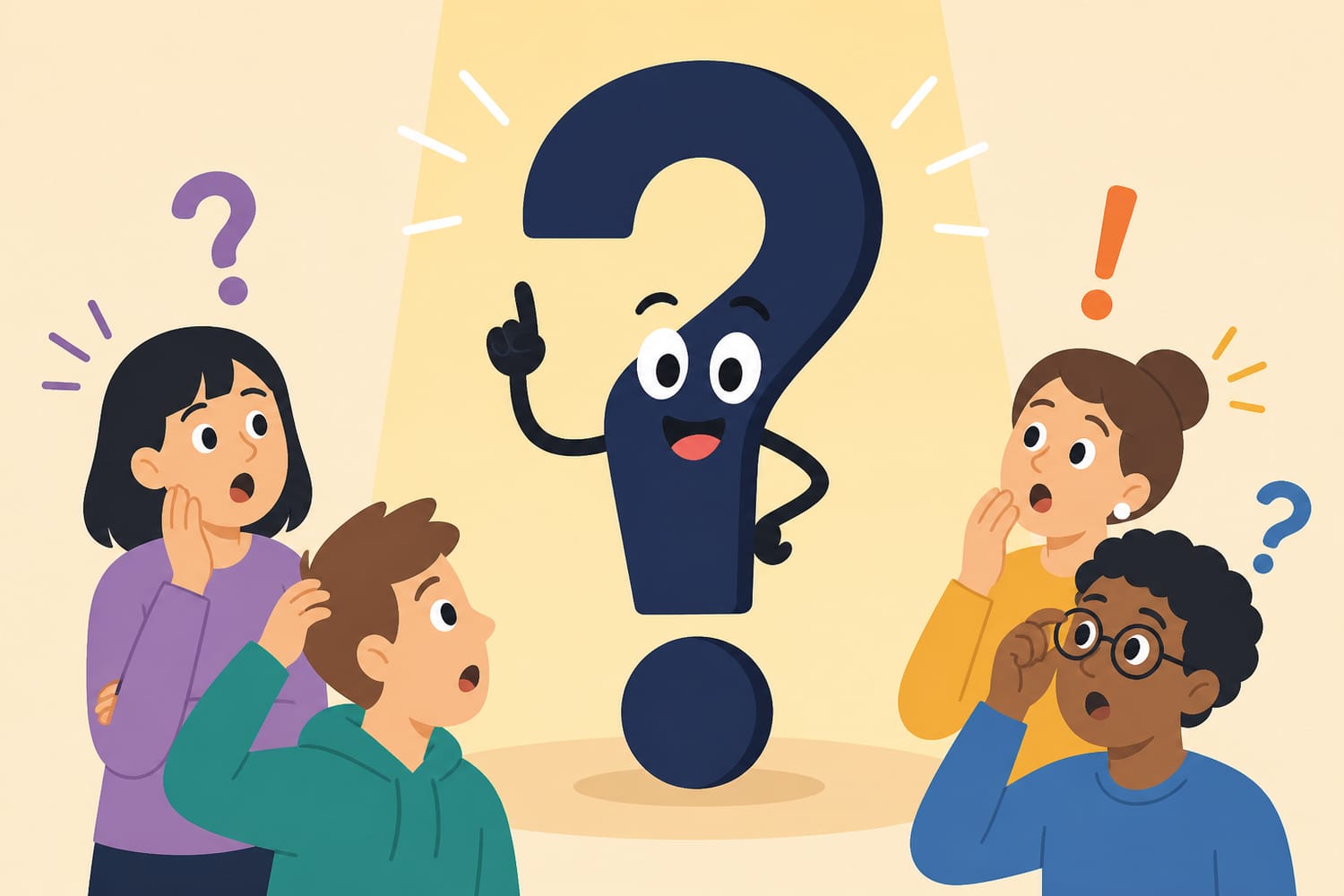
An interrobang is a punctuation mark that combines a question mark and an exclamation point into one symbol: ‽. It belongs at the end of a question asked with surprise, excitement, or disbelief. Think “You won the lottery‽” It’s the written equivalent of raising your eyebrows and your voice at the same time.
Most people express that feeling with ?! or !?, and that works too. The interrobang simply squeezes the two marks together. It’s a tiny piece of punctuation with the energy of someone opening a bill, spotting an extra zero, and saying, “How much‽”
Why Does It Look Like That?
Look closely at ‽. The question mark supplies the curve; the exclamation point shares the space beneath it. Rather than appearing side by side, they overlap.
That design tells you what the mark does. A plain question mark asks: “There’s cake left?” An exclamation point announces: “There’s cake left!” An interrobang reacts to the unlikely good news: “There’s cake left‽”
The word is a mash-up as well. Interro- comes from interrogation, while bang is a term for an exclamation point. Put them together and you get interrobang: a name that sounds like a small theatrical explosion, but is really quite literal.
If you enjoy discovering that familiar marks have unexpected names, meet the tittle, the tiny dot above a lowercase i or j. It has a much quieter job than the interrobang.
Who Invented the Interrobang?
Unlike punctuation marks whose beginnings disappear into centuries of handwriting, the interrobang has a fairly clear origin. American advertising executive Martin K. Speckter introduced the idea in 1962 in TYPEtalks magazine. He wanted a single mark for sentences that were both questions and exclamations—especially the sort of emphatic questions that turn up in advertising.
Picture a headline asking, “What could be better than this?!” The question mark alone might feel too mild; the exclamation point alone would make it a statement. Speckter’s proposed mark offered a compact way to say both things at once.
The idea made it beyond the drawing board. American Type Founders included an interrobang in its Americana typeface in 1966, and Remington Rand offered it as an option on some typewriters in 1968. That is a respectable debut for a newcomer trying to join punctuation’s long-established cast. You can read more in this short history of the interrobang.
Still, a mark can appear in typefaces and on typewriters without becoming an everyday habit. The interrobang never displaced the question mark, the exclamation point, or the convenient two-character ?!. It remains an option rather than a punctuation requirement.
When Should You Use One?
Use an interrobang when a sentence is genuinely a question and carries the force of an exclamation. Surprise is its natural habitat, though excitement, outrage, and delighted disbelief can live there too.
For example:
- “You brought the whole cake‽”
- “The train leaves in two minutes‽”
- “That puppy learned to open doors‽”
- “We got front-row seats‽”
Read those aloud. Each invites a response, but none sounds like a calm request for information. The speaker is reacting as much as asking.
Now compare “What time does the library close?” That question probably needs no fireworks. “The library closes at six!” is an exclamation, not a question. An interrobang would add a feeling neither sentence calls for.
It can also suit a rhetorical question, such as “Who thought putting glitter in the ceiling fan was a good idea‽” The writer may not expect an answer; the point is the astonishment. But the mark cannot create emotion that the words and context do not support. Use it because the sentence needs it, not because you’ve just discovered where to find it.
Is ?! the Same Thing?
?! and ‽ do much the same expressive work, but they aren’t the same characters. ?! is a question mark followed by an exclamation point. ‽ is a single character with its own entry in the Unicode list of punctuation characters: U+203D INTERROBANG.
For most readers, the practical choice is simple. Use ?! when you want an immediately familiar look. Use ‽ when you want the compact symbol and your audience is likely to enjoy—or at least understand—it.
Neither choice means you have to abandon ordinary punctuation. A question mark is usually best for an ordinary question, even an important one. The interrobang earns its place when “Wait, what?!” is part of the meaning.
And it has a peculiar relative: the inverted interrobang, ⸘. Unicode records that as a separate character, U+2E18. You’re unlikely to need one for your grocery list, but it’s a pleasing reminder that punctuation has more surprises tucked away than most keyboards reveal.
How Do You Type an Interrobang?
The easiest method is right here: copy and paste this mark → ‽
If you’d rather insert it yourself, you have a few options:
- In Microsoft Word: Type
203D, then press Alt+X to convert the Unicode code into an interrobang. If Word converts more than you intended, select only203Dbefore pressing the shortcut. Microsoft explains the process in its guide to inserting Unicode characters in Word. - On a Mac: Open the Character Viewer from Edit > Emoji & Symbols, then search for interrobang or
203D. - In an app with a symbol picker: Search for the name interrobang. If the app cannot find it, copying and pasting is perfectly fine.
One small caution: your font affects how the mark appears. If ‽ looks oddly shaped or fails to display as expected, try another font—or fall back to ?!. The point is to communicate surprise, not to send your reader on a symbol hunt.
Why Isn’t It Everywhere?
The interrobang solves a real problem, but it has a formidable competitor: two keys people already know how to press. ?! is easy to type, easy to recognize, and expressive enough for most situations. A mark that needs a symbol picker or a shortcut has to offer something extra.
What it offers is elegance of a wonderfully silly kind. It gives the double feeling of “Are you serious?!” one neat shape. In a playful caption, a lively piece of fiction, or a headline with a startled voice, that can be exactly right. In a form, a formal report, or instructions where instant clarity matters most, familiar punctuation is usually the safer choice.
The interrobang also has company among oddly named marks. A burst of symbols such as @#$% can stand in for a swear word; that arrangement is called a grawlix. One mark expresses incredulity, the other lets a cartoon character lose their temper without spelling everything out.
So, will the interrobang replace ?!? It doesn’t need to. Knowing it exists gives you another way to make your writing sound like a human voice: startled, delighted, perhaps slightly indignant. The next time you type “You did what?!” and wish the punctuation could share a single breath, it can. You did what‽