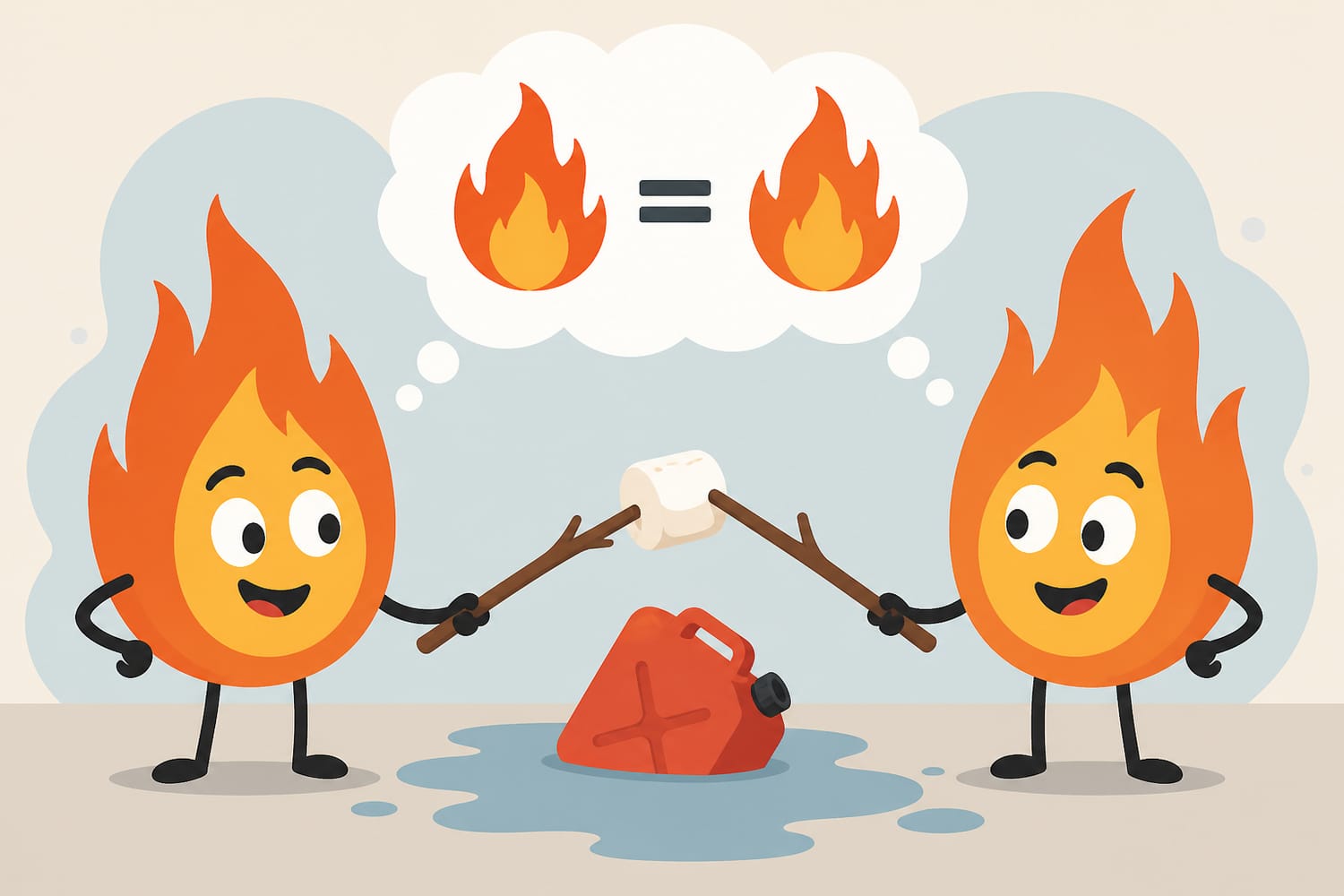
The Short Answer: Both Mean “Watch Out for Fire”
Flammable and inflammable both describe something that can catch fire and burn readily. The trick is that the in- in inflammable does not mean “not.” It comes from a Latin word meaning “to set on fire.” If you want the opposite, say nonflammable—not inflammable.
That is a useful fact to know before you start making assumptions about the contents of a paint can.
English has handed us two words that look like opposites, mean nearly the same thing, and appear in situations where a misunderstanding could matter. It is a splendid vocabulary puzzle and a terrible design choice for a warning label. So how did we get here?
The Two Different In- Prefixes
Most of us learn one meaning of in- early on: “not.” Inactive means not active. Inaccurate means not accurate. By that familiar pattern, inflammable looks as though it ought to mean “not flammable.”
But English has more than one in-. The one in inflammable comes from Latin inflammare, meaning “to set on fire.” In that word, in- carries the sense of “in,” “into,” or causing something to enter a state. It is also the source of inflame. When you inflame an argument, you make it hotter, at least figuratively; you do not make it less argumentative.
Think of the confusion as a case of mistaken identity. One in- is the familiar little “not” sign. The other arrived already attached to a word about flames. They happen to look alike on the page, but they are doing different jobs.
That does not make anyone foolish for guessing wrong. It makes the guess understandable. Our brains are good at finding patterns, and in- usually looks like a perfectly serviceable clue—until a centuries-old Latin word walks in carrying a match.
How Did We End Up With Both Words?
Inflammable was here first. Its fire-related meaning entered English in the early 1600s, drawing on inflammare. Flammable appeared much later: Merriam-Webster dates it to an 1813 translation from Latin. Both words grew from the same family of flame-related words, so their shared meaning was no accident.
Imagine being an English speaker before flammable became established. Inflammable simply meant capable of catching fire. Then its shorter cousin turned up, making the older word look suspiciously like its opposite. The newcomer did not change what inflammable meant; it changed how easy the older word was to misread.
This is one of the reasons word histories can be more revealing than word parts alone. If you slice inflammable into in- plus flammable, you get a convincing explanation—and the wrong answer. The word did not begin as a negative form of flammable. It has its own, older route into English.
For another vocabulary trap where a familiar-looking word leads the mind astray, explore Uncover Words’ collection of words that mean something different from what they sound like. The surprise is often easier to understand once you know a word’s history.
Why Safety Warnings Favor Flammable
In a poem, a word that makes you pause can be delightful. On a container of fuel, not so much.
Because some readers interpret inflammable as “not flammable,” flammable is generally the clearer choice for warnings and everyday instructions. The American Heritage Dictionary’s usage note recommends avoiding inflammable when clarity is important. That is not because inflammable is incorrect. It is because a technically correct warning is not especially helpful if someone reads it backward.
Safety communication also uses more than words. The U.S. Occupational Safety and Health Administration’s guide to hazard pictograms shows the flame symbol used for flammable hazards and several other fire-related hazards. A label’s wording and symbols work together to tell readers what they need to know.
Here is a sensible rule for ordinary writing:
- Flammable: Use this when you mean something catches fire readily.
- Inflammable: Recognize it as a synonym of flammable, but avoid it where confusion could be risky.
- Nonflammable: Use this when you mean something does not readily catch fire.
One caution: nonflammable does not mean “impossible to burn under every imaginable condition.” If you are handling a product, follow its actual label and safety instructions rather than treating any single word as the whole story.
Is Inflammable Ever the Better Word?
It can be—just probably not on a warning sign.
Outside literal fire, inflammable can describe a person who is quickly stirred to strong emotion. An inflammable temper is one that flares up easily. Flammable does not ordinarily do that same work: calling someone’s temper flammable might make a colorful joke, but inflammable has an established figurative meaning.
That connection is not hard to picture. A heated exchange can flare up. A remark can spark an argument. Someone can inflame a crowd. English has long borrowed the behavior of fire to describe the behavior of feelings.
You could write, “The meeting was already tense, and one sarcastic comment reached an inflammable audience.” Nobody is suggesting the audience should be kept away from the barbecue. The danger is conversational, not chemical.
Still, context matters. If you are telling a story, the figurative sense can be vivid and precise. If you are giving safety directions, vividness can step aside for the plainest possible wording.
A Mistake That Makes Perfect Sense
There is something reassuring about this particular mix-up: it follows a real pattern. Invisible means not visible; incapable means not capable. Someone encountering inflammable for the first time is not inventing a meaning out of thin air. They are applying a familiar rule to the wrong in-.
That habit—building meaning from recognizable pieces—usually helps us. It also explains why some mistaken expressions feel more logical than the originals. Uncover Words explores that impulse in its article on eggcorns, mistakes that seem to make sense. Inflammable is not an eggcorn, but it catches our pattern-seeking brains in a similar act of confident guesswork.
The fix is not to stop looking for patterns. It is to remember that words have histories, and those histories do not always line up neatly with their modern appearance. Sometimes two identical-looking prefixes have different origins. Sometimes a newer word makes an older one look misleading. And sometimes the best choice is simply the word your reader is least likely to misunderstand.
The Takeaway
Flammable and inflammable both mean capable of catching fire. Inflammable inherited its in- from a Latin word meaning “to set on fire”; it never meant “not flammable.” The actual opposite you usually want is nonflammable.
So enjoy the linguistic oddity—but do not let it win an argument with a warning label. When fire is involved, choose the clearest word, pay attention to the label, and leave the delightful ambiguity to the dictionary.