The Short Answer: A Joke That Refused to Go Away
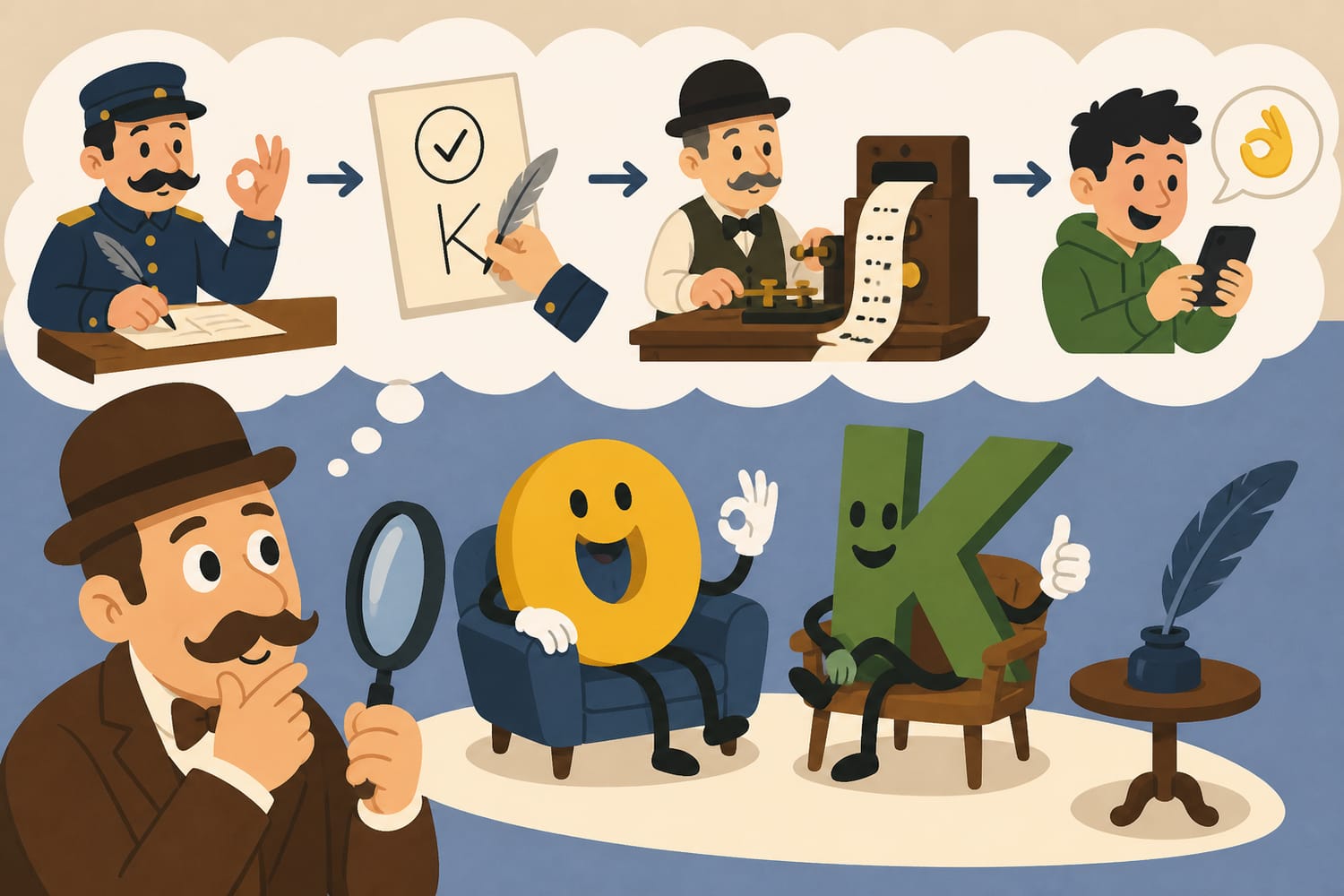
OK began as a joke. Its earliest known appearance in print is in the Boston Morning Post on March 23, 1839, during a fad for abbreviations based on deliberately misspelled phrases. The letters stood for oll korrect—a playful version of “all correct.” An election campaign helped the joke spread, and everyday speakers made it their own.
That is a remarkable career for two letters. Today, OK can approve a plan, acknowledge a message, ask about someone’s well-being, or describe a movie that was not quite worth the ticket price. Its origin, though, involves neither a grand invention nor an ancient secret: just a newspaper editor having fun.
Boston Had an Abbreviation Habit
Imagine scrolling through a newspaper and finding its writers enthusiastically making up initials for jokes that might not be funny tomorrow. That was part of the scene in American newspapers in the late 1830s. Shortened expressions were fashionable, and some were built from words spelled incorrectly on purpose.
One example was O.W., for oll wright, a deliberately mangled “all right.” Another was K.G., for know go, playing on “no go.” They were the sort of jokes that reward a reader for puzzling them out—and occasionally make that reader wonder whether the writer needed a proofreader.
OK belonged to the same crowd. To get from all correct to O.K., you first had to bend the spelling into oll korrect. The mistake was the point. It was not an older, correct way to spell the phrase, and its creators were not trying to reform English. They were playing with it.
For a modern comparison, think of a message that says “kewl” instead of “cool.” You understand the word because the spelling is conspicuously wrong. The Boston joke added one more step: it reduced its wrong spelling to initials.
The Newspaper Appearance That Gave OK a Date
On March 23, 1839, the Boston Morning Post printed “o.k.” in a humorous item involving the editor of a rival paper, the Providence Journal. The Post followed the letters with “all correct,” explaining the meaning to readers who might not yet have met this particular joke. That surviving appearance is why historians can give OK an unusually precise place and date in the written record.
There is a small but important distinction here: the earliest known printed example is not necessarily the first time anyone said or wrote OK. A reader might have used it in a letter that disappeared; someone might have tried it aloud and left no record at all. What we have is the earliest printed evidence researchers have found, not a certificate of invention.
The evidence owes much to scholar Allen Walker Read, who investigated OK’s early appearances in newspapers and untangled its history from competing origin stories. If you would like to see more of the newspaper-era wordplay, Merriam-Webster’s account of OK’s history gives the original item its wonderfully odd context.
So why did this abbreviation survive when its fellow jokes faded? For that, we have to leave the newsroom and head to a presidential campaign.
What Did “Old Kinderhook” Have to Do With It?
In 1840, President Martin Van Buren was running for reelection. He came from Kinderhook, New York, and supporters called him “Old Kinderhook.” His nickname had the initials O.K.—the same letters that newspaper readers already knew as a playful way to say “all correct.”
That coincidence was irresistible campaign material. Supporters formed OK Clubs and put the initials to work for their candidate. In effect, the slogan could suggest both Old Kinderhook and all correct. Whether or not you liked Van Buren, it was a tidy bit of political branding.
It also created a lasting mix-up. You may hear that OK originally stood for “Old Kinderhook.” The campaign certainly helped popularize the letters, but the Boston Morning Post example appeared in 1839, before the 1840 campaign. The two explanations describe different chapters: oll korrect explains the earlier newspaper expression; Old Kinderhook helps explain why so many more people encountered it.
Van Buren lost the election to William Henry Harrison. OK, on the other hand, enjoyed an impressively long political afterlife—without having to run again.
How Did Two Letters Become So Useful?
The election gave OK publicity, but publicity alone cannot keep a word alive. OK was also short, easy to write, and useful in many situations. It could mark something as correct or approved without requiring a sentence of explanation. The growing use of the telegraph gave brief expressions another place to travel; an 1865 example records OK in the language of telegraphers.
As the word spread, it no longer had to mean strictly “all correct.” Consider how many jobs it can do in an ordinary day:
- “OK, I’ll be there” means I agree.
- “Is the door OK?” asks whether something is working or undamaged.
- “The soup was OK” offers praise so faint the chef might prefer silence.
- “Are you OK?” asks about someone’s condition, not the accuracy of their spelling.
This flexibility helps explain its endurance. A quick “OK” can move a conversation along, while “okay…” with a long pause can signal that a person has reservations. The original newspaper joke supplied the letters; speakers kept finding new uses for them.
That journey from a particular meaning to a broader one is not unusual. A phrase such as “a dime a dozen” can still make sense even when nobody is buying twelve items for ten cents. With OK, you can go through an entire day using the word without once thinking about whether anything is literally “all correct.”
What About the Other Origin Stories?
A word as common as OK was bound to attract explanations. One persistent theory connects it to the Choctaw word okeh. Others have linked the letters to Andrew Jackson or to expressions from other languages. These stories are worth knowing about, but they do not have the same documented sequence as the Boston newspaper usage followed by the Van Buren campaign. The Choctaw explanation, in particular, lacks evidence showing that it produced the newspaper abbreviation.
This is not a judgment about whether a similar-sounding word exists elsewhere. Two words can resemble each other without one being the source of the other. To establish an origin, word historians look for evidence connecting a proposed source to the word’s early use—not just a satisfying resemblance.
It is sensible to take a neat origin story with a grain of salt when it skips that step. OK’s best-supported history is surprising enough without giving it an undocumented ancestor.
Is It “OK,” “O.K.,” or “Okay”?
The earliest newspaper example used “o.k.”, with periods. Today, OK and okay are both established spellings; lowercase ok is also used. The longer spelling does not reveal a different origin—it spells out the sound of the two letters.
You can choose whichever form suits what you are writing, though consistency is helpful in a longer piece. If you are quoting the 1839 newspaper, keep its periods. If you are texting that you will pick up milk, history will not object to “okay.”
The funny part is that a joke built on spelling something incorrectly has become one of our most dependable expressions of agreement. The next time you type OK, you are using a tiny survivor of newspaper humor, nineteenth-century politics, and generations of people who found two letters too handy to give up.