The Short Answer
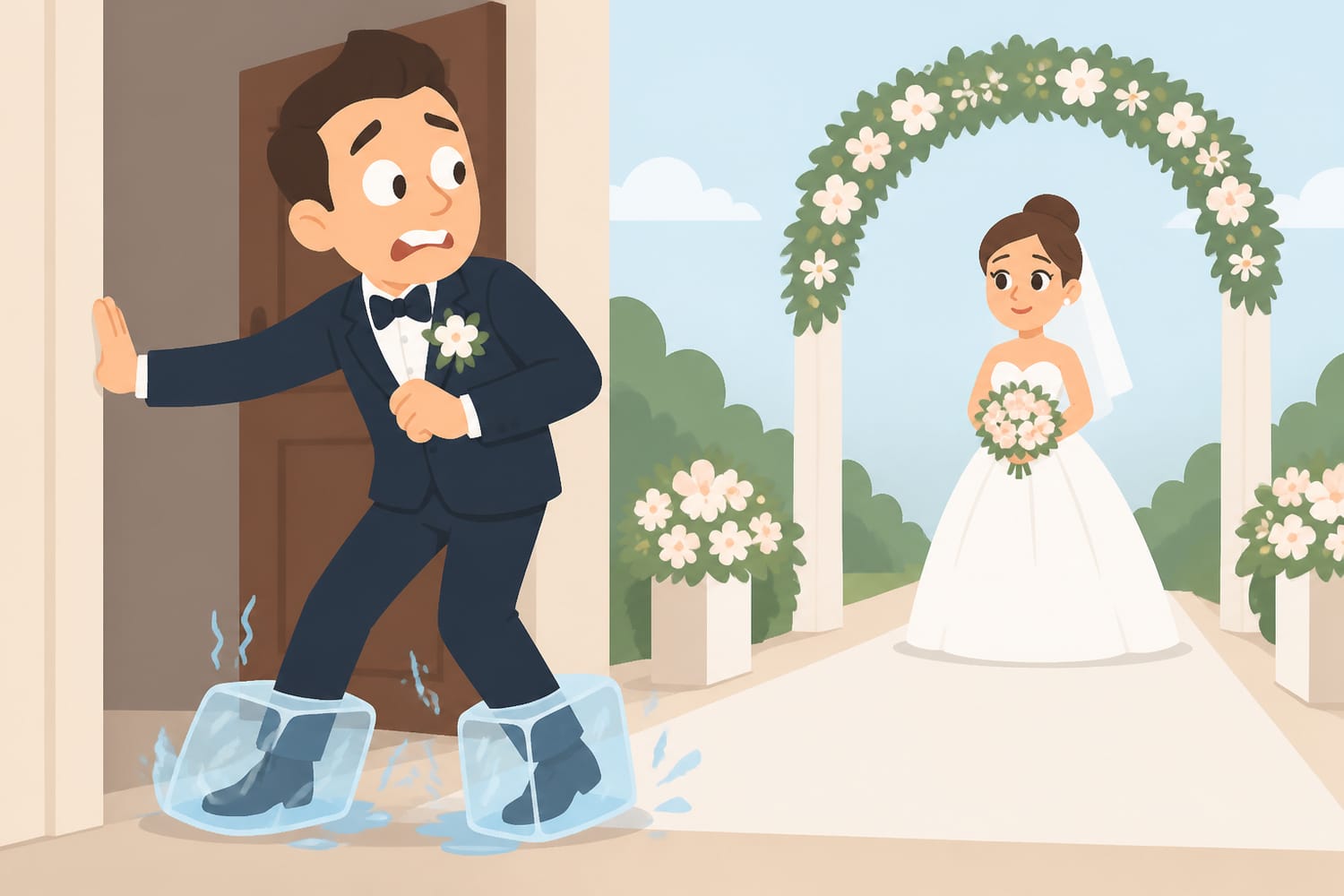
To get cold feet is to lose your nerve just as you’re about to do something you intended to do. It might happen before a wedding, a job change, or a speech. The image fits: when you feel afraid, it can seem hard to take the next step. But the exact origin of the expression remains uncertain.
What Does “Get Cold Feet” Mean?
Picture someone who has spent months planning a move. The boxes are packed, the lease is signed, and the van is booked. Then, the night before departure, they wonder whether they should stay put.
They’ve got cold feet.
The phrase usually describes a change in confidence before an anticipated action, not a settled dislike of the idea. If you never wanted to move, you didn’t get cold feet; you were unconvinced from the start. If you were excited until the move became real, the expression fits beautifully—though perhaps not comfortably.
Weddings are a familiar setting, but marriage doesn’t have exclusive rights to chilled toes. You can get cold feet before accepting a promotion, auditioning for a play, signing up for a marathon, or asking someone out. The plan matters enough that backing away feels possible, tempting, or both.
Nor does the phrase always mean someone actually backs out. “I got cold feet, but I went through with it” makes perfect sense. The cold feet were the moment of hesitation; what happened next is another story.
Why Feet?
Feet are what carry us forward. If you’re standing at the edge of a big decision, a phrase that draws attention to your feet gives the feeling a physical shape: you were ready to go, and now you’re rooted to the spot.
That’s an appealing way to understand the expression. It isn’t, however, a proven account of how it began. Language history has a habit of resisting explanations that are just a little too perfect. The Phrase Finder, which researches idioms and their origins, says the reason “cold feet” acquired its figurative meaning is unclear.
There is a real bodily connection worth noting. Stress and anxiety can make hands and feet feel cold as part of the body’s fight-or-flight response, as Cleveland Clinic explains. That makes the idiom feel surprisingly plausible. It does not establish that someone observed anxious, cold-footed people and coined the phrase on the spot. A possible physical explanation and a documented word origin are different things.
What Do the Earliest English Examples Tell Us?
The written trail takes us to the late nineteenth century. The Online Etymology Dictionary’s entry for cold feet dates its figurative American English use—fear or doubt that reverses an intention—to 1893. Collins likewise places the expression in the 1890–95 period.
A particularly memorable example appears in the 1896 edition of Stephen Crane’s novel Maggie: A Girl of the Streets. A character says, “They got cold feet.” He isn’t issuing a weather report. He means that someone failed to follow through. The Phrase Finder’s account includes this example while acknowledging that it doesn’t reveal why the expression was coined.
Did Crane invent it? We can’t conclude that from its appearance in his novel. A dated example tells us the phrase was in use by then, not that it sprang into existence on the day the book was printed. People talk far more than they publish, and everyday speech rarely keeps minutes.
Was It About Gamblers—or Money?
Here’s where the story gets interesting. The Online Etymology Dictionary notes a possible connection to a Lombard expression associated with having no money. It also points out that some early English uses involved gamblers. That combination suggests a possible route from being unable—or unwilling—to keep playing to losing the nerve to proceed. But it remains a possibility, not a solved case.
Imagine a card player sitting at a table as the stakes rise. If they stop playing, is it because their money has run out, their confidence has run out, or they’re wisely deciding that one more hand is a terrible idea? From across the room, those can look remarkably similar.
It’s a useful scene for thinking about how meanings might shift. It would be a mistake, though, to present that scene as the expression’s confirmed birthplace. Early uses and related expressions offer clues; they don’t give us a witness who can say exactly what the first speaker meant.
Why Do We Associate Cold Feet With Weddings?
Because a wedding makes the idea vivid. There’s a date, an audience, and a decision with enormous personal meaning. Someone who was cheerful while choosing flowers may feel quite different when they’re expected to walk down the aisle.
Still, the expression itself is broader than wedding nerves. Its basic meaning is a loss of courage or confidence, not specifically fear of marriage. A person might have cold feet about proposing, but they could just as easily have cold feet about taking a new job or stepping onto a stage.
That stage offers a nice contrast with another familiar idiom. Before a performance, someone may wish you good luck by saying “break a leg.” If you suddenly want to cancel the performance, you’ve got cold feet. One expression cheers you toward the spotlight; the other captures your urge to retreat from it.
Cold Feet, Butterflies, and Second Thoughts
English gives us plenty of ways to describe the uneasy moments before a big event. They overlap, but they aren’t quite interchangeable.
Butterflies in your stomach emphasize the fluttery feeling of nervous anticipation. You might have butterflies before giving a speech while remaining eager to give it. If those nerves make you reconsider whether you’ll speak at all, cold feet becomes more precise. For a delightfully old-fashioned name for stomach-centered jitters, there’s also collywobbles.
Second thoughts emphasize reconsideration. They may be calm and practical: perhaps new information shows that a house needs expensive repairs. Cold feet adds the flavor of nerves or a faltering resolve. You can have both at once, but you don’t need to.
And cold feet isn’t the same as cowardice. The expression describes a feeling or hesitation; it doesn’t tell us whether the decision is good, bad, brave, or foolish. Sometimes moving forward is right. Sometimes the hesitation deserves a closer look.
How Do You Use the Phrase Naturally?
The usual forms are “get cold feet” and “have cold feet.” The first often points to the moment confidence wavers; the second describes the state someone is in.
- “I was ready to apply, but I got cold feet when I saw the interview date.”
- “She has cold feet about moving across the country.”
- “We nearly canceled the trip because we got cold feet.”
Notice that each example involves something planned or seriously considered. If you’re merely wondering whether you might do something someday, “cold feet” can sound premature. The phrase works best when there’s a next step to hesitate over.
The Takeaway
We say someone gets cold feet when their confidence cools just as it’s time to act. The expression is recorded in American English in the 1890s, but no single explanation for its origin has been proved. Gambling, money, and the physical sensations of fear all offer interesting possibilities; none should be mistaken for a definitive answer.
Perhaps that uncertainty is fitting. Cold feet describe a moment when a person hasn’t quite decided what comes next. The phrase’s history leaves us in much the same position: standing at the threshold, looking for one more clue before we take the next step.