The Short Answer
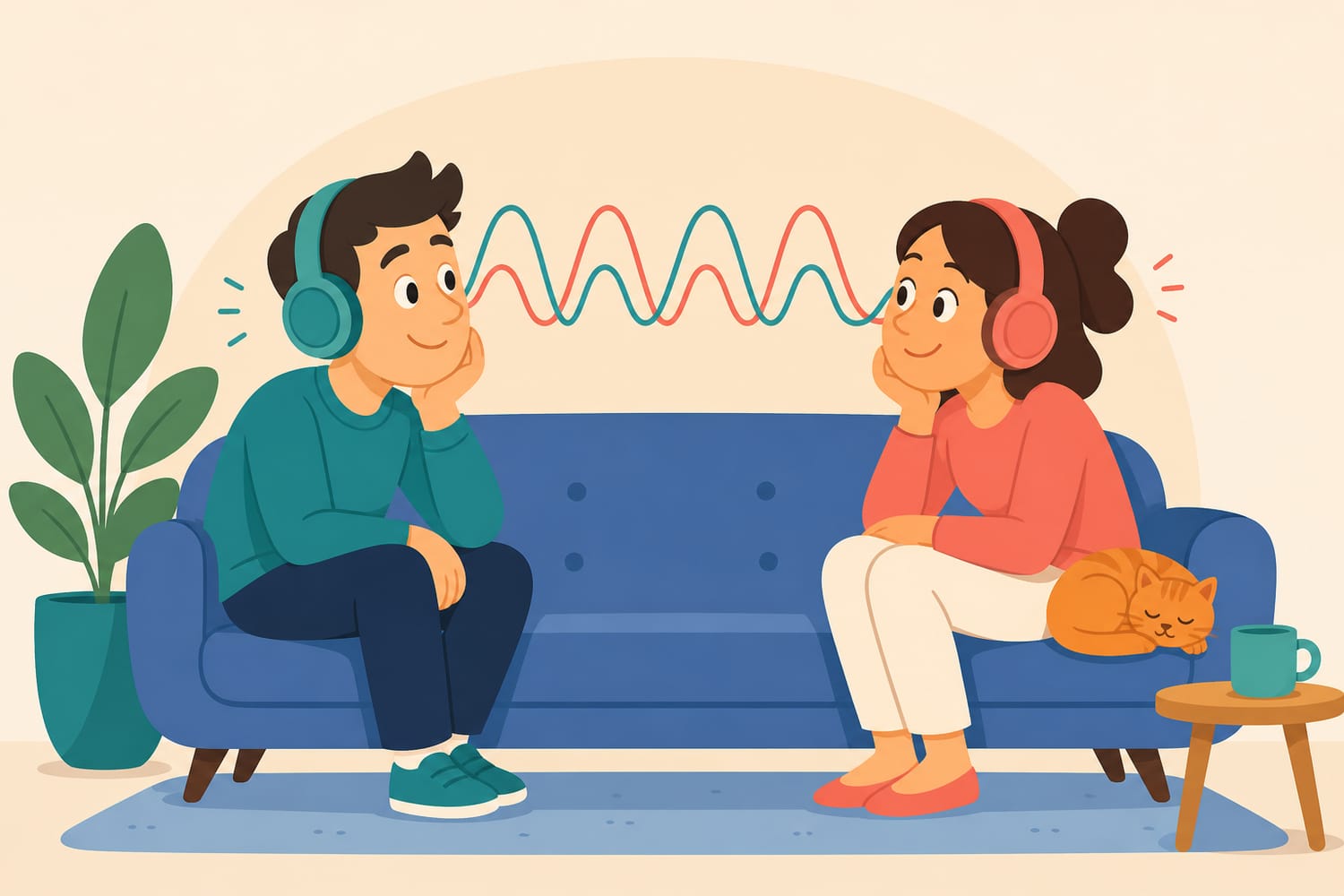
We say people are “on the same wavelength” when they think alike, understand each other easily, or share similar feelings. The expression comes from early radio technology: a receiver had to be tuned to the wavelength of a transmitted signal to pick it up clearly. Human understanding became the metaphorical signal.
What Does “On the Same Wavelength” Mean?
If two people are on the same wavelength, communication between them feels unusually easy. They may share the same opinion, anticipate each other’s reactions, or understand what the other person means without needing a lengthy explanation.
You might say:
- “My sister and I are on the same wavelength when it comes to travel.”
- “The designers were immediately on the same wavelength.”
- “I don’t think our manager and the client are on the same wavelength.”
- “We both suggested tacos at exactly the same moment. Clearly, we’re on the same wavelength.”
The expression usually suggests more than simple agreement. You can agree with someone’s conclusion while reaching it in a completely different way. Being on the same wavelength implies a deeper sense of mental harmony—as though your thoughts are traveling along the same invisible channel.
That is why the phrase works equally well for opinions, humor, emotions, creative ideas, and working styles. The Cambridge Dictionary definition of “on the same wavelength” sums it up as thinking in the same way as another person.
The Radio Technology Behind the Expression
To understand the phrase, imagine operating an old-fashioned radio.
Radio signals travel as electromagnetic waves. Every wave has a wavelength, meaning the distance between corresponding points on successive waves—such as one crest and the next. Wavelength is closely related to frequency: as frequency increases, wavelength decreases, provided the wave is traveling through the same medium.
In radio broadcasting, a station transmits its signal using a particular carrier frequency. A listener must tune a receiver to that signal. Tune correctly, and music or speech emerges. Tune poorly, and you may hear static, interference, or another station trying to sell you something at alarming volume.
Today, people generally identify broadcast stations by frequency, such as “101.5 FM.” During radio’s early development, however, stations and radio bands were also commonly described by wavelength, often measured in meters. A station might therefore be identified by the length of its radio waves rather than by the frequency number familiar to modern listeners.
Radio itself became practical around the turn of the 20th century. The Museum for Communication Nuremberg’s history of radio traces its development from the theoretical work of James Clerk Maxwell and the experiments of Heinrich Hertz to early wireless links and the successful transmission of speech and music.
Against that technological background, being “on the same wavelength” created a wonderfully clear mental picture. If two devices were properly tuned, the message came through. If two people were mentally “tuned” to one another, their meaning came through too.
When Did the Phrase Become Figurative?
The word wavelength was in scientific use during the 19th century, long before families gathered around radios for news and entertainment. Merriam-Webster dates its first known use to 1850, when it referred to the physical measurement of a wave.
Its metaphorical journey began once radio entered everyday life. According to the Online Etymology Dictionary’s history of wavelength, the radio-related sense was established by the 1920s, and figurative references to mental harmony are recorded by 1927.
That does not necessarily mean someone invented the full expression during a single dramatic conversation in 1927. Idioms rarely arrive with a ribbon-cutting ceremony. They tend to develop gradually as speakers notice that a technical idea also describes an ordinary human experience.
Radio provided the perfect metaphor. Its concepts—signals, interference, reception, tuning, and static—were becoming familiar to the public. People naturally began borrowing those concepts to talk about communication between minds.
The expression was especially useful because it described something older phrases did not capture quite as vividly: the feeling that another person is receiving your meaning accurately, almost as soon as you transmit it.
Why the Metaphor Works So Well
“On the same wavelength” has survived because it turns an invisible social connection into something we can picture.
Thoughts cannot literally be placed beside one another and measured. Yet most of us recognize the experience of meeting someone who immediately understands our humor, priorities, or point of view. Conversation flows. Explanations become shorter. Occasionally, both people say the same thing at once and then stare at each other as though they have briefly acquired telepathy.
The radio metaphor captures several parts of that experience:
- There is a sender and a receiver. One person expresses an idea, and another interprets it.
- Tuning matters. Attention, shared knowledge, and empathy help someone understand the intended message.
- Interference is possible. Assumptions, distractions, cultural differences, or unclear language can distort communication.
- A clear signal feels effortless. When people understand one another, the exchange can seem almost instantaneous.
Of course, human beings are far more complicated than radios. You cannot improve a family disagreement by turning your uncle slightly to the left and adjusting his antenna. Still, the comparison is instantly understandable.
Is It the Same as “On the Same Page”?
The expressions “on the same wavelength” and “on the same page” overlap, but they are not always identical.
Being on the same page usually means sharing an understanding of a particular plan, situation, or goal:
“Before we announce the schedule, let’s make sure everyone is on the same page.”
Being on the same wavelength often suggests broader personal compatibility:
“We had only just met, but we were immediately on the same wavelength.”
A project team might get on the same page after reviewing a document, even if its members have very different personalities. Two friends may be on the same wavelength because they naturally share a sense of humor, yet still disagree about where to eat dinner.
Other related expressions include:
- See eye to eye: agree about something.
- Think alike: have similar thoughts or ideas.
- Be in sync: work or react harmoniously.
- Speak the same language: understand one another’s outlook or priorities.
- Be of one mind: share an opinion or intention.
The distinction is subtle, and everyday usage varies. English speakers are not usually running a full idiom inspection before talking. In many situations, either “same page” or “same wavelength” will make sense.
Can People Be on Different Wavelengths?
Absolutely—and this version of the expression is often just as useful.
If two people are on different wavelengths, they are approaching a subject with different assumptions, expectations, or emotional states. One person may be discussing practical details while the other is looking for reassurance. Both may be speaking clearly, yet neither is receiving the message the other intends.
For example:
“I was talking about keeping costs down, but she thought I was criticizing her work. We were on completely different wavelengths.”
The phrase can soften criticism because it does not automatically blame either person. It suggests a problem of alignment rather than stupidity or bad intentions. Nobody has to be “wrong”; the mental radios simply need retuning.
When that happens, it helps to:
- Ask what the other person understood.
- Explain the intention behind your words.
- Identify any assumptions you are making.
- Replace vague phrases with specific examples.
- Summarize what you agree on before discussing differences.
Uncover Words’ guide to asking smart questions offers useful ways to clarify what someone means, while these smarter alternatives to simply saying “I agree” can help turn shared understanding into a more productive conversation.
A Phrase That Traveled Beyond the Radio
Although many people now stream music through phones and smart speakers, the expression remains alive and well. A person does not need to have tuned an antique radio—or even know precisely what a wavelength is—to understand the metaphor.
That is one of language’s cleverest habits. It preserves traces of technologies long after our relationship with those technologies has changed. We still “dial” telephone numbers, “hang up” calls, and “rewind” videos, even when there is no rotary dial, receiver hook, or tape involved.
“On the same wavelength” belongs to that linguistic time capsule. It carries the excitement of early radio into modern conversations, meetings, friendships, and relationships.
So, the next time someone understands exactly what you mean before you have finished explaining it, you can thank a century of radio history—and enjoy the rare pleasure of receiving a perfectly clear signal.