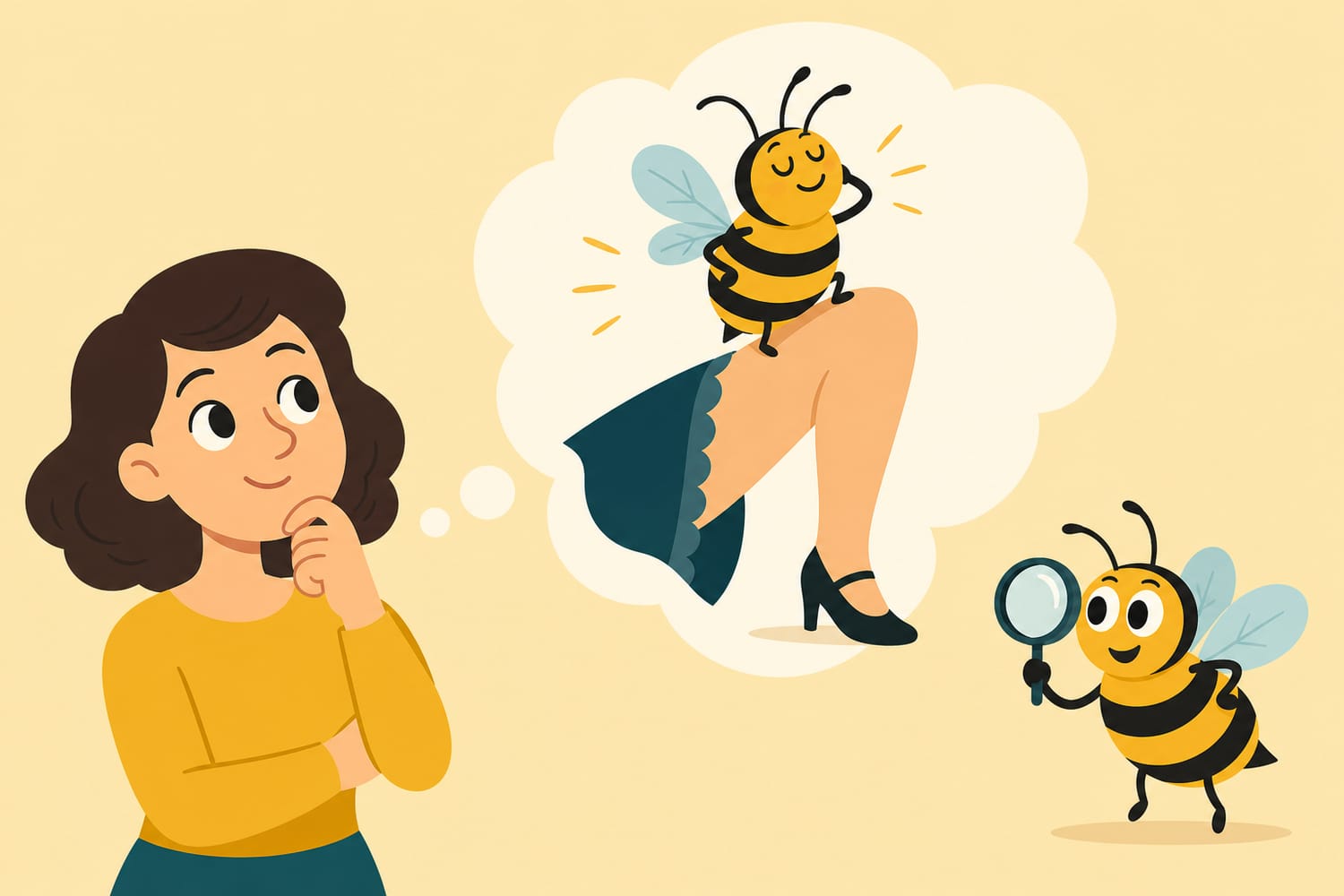
Why Do We Say “The Bee’s Knees”—And What Do Bees Have to Do With It?
What Does “The Bee’s Knees” Mean?
To call someone or something “the bee’s knees” is to say it is excellent, outstanding, or highly admired. The expression became a Jazz Age favorite, but its history stretches back further—and takes a surprising turn from “ridiculously tiny” to “absolutely wonderful.” Actual bee anatomy probably had little to do with it.
You might use the phrase to praise almost anything:
- “That bakery’s lemon tart is the bee’s knees.”
- “My new neighbor fixed the gate for free. She’s the bee’s knees.”
- “Pockets in formal clothing? The absolute bee’s knees.”
Today, the expression often sounds playfully old-fashioned. It delivers a compliment with more sparkle than simply saying “That’s good.” It is praise wearing a bow tie and doing a little Charleston.
The Phrase Originally Meant Something Tiny
Long before the bee’s knees represented greatness, a bee’s knee represented smallness.
One early example appears in a letter dated June 27, 1797, in the comparison “not as big as a bee’s knee.” That makes intuitive sense: if a bee has knees, they must be extremely small. Similar uses continued through the 19th century, with people describing tiny portions as being no bigger than a bee’s knee.
Around the beginning of the 20th century, however, the phrase grew stranger. “Bee’s knees” began appearing alongside imaginary delicacies and impossible objects such as clam’s ankles, seedless orange seeds, and fried ice cream. In one sense, it worked like “tartan paint” or a “left-handed screwdriver”—something absurd that could not reasonably be requested or supplied.
Then the meaning flipped.
Instead of referring to something tiny, insignificant, or fanciful, the bee’s knees came to describe something exceptional. Detailed historical research has identified a possible transitional use in Australia in 1905, an unambiguous complimentary use in England in 1910, and an American military example from 1917. Merriam-Webster dates its first known use in the familiar modern sense to 1920, reflecting the period when the expression became widely visible in print.
Language does this occasionally. A phrase can drift, gather new associations, and eventually mean nearly the opposite of what it once meant. For another expression whose history is less straightforward than it appears, explore why we say “Cat got your tongue?”.
The Jazz Age Loved Nonsensical Compliments
“The bee’s knees” found its perfect habitat in the 1920s, a decade filled with energetic music, changing fashions, social experimentation, and gloriously inventive slang.
People did not merely call something wonderful. They called it:
- The cat’s pajamas
- The cat’s meow
- The snake’s hips
- The clam’s garters
- The elephant’s tonsils
- The bullfrog’s beard
- The canary’s tusks
Some of these expressions survived. Others disappeared, perhaps because society was not prepared to appreciate the full majesty of a well-dressed clam.
There was no need for such phrases to make literal sense. In fact, nonsense was part of the attraction. An impossible animal feature sounded rare, surprising, and special. If something was as remarkable as a snake with hips or a canary with tusks, it must have been worth noticing.
“The bee’s knees” also benefits from rhyme. Bees and knees create a short, bouncy phrase that is easy to remember and satisfying to say. It belongs to the same playful side of English celebrated in these funny-sounding words that are completely real.
So, Do Bees Actually Have Knees?
Sort of—and this is where entomology buzzes into the story.
Bees have six jointed legs. Each leg includes sections called the coxa, trochanter, femur, tibia, and tarsus. Because humans also use the words femur and tibia, the joint between those two sections can reasonably be nicknamed a bee’s “knee.” It is not a human-style knee, however. There is no miniature kneecap waiting to be fitted with an even tinier knee brace.
A bee’s legs are impressive tools. Depending on the leg and species, they help the insect walk, grip surfaces, groom its body, clean its antennae, and collect or carry pollen. The honey bee anatomy guide from Arizona State University explains that the pollen basket of a honey bee’s hind leg is located on the tibia.
That pollen basket has inspired a popular explanation for the idiom: perhaps bee knees were considered wonderful because valuable pollen accumulated nearby.
It is a charming idea. Unfortunately, there is no solid historical evidence that pollen baskets created the expression’s complimentary meaning. The phrase appears to have developed through slang and wordplay, not careful observation of insect legs.
In other words, bees really do have knee-like joints—but their knees probably did not earn the phrase its meaning.
Popular Origin Stories That Don’t Quite Fly
Famous expressions attract neat explanations in the same way picnic tables attract wasps. Unfortunately, the neatest stories are not always the most accurate.
It Came From “The Business”
One theory claims that “the bee’s knees” is a playful reshaping of “the business,” which can also mean something excellent or exactly right. Say “business” in a sufficiently theatrical voice and it may sound vaguely like “bee’s knees.”
The resemblance is entertaining, but resemblance is not proof. Earlier uses of “bee’s knee” and “bee’s knees” show that the expression had its own history. Researchers have not found convincing evidence that it began as a mispronunciation of “the business.”
It Was Inspired by a Dancer Named Bee Jackson
Another story credits Bee Jackson, a 1920s dancer known for performing the Charleston. According to the tale, audiences were so impressed by Bee’s energetic knees that they began calling wonderful things “Bee’s knees.”
The problem is timing. The complimentary phrase was already in use before Jackson became famous. She may have provided an irresistible pun, but she did not originate the expression.
It Refers to Pollen as “The Good Stuff”
Bees carry pollen on specialized hairs or, in certain species, in baskets on their hind legs. This has encouraged the claim that the knees were praised because that was where bees kept something valuable.
Again, it is a tidy explanation assembled after the fact. The anatomy is real; the proposed etymology is unsupported.
These stories illustrate an important rule of word history: a plausible origin is not necessarily the true origin. The same warning applies to many familiar idioms, including the competing theories surrounding “Raining cats and dogs”.
The Bee’s Knees Became a Drink, Too
A phrase associated with fashionable 1920s slang was almost destined to end up on a cocktail menu.
The Bee’s Knees cocktail combines gin, honey, and citrus. Recipes vary, but the official International Bartenders Association version uses dry gin, honey syrup, fresh lemon juice, and fresh orange juice. The name is a wink to the expression’s “excellent” meaning, while the honey provides the obvious bee connection.
Unlike the idiom, then, the cocktail really does owe something to bees—or at least to their honey-making work.
The drink also helped reinforce the phrase’s Jazz Age image. Even now, “Bee’s Knees” sounds perfectly at home beside polished glasses, vintage clothing, and music drifting from a smoky piano bar.
How to Use “The Bee’s Knees” Today
The phrase remains understandable, but it carries a cheerful retro flavor. It works best when you want praise to sound affectionate, humorous, or deliberately quaint.
Good situations include:
- Complimenting a person: “Grandpa thinks his new physical therapist is the bee’s knees.”
- Praising an object: “This little handheld vacuum is the bee’s knees.”
- Celebrating food: “Those cinnamon rolls are truly the bee’s knees.”
- Adding comic exaggeration: “A spreadsheet that totals itself? The bee’s knees!”
Because the phrase is informal, it may sound out of place in a legal document, scientific report, or solemn announcement. Then again, a tax form described as “the bee’s knees” would at least be memorable.
The standard spelling is “the bee’s knees.” The apostrophe comes after bee because the knees belong—grammatically, if not philosophically—to one bee. The idiom is fixed in this singular possessive form, even though real bees have multiple knee-like joints.
Why Has This Strange Expression Survived?
Most of the era’s animal-based compliments vanished. Few people now praise a new haircut by calling it “the elephant’s instep.” Yet “the bee’s knees” survived.
Its staying power probably comes from several qualities working together:
- It rhymes. Rhyming expressions are easy to remember.
- It creates a funny picture. Imagining tiny bee knees gives the phrase instant personality.
- Its meaning is positive. Compliments remain useful in every generation.
- It sounds nostalgic. The phrase evokes the lively slang of the Jazz Age without being difficult to understand.
- Bees are familiar. They appear in gardens, stories, foods, symbols, and numerous English expressions.
Most importantly, saying “the bee’s knees” is simply more fun than saying “excellent.” It turns an ordinary compliment into a miniature performance.
A Tiny Phrase With a Remarkable Journey
“The bee’s knees” began with the idea of something extremely small, wandered through a world of imaginary foods and absurd animal parts, and emerged as a sparkling compliment. Its popularity surged around the 1920s, when playful expressions such as “the cat’s pajamas” were all the rage.
Bees themselves played only a supporting role. They possess knee-like leg joints and remarkable pollen-carrying equipment, but neither fact convincingly explains the idiom. The expression’s real fuel was human creativity: our fondness for rhyme, exaggeration, nonsense, and praise with a bit of theatrical flair.
So, the next time something is genuinely first-rate, feel free to call it the bee’s knees. You will be using a phrase with more than two centuries of history—and giving the humble bee credit for a compliment it probably never asked for.