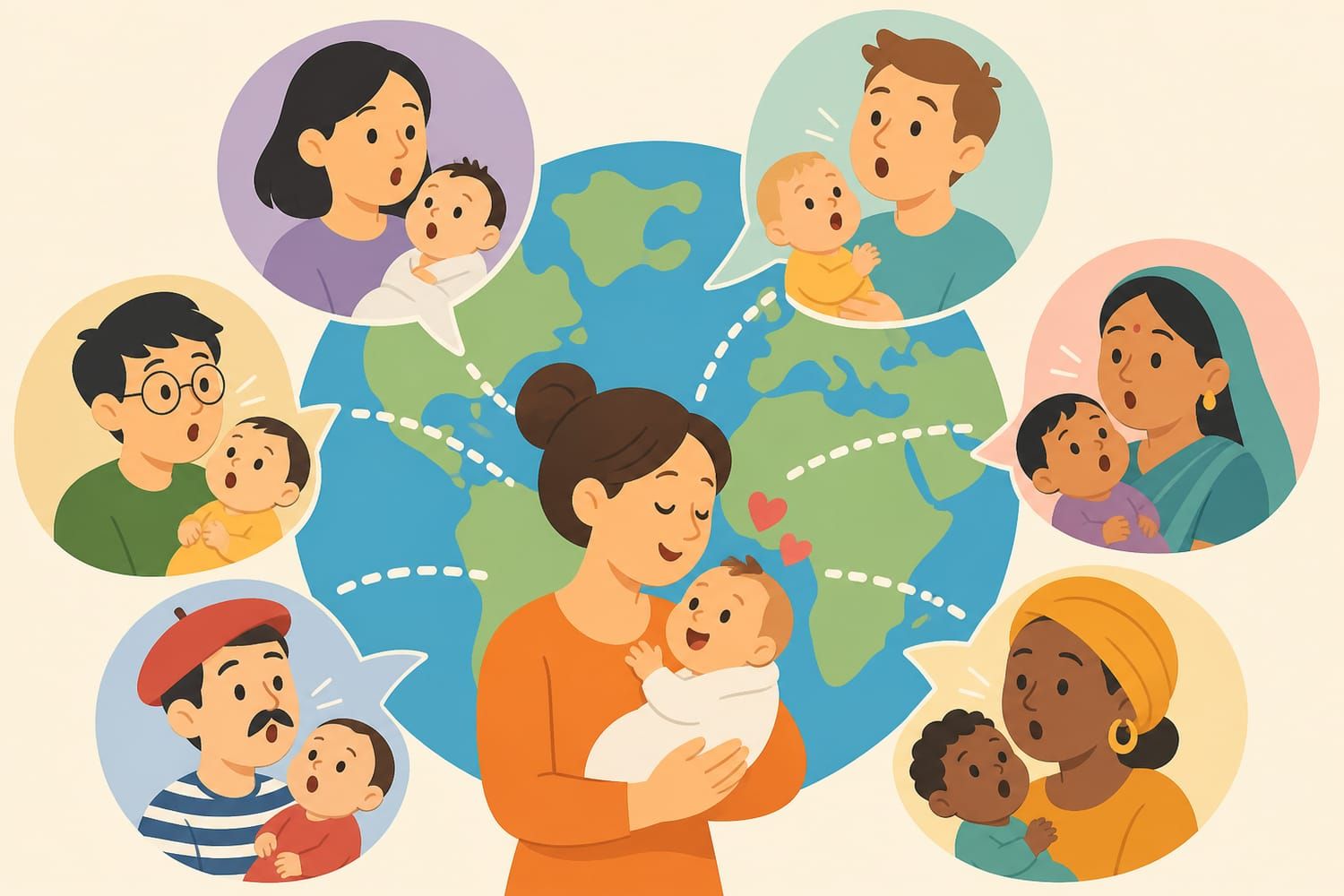
The Short Answer: Babies Help Shape the Words
Words for “mom” often sound alike across languages because babies tend to babble simple, repeated syllables such as ma-ma, and caregivers can turn those sounds into familiar names. It’s a strong pattern, not a universal rule—and it doesn’t mean every language inherited mama from one ancient word.
That answer is charmingly simple. The full story is even better: it involves tiny mouths learning to move, adults listening for meaning, and languages occasionally doing exactly the opposite of what you expect.
Start With a Baby’s Mouth
Try saying ma. Your lips meet, your voice hums through your nose, and your jaw opens for the vowel. Now say it twice: ma-ma. No tricky tongue-twisting required.
The m sound is made with the lips closed, while a can be produced with an open mouth. Babies also practice repeated syllables as they learn to coordinate their voices and mouths. That makes sequences such as mamama, bababa, and dadada familiar features of early babbling—not proof that a baby has already chosen a favorite parent.
Repeating a syllable has a name: reduplication. It turns ma into mama and da into dada. For a baby practicing new movements, repetition makes sense. For an adult listening nearby, it sounds remarkably like the beginning of a conversation.
This helps explain why parent names often draw from a small collection of simple sounds: m, n, p, b, t, and d. It does not mean every child produces them in the same order, or that mama is automatically every baby’s first word.
How Does Babbling Become a Name?
Picture a baby cheerfully announcing “mamamama” to the ceiling fan. A caregiver hears it, smiles, and responds: “Mama’s here!” Over many interactions, a sound the baby was practicing can become associated with a particular person.
There is an important difference between making a word-like sound and using a word with meaning. A baby might say mama while playing, hungry, or looking at absolutely nothing in particular. Later, the child may use it consistently to get someone’s attention. The American Academy of Pediatrics describes this shift from accidentally producing recognizable syllables to using words deliberately.
Adults are part of the process, too. We repeat what babies say, offer words back to them, and respond when a sound seems to be directed at us. A child doesn’t have to invent the family vocabulary from scratch; they are learning the names people around them already use.
As Uncover Words explores in its article on how baby talk differs around the world, caregivers speak to infants through the sounds and habits of their own languages. A baby’s vocal experiments and a community’s existing words meet somewhere in the middle.
A Little World Tour of “Mom”
The resemblance is easy to spot in familiar forms. English has mom, mum, and mama. Spanish has mamá. Mandarin has 妈妈, commonly written māma in pinyin. These words look strikingly similar on the page, though their pronunciation and place in each language are not identical.
And then there is Georgian, ready to keep everyone humble: mama means “father,” while deda means “mother.” The sounds are familiar, but their assignments are different. If ma naturally and inevitably meant “mother,” Georgian would be difficult to explain. If simple syllables can become family names through language and social convention, Georgian fits the picture just fine.
Other languages remind us that mama is only one possibility. Japanese speakers commonly use okāsan to address or refer to someone’s mother, while Indonesian uses ibu. Looking only for ma words gives us a delightful pattern—but not a complete map of how the world says “mom.”
Even within one language, a family nickname and a more formal word can sound quite different. English speakers may say Mom at home and mother in a formal introduction. Spanish has mamá and madre. Comparing mama-like nicknames in one language with dictionary terms in another can make the pattern seem either stronger or weaker than it really is.
Does This Mean All Languages Share One Original “Mama”?
Not necessarily. Similar-sounding words can arise for different reasons, and linguists need more than a matching syllable to establish a shared origin.
Consider English mother and Spanish madre. Those words are related through the Indo-European language family: they descend, by different historical routes, from an older ancestral form. The Online Etymology Dictionary’s history of mother traces the English word through Old English and earlier forms and notes relatives including Latin māter. That is a case of inheritance—related languages passing a word down over time.
But the appearance of mama-like parent names in historically unrelated languages cannot, by itself, demonstrate that they all preserved one identical prehistoric word. Another explanation is recurring invention: babies in different places make some of the same accessible sounds, and people repeatedly put those sounds to use as names.
Both processes can matter. Languages inherit words, borrow them from neighbors, and create or reinforce affectionate forms through everyday family life. The resemblance is real; the mistake would be insisting that it has only one cause. A cross-language study cataloged by Yale’s Human Relations Area Files found that ma, na, pa, and ta sound classes are especially common in parental terms—evidence of a tendency, not an exception-free rule.
Why Do “Dad” Words Get in on the Act?
Once you notice mama, it is hard not to notice papa, baba, dada, and tata. They have the same satisfying, two-beat rhythm. They also use sounds that appear in early babbling.
But there is no worldwide agreement that papa must mean “father,” any more than there is a rule that mama must mean “mother.” Languages choose among these sounds in different ways. Georgian’s mama for “father” is the wonderfully memorable reminder.
The pattern extends beyond parents. Repeated, easy-to-say forms also turn up among names for grandparents and other relatives, although the relationships those names identify vary by language and culture. That variety is part of the story behind why languages have different words for grandparents. A sound may be easy to say; a family and its language decide whom it names.
A Familiar Sound, Not a Universal Translation
So, why do words for “mom” sound so similar? Because humans share some of the same early speech abilities, and caregivers everywhere have good reason to notice—and respond to—the sounds babies make. Simple syllables can become affectionate, durable family names.
Yet mom words also carry histories that babbling alone cannot explain. They can be inherited, reshaped, borrowed, or assigned to different relatives altogether. The next time you hear mama in another language, enjoy the resemblance. Just check whom the speaker is calling before you turn around.