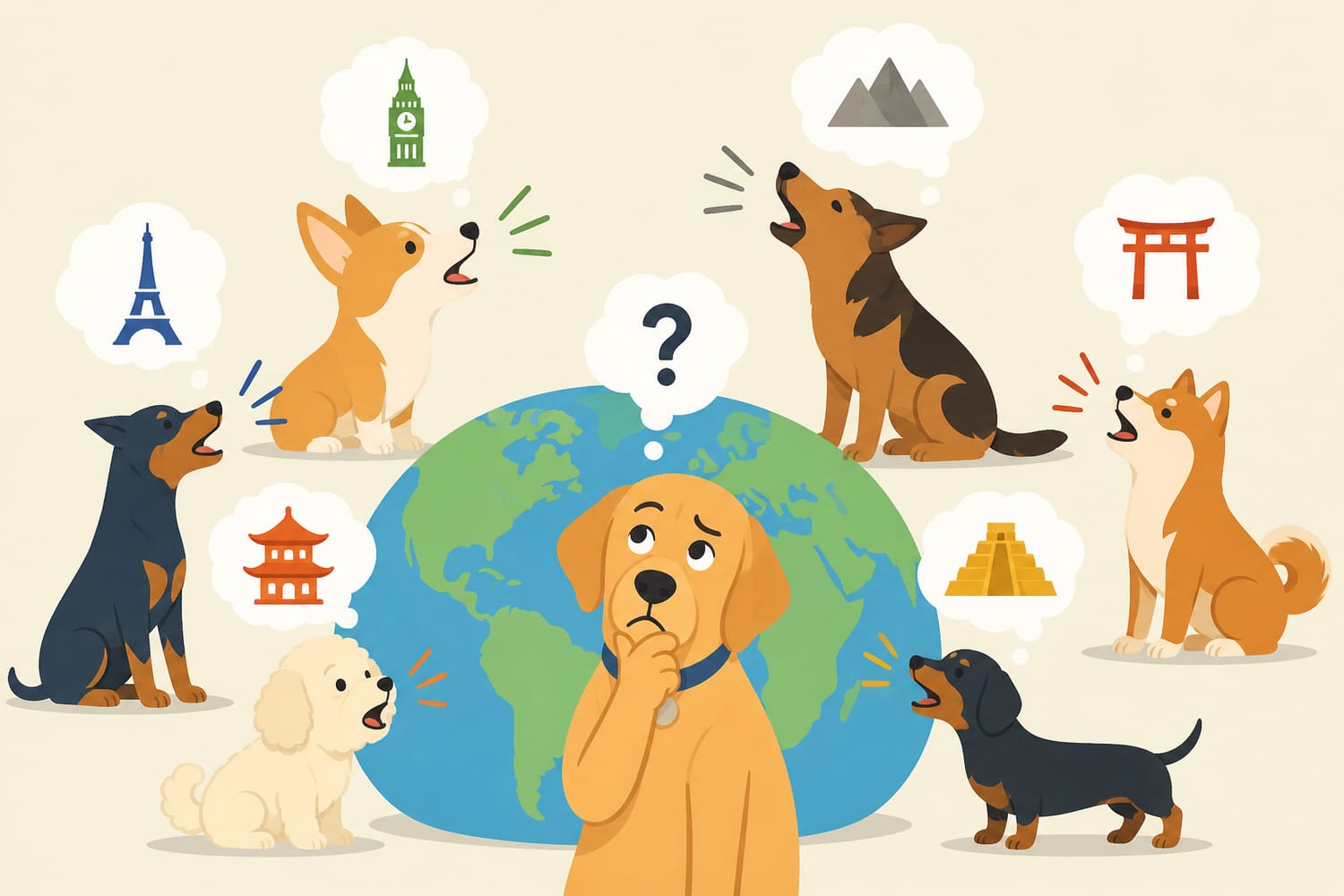
The Short Answer: Humans Translate Barks Into Words
Dogs do not literally say “woof.” They produce complex vocalizations, and humans squeeze those sounds into the familiar building blocks of their own languages. English speakers hear woof, Japanese speakers hear wan, and Spanish speakers hear guau. The dog supplies the bark; language supplies the spelling.
A Bark by Any Other Name
Ask an English-speaking child what a dog says, and the answer will probably be “woof-woof,” “ruff-ruff,” or “bow-wow.” Ask the same question elsewhere, and the neighborhood dogs suddenly seem remarkably multilingual.
Here are a few common ways people represent barking:
| Language | Conventional dog sound | |---|---| | English | woof-woof, ruff-ruff, bow-wow | | Spanish | guau-guau | | French | ouaf-ouaf | | Italian | bau-bau | | Japanese | wan-wan | | Korean | meong-meong | | Russian | gav-gav | | Mandarin Chinese | wang-wang | | German | wau-wau or wuff-wuff | | Turkish | hav-hav |
Exact spellings and preferred forms can vary by region, speaker, and source. Even within English, a large guard dog may go woof, a terrier may go yap, and a cartoon puppy may say bow-wow while wearing an improbably large bow tie.
The animals are not changing their accents at national borders. Instead, people are interpreting a noisy, irregular natural sound through different linguistic systems. Collections of dog sounds from around the world reveal just how inventive those interpretations can be.
The Wonderful World of Onomatopoeia
Words such as woof, buzz, hiss, clang, and splash are examples of onomatopoeia. The Cambridge Dictionary definition of onomatopoeia describes it as creating or using words whose sounds resemble the noises they refer to.
That sounds straightforward, but onomatopoeia is not the same thing as making an audio recording.
If someone drops a metal tray, the actual noise is a chaotic burst of vibrations. English might package it as clang, clatter, crash, or bang. None is a perfect reproduction. Each word captures a particular feature of the event and turns it into something a human mouth can pronounce.
Dog sounds work the same way. A bark contains changes in pitch, loudness, duration, rhythm, and noisiness. Humans listen to that acoustic jumble and create a manageable verbal imitation.
In other words, woof is not the bark itself. It is an English-language sketch of a bark.
Every Language Has Its Own Sound Toolbox
Languages do not all use the same collection of speech sounds. They also have different rules about how those sounds may be combined.
English comfortably permits words beginning with w and ending with f, making woof feel perfectly pronounceable. Another language may favor open syllables ending in vowels, avoid certain consonant clusters, or use consonants that English speakers find difficult to distinguish.
Linguists call a language’s meaningful sound categories phonemes. The rules governing how those sounds can be arranged are known as phonotactics.
When people imitate a dog, they normally reach for sounds already available in their linguistic toolbox. A bark must therefore pass through several filters:
Which part of the bark attracts attention?
One listener may notice its rounded beginning, while another focuses on its abrupt ending.Which familiar speech sounds come closest?
People tend to interpret unfamiliar noises using sound categories they already know.Which combinations are easy to pronounce?
The imitation must fit the language’s preferred syllable patterns.Which form has society already accepted?
Children usually learn an established animal sound from adults, songs, books, and cartoons.
A University of Pennsylvania Language Log discussion of animal sounds across languages highlights the influence of phonemic inventories, speech preferences, related languages, and cultural convention. It also notes that apparently different forms may still share underlying sound patterns.
Dogs Don’t Produce Just One Kind of Bark
There is another reason no written imitation can be completely correct: dogs make many different sounds.
A dog can bark, whine, howl, yelp, growl, grunt, moan, or produce something that sounds suspiciously like a complaint about the household dinner policy. Even barking itself is not a single, identical noise.
Research has found that dog barks vary with context. Barks produced during a disturbance, such as the arrival of a stranger, tend to differ acoustically from those heard during play or isolation. Pitch, duration, repetition, and tonal quality can all change.
That helps explain why English alone has so many possibilities:
- Woof suggests a rounded, substantial bark.
- Ruff often represents a rougher, shorter sound.
- Yap suggests a sharp, high-pitched bark.
- Yip sounds brief and squeaky.
- Arf captures a punchy, throaty quality.
- Bow-wow imitates a two-part rise and fall.
These are not scientific transcriptions. They are expressive labels that help people imagine different canine voices.
For more on how pitch, context, and body language contribute to interpretation, the American Kennel Club offers a reader-friendly guide to understanding different dog sounds.
Why Do We Repeat the Sound?
Dogs rarely receive just one syllable. They usually get woof-woof, wan-wan, gav-gav, or bau-bau.
This repetition is called reduplication, a linguistic process in which a sound, syllable, or word is repeated. It appears in ordinary vocabulary as well as playful and child-directed speech: bye-bye, night-night, choo-choo, and no-no.
Repetition suits animal noises because animals often vocalize in sequences. A dog seldom walks to the window, delivers one carefully edited bark, and considers the matter closed. More commonly, it produces a series: bark, bark, bark—there is a squirrel, and everyone must be informed.
Repeated forms are also rhythmic, memorable, and easy for children to say. Animal sounds are often among the playful expressions adults teach young children, which helps conventional versions survive from one generation to the next.
This connection between early learning and culturally shaped sound words also appears in baby talk around the world, where repetition, affectionate vocabulary, and animal noises reflect the patterns of the surrounding language.
Are Some Animal Sounds More Universal?
Although animal noises vary across languages, the results are not random.
Many languages represent cats with something resembling meow, miau, or miaou. Cow sounds frequently contain an m followed by a rounded vowel, as in English moo and French meuh. These similarities exist because people are listening to the same broad acoustic features and possess roughly the same human vocal equipment.
However, similarity has limits. Listeners still select, simplify, and organize sounds according to linguistic convention.
This places onomatopoeia somewhere between pure imitation and ordinary vocabulary. The English word table does not naturally sound like a table. By contrast, buzz has an obvious connection to the noise it describes—but it remains an English word shaped by English spelling and pronunciation.
Onomatopoeia is therefore not a universal sound code. It is nature filtered through language.
Culture Teaches Us What to Hear
Once a community settles on a particular animal sound, that form becomes familiar. Parents repeat it. Picture books print it. Teachers use it. Cartoons exaggerate it. Eventually, speakers stop inventing a bark from scratch and simply use the bark their language has handed them.
This can even affect perception. If you have always called a dog’s sound woof, you become especially ready to notice the “w” and “f”-like qualities in a bark. After learning Japanese wan-wan or Russian gav-gav, however, you may suddenly hear why those versions make sense too.
Language does not prevent us from hearing reality, but it encourages us to sort experience into familiar categories. The same principle appears in less playful areas of vocabulary. As explored in why some languages describe smells better than English, communities differ in which sensations they routinely label and how precisely they divide them.
Dog noises provide a cheerful demonstration of that much larger idea: people can experience the same world while organizing it in different ways.
So, What Does a Dog Really Say?
Scientifically speaking, a dog produces a vocalization with a particular acoustic structure. Socially speaking, it may be greeting someone, requesting attention, warning an intruder, expressing excitement, or objecting to the outrageous fact that dinner is three minutes late.
Linguistically speaking, the answer depends on whom you ask.
The English dog says woof. The Japanese dog says wan. The Spanish dog says guau. The Russian dog says gav. None of these is completely accurate, yet none is simply wrong.
Each is a tiny act of translation—a natural sound reshaped by human ears, mouths, spelling systems, childhood traditions, and cultural expectations.
So the next time a dog barks, listen carefully. You may hear woof. Someone else may hear wan. The dog, meanwhile, is probably just saying, “There’s someone at the door, and I have handled the situation.”