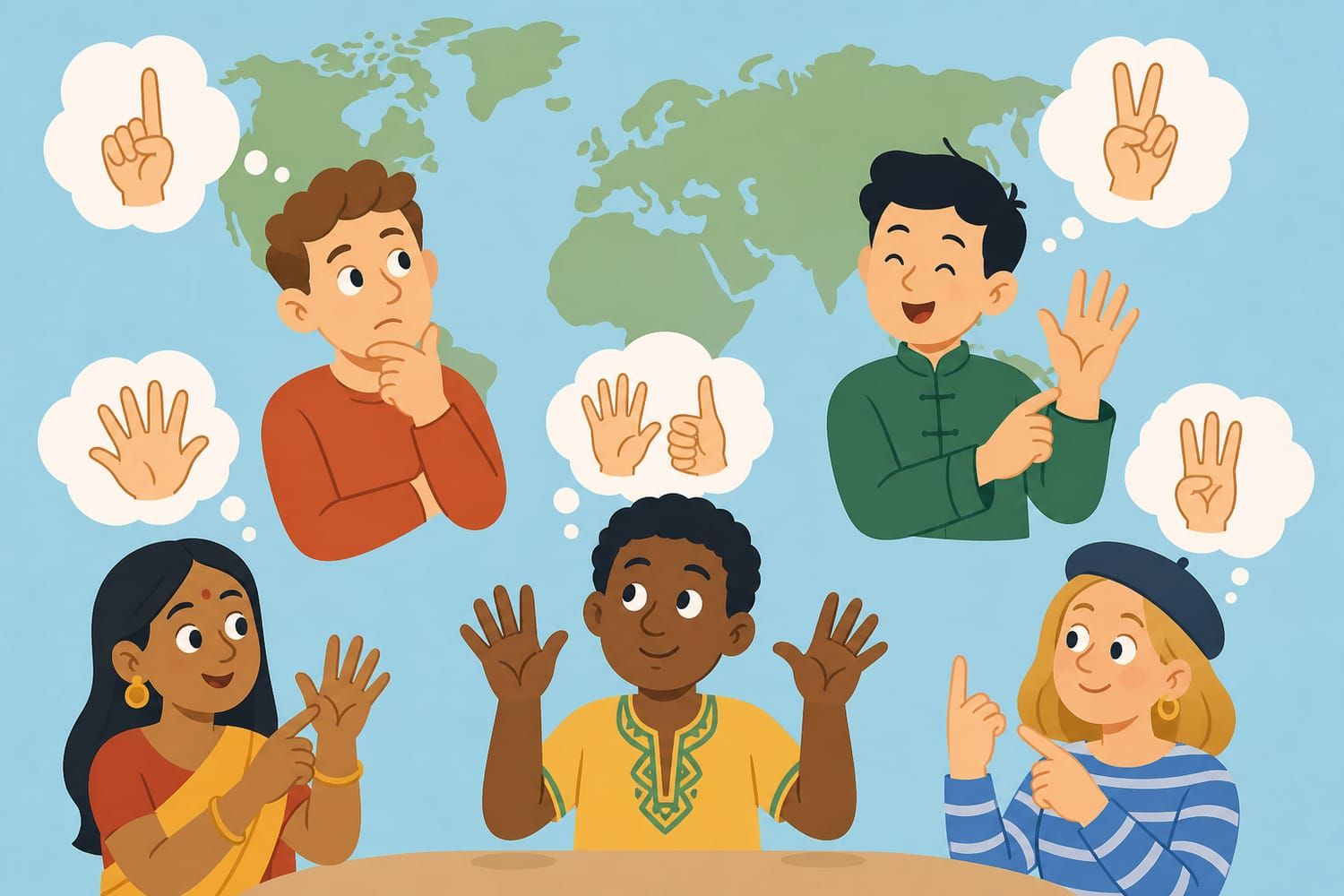
The Short Answer: Our Hands Speak With Accents
People count on their fingers differently because finger counting is learned, not automatic. Culture influences which hand begins, which finger means “one,” whether fingers rise or fold, and how numbers above five are shown. The quantity stays the same, but the gesture—like a spoken word—can have a distinctly local accent.
Ten Fingers, More Possibilities Than You Might Expect
At first glance, finger counting seems almost too simple to vary. You have ten fingers, numbers begin with one, and surely the rest follows naturally.
Except it does not.
A person might begin with the thumb, index finger, or little finger. They might start with a closed fist and extend fingers, or begin with an open hand and fold them inward. They might use the left hand first, the right hand first, or whichever hand is not currently holding a sandwich.
There is also an important difference between counting and showing a number. Researchers sometimes call the second action “finger montring”: producing a familiar hand shape all at once to communicate a quantity. You may count three objects using one sequence of fingers but hold up a different combination when someone asks you to show the number three.
That distinction helps explain why finger gestures can be surprisingly difficult to translate. As with other gestures that change meaning across cultures, the shape of a hand is only part of the message. Movement, direction, context, and shared convention matter too.
Where Does “One” Begin?
For many people in the United States and other English-speaking settings, counting begins with the index finger. The index finger represents one, the middle finger joins it for two, and the ring finger makes three. The thumb often waits until five.
In Germany and parts of continental Europe, counting commonly begins with the thumb. One is the thumb, two adds the index finger, and three uses the thumb, index, and middle fingers.
Film fans may recognize this difference from Inglourious Basterds, in which an undercover character gives himself away by using an unfamiliar gesture for three. The scene is dramatic fiction, but the cultural contrast behind it is real: German and Anglo-American three-finger configurations commonly differ.
Even nearby countries are not completely uniform, however. Studies have found considerable variation in starting-hand preferences among Europeans, challenging the idea that one neat rule applies to an entire continent. Family habits, schooling, handedness, and individual preference can all influence the sequence.
So a person’s first finger may offer a cultural clue, but it is not a passport.
Counting From the Other End
Cross-cultural research has also identified a common little-finger-first pattern among Middle Eastern participants.
In one survey, most Western respondents began with the left hand and associated one with the thumb, while most Middle Eastern respondents preferred the right hand and began with the little finger. The sequences effectively traveled in opposite directions across the hands.
Researchers have suggested that reading and writing direction may contribute to such preferences. People accustomed to left-to-right scripts might be more likely to imagine numbers progressing in one spatial direction, while readers of right-to-left scripts might favor another.
It is an interesting possibility, but not a universal law. Later research has shown substantial variation within cultures, suggesting that writing direction is only one influence among many. The hand you favor, the way you were taught, and the task you are performing may matter just as much.
Japan Turns the Usual Pattern Inward
A familiar Japanese counting method begins with an open hand rather than a fist. The fingers are then folded inward one at a time, commonly beginning with the thumb.
This can create an amusing misunderstanding. After the first finger has folded, four fingers remain visible. An observer accustomed to counting raised fingers might think the person is showing four, when the action actually marks the first step in a sequence.
The key is that this method tracks fingers folded, not fingers still visible. The movement carries the meaning.
After reaching five with a closed fist, the hand can reopen to represent a completed group of five. Additional fingers from the other hand may then touch the open palm for six through ten. However, Japanese people may use other, more immediately recognizable configurations when deliberately showing a number to someone else. Again, counting privately and communicating publicly are not always the same activity.
China Fits Ten Numbers Onto One Hand
Many Chinese number gestures allow a person to communicate numbers from one through ten using just one hand. That is especially useful when the other hand is occupied or when people need to exchange numbers across a noisy room or market.
One through five generally use visible fingers, although the exact configurations can vary. From six onward, conventional shapes do more of the work:
- Six is often shown with the thumb and little finger extended, resembling a “hang loose” gesture.
- Eight commonly uses the thumb and index finger in an L-like shape.
- Ten may be represented by a fist, crossed fingers, or two index fingers crossed to resemble the Chinese character 十.
Seven, eight, nine, and ten have notable regional variations, so even “the Chinese system” is really a family of related conventions. The Open University’s illustrated introduction to Chinese number gestures shows several widely recognized forms.
These gestures demonstrate that finger numbers do not always work by displaying the literal quantity. A hand showing six does not need six fingers—an anatomical inconvenience, to put it mildly. Instead, the shape functions as a symbol, much like a written numeral.
Why Stop at Ten?
Hands can count much higher than ten if we stop treating each finger as a single unit.
Look at the four fingers other than your thumb. Each has three segments, giving you 12 countable sections. Use your thumb as a pointer and tap each segment in sequence. You have now counted to 12 on one hand without any advanced gymnastics.
Use the fingers of your second hand to record completed groups of 12, and you can track as many as 60. This technique is often mentioned in discussions of dozen-based and 60-based counting, although tidy stories claiming that it single-handedly created ancient base-60 mathematics go beyond the available evidence.
Other societies extend counting beyond the hands altogether. The Oksapmin people of Papua New Guinea traditionally used a sequence of 27 body positions. The count begins on one hand, travels along the arm and upper body, reaches the nose, and continues down the opposite side to the other hand.
Anthropologist Geoffrey Saxe’s recordings of Oksapmin body counting show how the body can become a living number line.
This broader relationship between bodies, language, and mathematics also helps explain why numbers do not mean quite the same thing in every language. Some systems emphasize tens, others twenties, twelves, pairs, or fixed points along the body.
Why Do These Differences Develop?
No committee gathers to announce that everyone must begin counting with the thumb on Monday. Finger-counting systems grow through ordinary social learning.
Several influences can shape them:
- Imitation: Children copy parents, siblings, teachers, and friends.
- Writing direction: Reading habits may influence how people arrange numbers in space.
- Handedness: People often begin with the hand that feels easiest—or preserve their dominant hand for pointing and writing.
- Physical comfort: Some finger sequences are easier to perform than others.
- Communication needs: Traders, teachers, and people working in noisy environments benefit from distinctive, visible number signs.
- Existing traditions: Once a community recognizes a gesture, children learn it as the obvious way to count.
These habits may even influence how people process numbers. Research suggests that familiar finger configurations can affect number recognition and aspects of arithmetic thinking. Fingers are not merely emergency calculators used before children “graduate” to mental math; they can help build the earliest connections between number words, quantities, movements, and space.
How to Avoid a Numerical Mix-Up
Most finger-counting differences lead to curiosity rather than catastrophe. Still, if the number matters—when confirming a price, gate number, dosage, or meeting time—do not rely on an unfamiliar hand signal alone.
A few simple habits help:
- Say the number aloud when possible.
- Write or type it for confirmation.
- Notice whether fingers are being raised, folded, or touched.
- Ask rather than assuming a gesture is universal.
- Remember that individual habits may differ from national stereotypes.
Above all, resist the temptation to label another method “backward.” Every system feels natural to the people who learned it first.
The World Is Counting—Just Not in Unison
Finger counting is a tiny example of a much larger human pattern. We share similar bodies and face similar problems, yet we invent wonderfully different solutions.
The same ten fingers can become raised tallies, folded steps, symbolic signs, groups of 12, or the starting points of a journey across the entire body. None of these methods changes what numbers are. They change how numbers are made visible, memorable, and social.
So the next time someone shows three with the “wrong” fingers, pause before correcting them. They may not be counting incorrectly at all.
Their hands may simply be speaking another dialect.