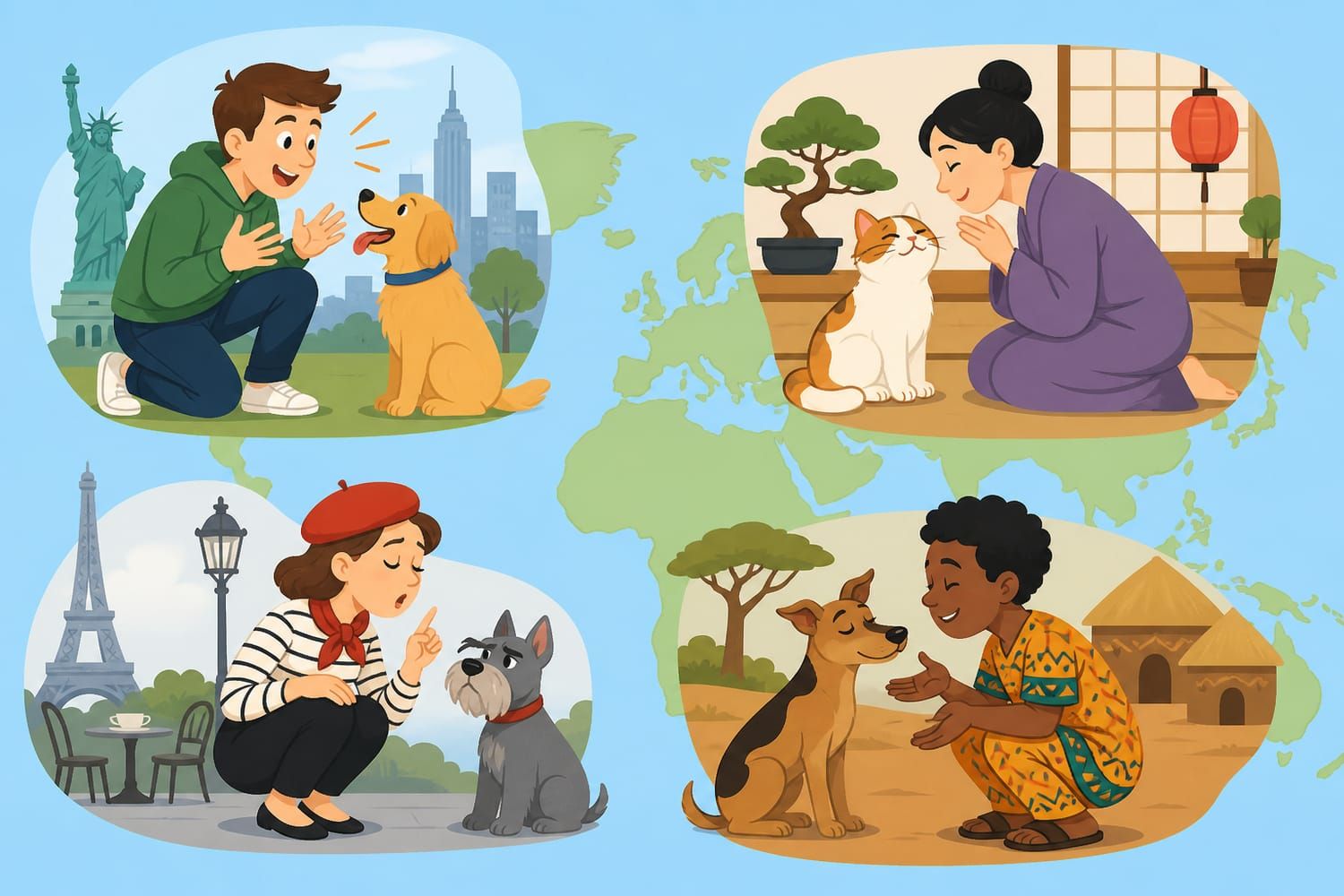
The Short Answer: Pet Talk Has a Local Accent
People around the world often change their voices when speaking to pets, but the result is shaped by language, culture, and the animal’s role in the household. Affection may sound high-pitched and playful in one home, calm and respectful in another, or appear mainly through practical commands rather than conversation.
The Voice Reserved for Nonhuman Roommates
Many people possess a voice they use only for babies, puppies, kittens, and occasionally an especially charming rabbit. It tends to be warmer, more expressive, and several notes higher than the voice used to discuss taxes.
Researchers call this pet-directed speech. It often includes:
- A higher or more varied pitch
- Shorter phrases
- Repeated words
- Affectionate nicknames
- Exaggerated emotion
- Frequent questions the animal is not expected to answer
This is a linguistic register—a way of speaking adapted to a particular listener and situation. Humans constantly switch registers, as explored in how language changes when talking to Grandma versus Google. Pets simply inspire one of the more dramatic transformations.
Pet talk also changes from moment to moment. Research involving dog owners found that reunions produced particularly high-pitched speech and affectionate nicknames, while commands brought more imperatives and attention-getting expressions. During play, owners used more questions—as though the dog might finally explain where the missing sock went.
Language Gives Cuteness an Accent
Pet-directed speech cannot sound identical everywhere because languages provide different building blocks.
English speakers can add -y or -ie to create words such as doggy, kitty, and birdie. Spanish speakers may use diminutive endings such as -ito and -ita, producing affectionate forms like perrito for a little or beloved dog. Japanese speakers may attach the affectionate suffix -chan to a pet’s name.
Repetition is another favorite. A pet may be called by a doubled nickname, offered a “treat-treat,” or invited to go “walkies.” Other languages have their own rhythmic, repetitive forms.
These patterns overlap with baby talk around the world, but pet talk is not merely baby talk aimed in the wrong direction. People may speak sweetly to a dog while discussing walks, dinner, veterinary appointments, neighborhood gossip, and the dog’s deeply questionable decision to bark at a trash can.
The sounds attributed to animals vary too. English dogs say woof, Spanish dogs say guau, Japanese dogs say wan, and Korean dogs say meong. As explained in why dogs do not say “woof” in every language, humans squeeze natural noises into the sound patterns their languages make available.
A Japanese owner saying wan-wan and an English owner saying woof-woof are not hearing different species. They are translating the same untidy bark through different linguistic filters.
Commands Do Not Need a Passport
A dog trained in English might respond to sit, while another recognizes German Sitz, French assis, or Japanese osuwari. None of these words is inherently more understandable to dogs.
Pets learn that a particular sound predicts an action, event, or consequence. To the animal, sit is not an English verb with a dictionary definition. It is a familiar acoustic signal connected to lowering the rear end—often followed by praise, food, or both.
This means pets can learn cues from several languages. A multilingual household might use one language for everyday chatter and another for training. A dog could even learn that sit, sienta, and a hand signal all request the same behavior, provided the associations are taught consistently.
Tone still matters. A cheerful invitation, a firm interruption, and a soothing reassurance have different rhythms and emotional qualities. Research indicates that dogs attend to both dog-relevant words and the expressive style in which they are delivered. In a University of York study of dog-directed speech, adult dogs preferred interacting with speakers who combined a lively, emotional voice with relevant phrases such as praise or references to walking.
Culture Shapes the Conversation
Language explains only part of the worldwide variation. Culture also influences what a pet is within a household.
In some homes, dogs and cats are treated much like children. Owners celebrate birthdays, narrate daily activities, and consult the pet about dinner despite receiving consistently unhelpful advice.
Elsewhere, an animal may primarily be a hunter, guardian, herder, pest controller, or working partner. The relationship can still be close, but the speech surrounding it may be more practical. A hunting dog might hear directional calls and commands more often than elaborate reports about how adorable its paws are.
It is important not to turn these differences into a ranking of affection. People express care in many ways, including:
- Feeding and grooming
- Training and working together
- Providing shelter or protection
- Physical touch
- Play and shared routines
- Quiet companionship
- Lively conversation
A 2026 study of hunting dogs and owners in rural communities in Vanuatu, Mongolia, Madagascar, Peru, and Germany found notable similarities in dog–human relationships despite major cultural and environmental differences. Owners across the communities enjoyed having their dogs around and generally viewed them as reliable partners and protectors. The Max Planck Institute’s summary of the research offers an encouraging reminder: customs differ, but interspecies attachment can cross enormous cultural distances.
Dogs and Cats Are Not Listening in Quite the Same Way
Pet talk also varies because species respond differently.
Dogs have a long history of cooperating closely with humans and are unusually attentive to pointing, gaze, voice, and body movement. Their owners often use energetic speech designed to attract attention and prompt action: “Who wants to go outside?”
Cats, meanwhile, tend to inspire a more negotiated style: “Would Your Majesty perhaps consider leaving the laundry basket?”
The jokes should not hide the science. Cats can recognize important features of human speech. In one small study involving 16 companion cats, the animals reacted differently when their owners switched between adult-directed and cat-directed tones. The same effect did not appear when unfamiliar people changed their speaking style, suggesting that cats learn the personal vocal habits of their own humans. The findings are summarized in this overview of how cats distinguish speech directed at them.
In other words, your cat may not respond to every sentence, but that does not necessarily mean the message went unnoticed.
Every Household Invents a Tiny Dialect
National language and culture matter, but no two homes speak to pets in exactly the same way.
Over time, people and animals build a private communication system from:
- Names and nicknames
- Commands and gestures
- Routines
- Emotional tones
- Repeated phrases
- Meaningful looks
- Sounds that would confuse every other household
One family may say, “Do you need to go out?” Another asks, “Business time?” A third rings a bell. If the pet has learned the pattern, all three can communicate roughly the same idea.
Pets shape this dialect too. A dog that becomes excited by one word encourages its owner to repeat it. A cat that responds to a particular clicking sound teaches the human to keep clicking. Communication develops through repetition, attention, and mutual adjustment—not through humans delivering endless one-sided speeches, although many pets politely tolerate those as well.
How to Make Yourself Understood
No universal pet language exists, but a few principles work across linguistic boundaries:
- Be consistent. Use the same cue for the same requested behavior.
- Pair words with clear signals. Gestures, posture, and context help animals interpret speech.
- Keep commands brief. A familiar one- or two-word cue is easier to recognize than a paragraph.
- Match your tone to your intention. Calm speech can reassure, while an upbeat voice can invite play.
- Watch the animal’s response. Ears, eyes, tail, posture, movement, and distance often reveal more than vocalizations.
Talking to pets is most effective when it becomes a conversation in the broadest sense: one side uses words, while the other answers through behavior.
Different Words, Familiar Feelings
People talk to pets differently around the world because every interaction passes through a local language, a cultural view of animals, and a unique personal relationship.
One owner says, “Who’s a good dog?” Another uses a diminutive nickname. Another gives a short working command. Their voices may differ in pitch, rhythm, vocabulary, and emotional display, yet they often serve the same purposes: attracting attention, sharing information, offering reassurance, and strengthening a bond.
Pets may never understand every word. Fortunately, neither affection nor the announcement of dinner depends entirely on perfect grammar.