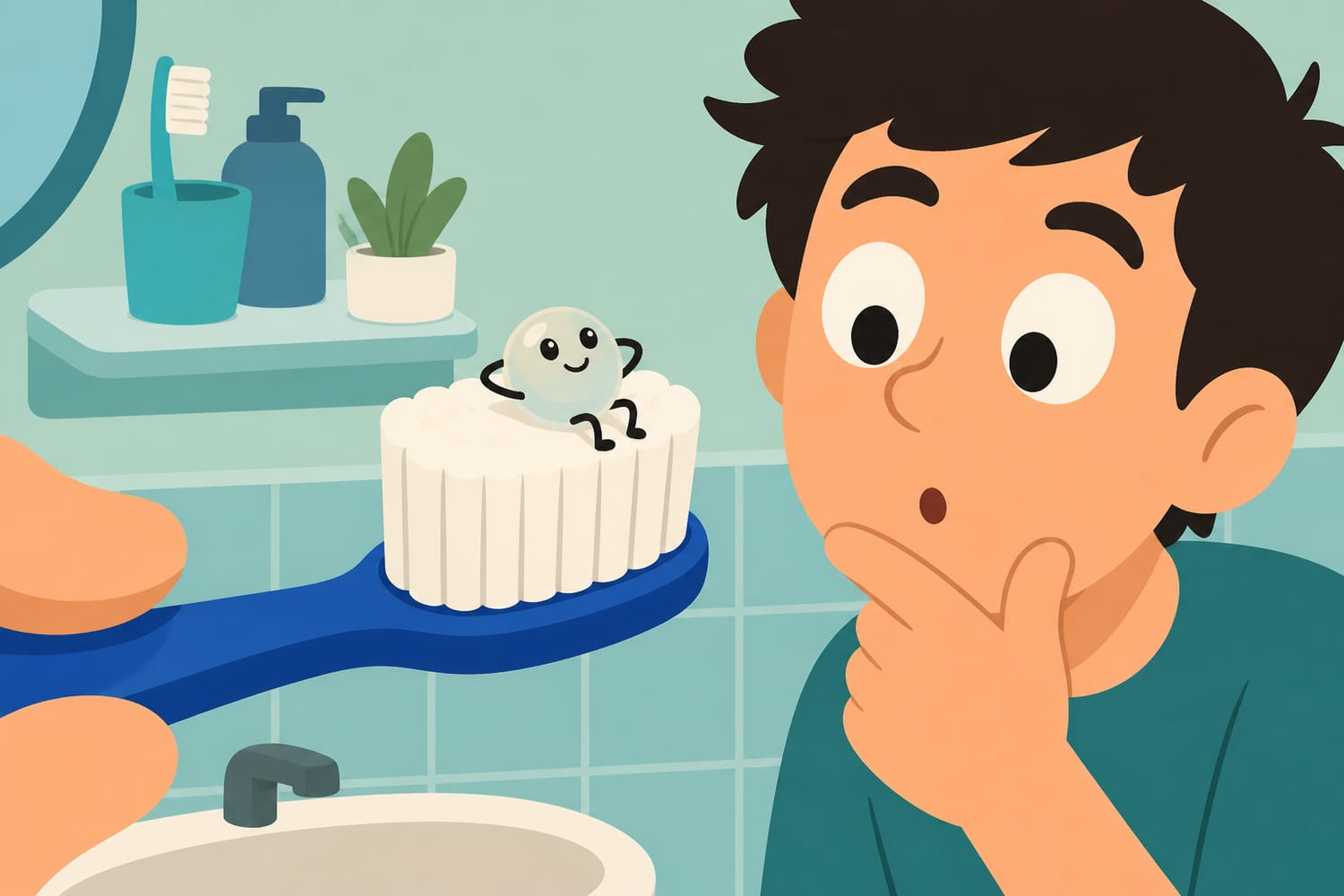
The Short Answer: A Nurdle Is a Blob of Toothpaste
A nurdle is the small ribbon, dollop, or wave-shaped blob of toothpaste squeezed onto a toothbrush—especially the suspiciously perfect version seen in advertisements. Pronounced NUR-dul, it is more of an advertising and industry term than a scientific unit. Still, it gives a wonderfully silly name to something most of us use every day.
Meet the Most Photogenic Blob in the Bathroom
Picture a toothpaste advertisement. The toothbrush is spotless. The bristles stand in flawless rows. Resting on top is a smooth ribbon of toothpaste that rises into a graceful curl, possibly with three colored stripes running through it.
That immaculate little sculpture is the classic nurdle.
Your own nurdles may be less distinguished. They might slump sideways, cling to the tube, fall into the sink, or land on your shirt before reaching your mouth. They are still nurdles—or at least close enough for ordinary conversation.
The term usually refers to toothpaste after it has been squeezed from the tube, particularly when it forms a neat length or wave on a brush. It is not an official measurement, however. A dentist will not prescribe “three nurdles before breakfast,” and tubes are not sold by the nurdle.
Instead, the word belongs to the delightful category of names for familiar things that most people never realized had names. It is in good company with the aglet at the end of a shoelace and the tittle above a lowercase i or j.
Where Did the Word “Nurdle” Come From?
The honest answer is delightfully unsatisfying: nobody knows for certain.
According to Merriam-Webster’s word history for nurdle, the word is probably expressive in origin. In other words, it may have been created because it simply sounded suitable. Comparisons have been made with words such as nodule, meaning a small lump, and knurl, but those connections have not been proved.
That uncertainty feels appropriate. Nurdle sounds exactly like what it describes: something small, soft, rounded, and faintly ridiculous.
The toothpaste sense is older than many online explanations suggest. Merriam-Webster traces it to no later than 1968, when advertisements for Bristol-Myers’ Vote toothpaste used the slogan “A nurdle a day keeps the dragon away.” The dragon represented bad breath, presumably because “A nurdle a day keeps your coworkers from backing away slowly” lacked the same sparkle.
The word may have been popularized later within advertising and oral-care circles, but the evidence shows it was already brushing shoulders with toothpaste in the 1960s.
Why Toothpaste Ads Love a Perfect Nurdle
A nurdle is more than a blob. In advertising, it is a miniature product display.
A plain tube tells you that toothpaste is inside. A glossy nurdle lets you see the product’s color, texture, thickness, stripes, sparkles, or gel-like transparency. It turns an unseen paste into something recognizable and, ideally, appealing.
The wave shape also performs several useful visual tricks:
- It fits neatly across a toothbrush head.
- It remains recognizable even when shown at a small size.
- It displays colored stripes clearly.
- Its upward curl suggests freshness and movement.
- It looks controlled, clean, and ready for action.
Real toothpaste rarely behaves so obediently. Advertising nurdles are carefully arranged for the camera, much as food photographs use deliberate lighting and styling. The goal is not to document the average chaotic bathroom. It is to create an instantly understandable symbol for clean teeth and fresh breath.
That symbol can be surprisingly valuable. In 2010, Colgate-Palmolive and GlaxoSmithKline filed competing lawsuits involving tricolored nurdles used on Colgate and Aquafresh packaging. The dispute concerned similarities between the striped toothpaste images and phrases such as “Triple Action” and “Triple Protection,” not ownership of every blob of toothpaste on Earth. The companies later agreed to end the dispute.
As this account of the toothpaste trademark battle demonstrates, even a tiny curl of paste can become serious business.
How Much Nurdle Do You Actually Need?
Advertisements often show toothpaste stretching across most or all of the brush head. That makes the product easy to see, but it should not automatically be treated as a universal dosage guide.
The proper amount is especially important for young children, who are more likely to swallow toothpaste. The American Dental Association’s toothpaste guidance recommends:
- From the first tooth until age 3: Use a smear of fluoride toothpaste about the size of a grain of rice.
- From ages 3 through 6: Use a pea-sized amount.
- Supervise young children: Help them brush and encourage them to spit out the toothpaste rather than swallow it.
So, for a toddler, the ideal nurdle is hardly a nurdle at all. It is more of a shy toothpaste whisper.
Adults should follow the directions on their toothpaste and any advice provided by their dentist. What matters is not producing the largest foam cloud possible. Regular brushing with an appropriate fluoride toothpaste, good coverage, and proper technique do the important work.
In short, the heroic brush-length nurdle from the box is a marketing image—not a challenge.
“Nurdle” Has Several Other Meanings
Before you announce that there is a nurdle in your bathroom, you should know that the word leads a surprisingly busy life.
Plastic Nurdles
Today, many dictionaries give small plastic resin pellet as the main definition of nurdle. These pellets are raw materials used to manufacture plastic products. When spilled during production or transportation, they can enter rivers, beaches, and oceans as microplastic pollution.
Plastic nurdles and toothpaste nurdles share a name, but they are not the same object. One is a tiny industrial pellet; the other is minty goo balancing on a toothbrush.
Context usually prevents confusion:
“I put a nurdle on my toothbrush.”
Probably toothpaste.
“Volunteers collected nurdles from the beach.”
Almost certainly plastic pellets—and brushing with them would be an exceptionally bad idea.
Nurdling in Cricket
In cricket, to nurdle means to guide or nudge the ball gently into an open area, often to score one or two runs. It is a controlled, understated shot rather than a dramatic swing toward the boundary.
This meaning fits the sound of the word rather well. You do not blast, smash, or thunder the ball. You nurdle it quietly into a gap and stroll away with a run.
A Tiddlywinks Meaning
The word has also appeared in tiddlywinks, where nurdling involves playing a wink very close to the pot in a position that makes it difficult to attack.
Toothpaste, plastics, cricket, and tiddlywinks may seem to have very little in common. Their shared theme is smallness, careful placement, or gentle movement—but that connection is an observation rather than a confirmed single origin.
Is “Nurdle” a Real Word?
Yes, but with a small asterisk shaped like a toothbrush.
Nurdle is unquestionably used as a real word, and major dictionaries record several of its meanings. However, the toothpaste sense is specialized and informal. It is most closely associated with packaging, advertising, product design, and word trivia rather than formal dentistry.
That does not make it fake. English is filled with vocabulary used mainly within particular professions, hobbies, or industries. A painter knows the metal part of a brush as a ferrule—a term you can explore among the tiny metal bands hiding on everyday objects. A typographer uses terms that may be unfamiliar to everyone else. Toothpaste marketers have nurdles.
Specialized words become more widely known when people find them useful, amusing, or excellent for ambushing friends with trivia. Nurdle succeeds on all three counts.
How to Use “Nurdle” in a Sentence
You probably will not need nurdle in an emergency, but it can brighten an otherwise uneventful discussion about dental hygiene.
Try:
“You have toothpaste on your sleeve. Your nurdle appears to have escaped.”
Or:
“I attempted a perfect nurdle, but it fell into the sink.”
Or, if you enjoy causing brief confusion:
“Please excuse me while I prepare my evening nurdle.”
The plural is nurdles:
“The children squeezed enormous nurdles onto their toothbrushes.”
The toothpaste sense is generally used as a noun, although nobody can physically stop you from saying that you have “nurdled” your toothbrush. Language has survived worse.
A Tiny Blob With a Surprisingly Big Story
A nurdle is the ribbon or dollop of toothpaste placed on a toothbrush, particularly the polished wave seen in advertisements. Its exact linguistic origin remains uncertain, but the toothpaste meaning appeared in advertising by at least 1968.
Since then, the nurdle has served as a product symbol, a branding device, a legal battleground, and an unusually entertaining piece of bathroom vocabulary. It also shares its name with plastic pellets and specialized moves in cricket and tiddlywinks, because English apparently decided one peculiar meaning was not enough.
The next time you squeeze toothpaste onto your brush, pause for a moment. You are not merely preparing to clean your teeth.
You are creating a nurdle.
Whether it looks ready for a glossy advertisement or like a mint-flavored caterpillar that has given up on life is entirely up to you.