The Short Answer: It Was Probably an Axe Head
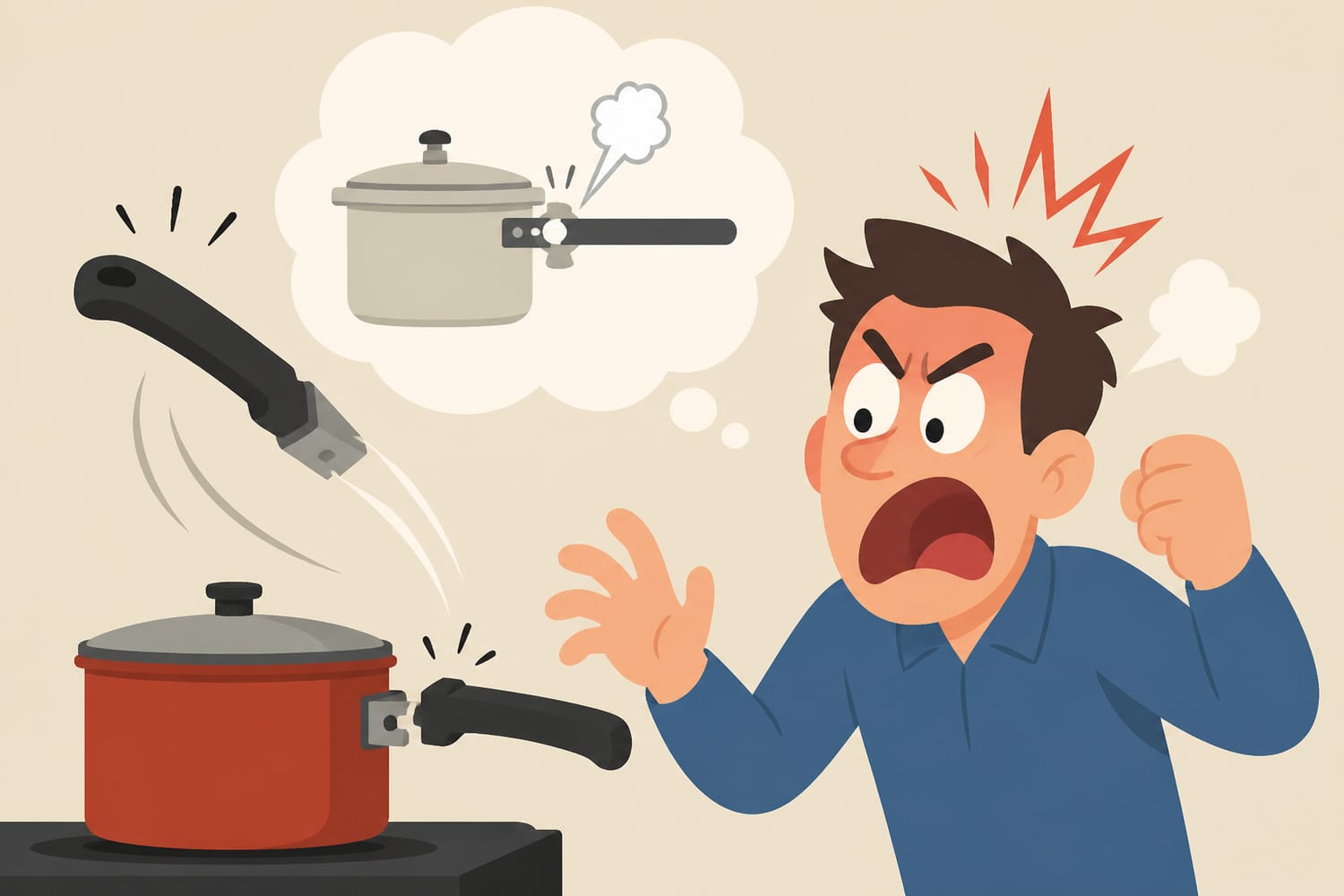
To “fly off the handle” means to lose your temper suddenly and dramatically. The expression comes from a genuinely dangerous mishap: the metal head of an axe—or possibly another handled tool—coming loose during use and flying away from its wooden handle. An angry person, similarly, has broken free of control and become unpredictable.
What Does “Fly Off the Handle” Mean Today?
If someone flies off the handle, they become extremely angry, often with little warning or for a reason that seems too small to justify the reaction.
You might say:
“Dad flew off the handle when he discovered that someone had changed the thermostat.”
Or:
“There’s no need to fly off the handle—it was only a typo.”
The phrase usually suggests more than ordinary irritation. A person who flies off the handle does not simply frown, sigh, or quietly reconsider their opinion of humanity. They explode. They may shout, make rash decisions, or say things they later regret.
That sense of sudden, uncontrolled anger is central to the expression. The Collins English Dictionary definition describes it as suddenly and completely losing one’s temper.
What Was Actually Flying?
The traditional answer is the head of an axe.
An axe consists of two main parts:
- The handle, traditionally made from wood
- The head, the heavy metal part containing the cutting edge
The handle passes through a hole in the axe head known as the eye. In many traditional axes, the top of the handle is split slightly, and a wedge is driven into that split. The wedge expands the wood so that it grips the inside of the eye and holds the head firmly in place.
If the fit becomes loose, however, the axe head can slide free. Swing the tool hard enough, and momentum may send the heavy, sharpened piece of metal sailing through the air.
This is not a charming little woodworking inconvenience. It is an extremely dangerous failure involving a sharp object traveling rapidly in an unintended direction—the tool equivalent of announcing, “Well, this situation has developed.”
The U.S. Forest Service’s detailed guide to hanging an axe explains how a properly fitted wedge expands the handle inside the axe head to create a secure grip.
Why Would an Axe Head Come Loose?
Axe handles and heads endure repeated shocks. Every strike sends force through the metal and wood, so a poor fit or neglected handle can gradually become unsafe.
Several things may contribute to a loose head:
The handle was fitted incorrectly. If the wood does not fill the axe’s eye properly, the head may never be truly secure.
The wood shrank. Wooden handles can lose moisture and contract, especially when stored in very dry or warm conditions.
The wedge loosened or failed. Without a tight wedge, the top of the handle may not press firmly enough against the eye.
The tool suffered damage or heavy wear. Repeated use can weaken the connection between the parts.
The failure might appear sudden, but the loosening often develops over time. The final swing merely reveals the problem in the most alarming way possible.
Modern axe makers still warn users to check that the head is secure. The physics behind the idiom has not expired simply because the expression is old.
How Did a Tool Accident Become a Temper Tantrum?
The metaphor is remarkably neat.
A properly assembled axe is controlled. The user swings the handle, and the head follows a predictable path. Handle and head work as one tool.
Once the head breaks free, that control disappears. It shoots away independently, no longer guided by the person holding the handle.
An angry outburst can look much the same in figurative terms. The person is no longer behaving with their usual restraint. Emotion has broken loose, and nobody is entirely sure where it will land.
The phrase therefore captures several features of a sudden temper:
- It happens quickly.
- It represents a loss of control.
- It may be dangerous.
- It can affect innocent bystanders.
- It often leaves a mess to repair afterward.
Most metaphors would be delighted to accomplish three of those things.
English frequently turns physical activities into descriptions of behavior. We beat around the bush when avoiding the point, even if there is not a shrub in sight. In the same way, we fly off the handle without touching an axe.
How Old Is the Expression?
“Fly off the handle” appears to be an American expression from the early 19th century.
Detailed historical research has found a figurative use in the Portland Gazette and Maine Advertiser dated September 24, 1816. The writer described a political group as being “ready to fly off the handle”—proof that the phrase was already being used metaphorically rather than as a report about defective equipment.
Other examples appeared during the 1820s and 1830s. In 1843, the writer Thomas Chandler Haliburton included the line “He flies right off the handle for nothing” in The Attaché; or, Sam Slick in England. That example is frequently presented as the phrase’s first appearance, but earlier newspaper evidence shows that it was already in circulation.
This illustrates an important point about etymology: the earliest known written example is not necessarily the moment a phrase was invented. Informal expressions may be spoken for years before anyone records them—or before a surviving record is discovered.
Origin stories should sometimes be taken with a grain of salt, especially when they claim that one famous writer created a phrase that was already wandering through everyday speech.
Was It Definitely an Axe, or Could It Have Been a Hammer?
Here the story becomes slightly less tidy.
Many explanations identify the flying object as an axe head. An influential 19th-century Dictionary of Americanisms defined the expression as flying into a passion and stated that it alluded to the head of an axe.
Other dictionaries have explained it using a loose hammer head. That is mechanically possible: hammers, picks, and similar tools also have heavy heads attached to handles, and those heads can come loose.
The safest conclusion is that the expression refers to the uncontrolled flight of a loose tool head, with the axe being the traditional and most commonly cited example. Research into early uses describes the image as the head of “an axe or other tool” becoming detached.
So, what was flying? Almost certainly not the handle. The handle remained in someone’s hands while the dangerous part made an unscheduled departure.
Why “Fly” Instead of “Fall”?
The verb fly gives the expression its energy.
A loose axe head does not necessarily drop politely at the woodcutter’s feet. During a forceful swing, it may continue moving through the air. “Fall off the handle” would sound inconvenient. “Fly off the handle” sounds sudden, violent, and unpredictable.
That difference matters figuratively, too.
Someone who slowly becomes annoyed is not necessarily flying off the handle. The idiom is best suited to an abrupt emotional launch:
“When the restaurant forgot his side of fries, he flew off the handle.”
It would sound excessive for mild displeasure:
“She flew off the handle by quietly saying she preferred a different table.”
Unless she whispered it while overturning the table, another expression would probably work better.
Similar Ways to Describe Sudden Anger
English has assembled an impressive collection of expressions for losing one’s temper:
- Blow your top
- Hit the roof
- Flip your lid
- Blow a fuse
- See red
- Go ballistic
- Lose your cool
- Have a meltdown
These expressions rely on different images—explosions, overheating, broken machinery, flying lids—but they share the idea that normal control has failed.
“Fly off the handle” is especially effective because its original image contains both separation and danger. Something important has come loose, and it may hurt whoever happens to be nearby.
That clarity contrasts with phrases such as “cat got your tongue?”, whose exact historical origins remain uncertain. Sometimes an idiom’s literal picture is mysterious. In this case, it is disturbingly practical.
Why Has the Phrase Lasted?
Few people today regularly fit wooden handles to axe heads, yet the expression remains easy to understand. That is because its emotional meaning does not require technical knowledge.
The words themselves create a sense of detachment. Something has broken away from the part that was controlling it. Even without picturing an axe, listeners can feel that control has been lost.
The phrase is also flexible. It works in family stories, workplace conversations, political commentary, fictional dialogue, and complaints about people who treat minor inconveniences as declarations of war.
Most importantly, it turns an invisible emotional change into a visible action. Anger cannot literally detach itself and shoot across a room—but an axe head can. The metaphor gives sudden rage weight, speed, and a dangerously sharp edge.
A Phrase With a Point
To “fly off the handle” is to lose control suddenly, especially through anger. The phrase arose in early American English and refers to a loose tool head—traditionally an axe head—breaking free from its handle during a swing.
The image is both simple and memorable: one moment, everything is working as intended; the next, the heaviest and most dangerous part is flying independently through the air.
So the next time someone flies off the handle, remember the original warning hidden inside the idiom: when something comes loose under pressure, everyone nearby should probably take a step back.