The Short Answer
“Straight from the horse’s mouth” means information received directly from the person—or source—that knows it firsthand. The expression emerged from British horse-racing culture in the 19th century, where the ultimate racing tip was jokingly imagined as coming from the horse itself, without interference from owners, trainers, jockeys, or gossiping bettors.
What Does “Straight from the Horse’s Mouth” Mean?
If you hear something “straight from the horse’s mouth,” you have obtained the information from its original source.
Suppose your coworkers are whispering that Maya has been promoted. If Maya tells you herself, you have heard the news straight from the horse’s mouth. If Kevin from accounting heard it from Maya’s cousin’s neighbor at a barbecue, you are considerably farther from the horse.
The expression usually suggests two things:
- The source has firsthand knowledge.
- The information has not been altered by intermediaries.
That second point matters. Stories have a habit of changing as they pass from person to person. Details disappear, guesses become facts, and an ordinary office meeting somehow turns into a company-wide emergency involving lawyers and a suspiciously large shredder.
Information from the horse’s mouth skips that chain. It comes directly from the person involved.
However, firsthand does not automatically mean correct. People can be mistaken, forgetful, biased, or dishonest even when discussing their own experiences. The phrase identifies the original source, not a magical guarantee of truth.
Why a Horse?
The expression’s most convincing origin lies in the world of horse racing.
Before a major race, bettors naturally wanted reliable information about the competing horses. Was a favorite in excellent condition? Had an outsider been performing surprisingly well? Was a horse carrying an injury? A useful tip could make the difference between a profitable afternoon and a long, gloomy walk home.
Plenty of people might claim to possess inside knowledge:
- Owners knew their horses’ histories and prospects.
- Trainers observed their condition and performance.
- Stable workers saw the animals every day.
- Jockeys experienced how the horses behaved on the course.
- Tipsters claimed to know everything, whether they did or not.
But who would know more about a horse’s chances than the horse itself?
That was the joke. Horses could not actually offer betting advice, but the fantasy of receiving a tip directly from the animal represented the closest possible connection to the truth.
Merriam-Webster’s history of the expression points to early examples in British sporting newspapers. One appeared in Bell’s Life in London in 1861 and advertised a racing selection as “straight from the horse’s mouth.” Another, published in 1879, joked about bettors hoping for tips that supposedly came from the horses themselves.
These examples make the racing explanation especially persuasive. The earliest known appearances do not merely mention horses; they appear in writing about horse racing and insider information.
But What About Looking at a Horse’s Teeth?
There is another popular explanation for the phrase: a horse’s age can be estimated by examining its teeth.
This is a genuine practice. The eruption, shape, angle, and wear of a horse’s teeth can provide clues about its age. The USDA’s guide to equine teeth and aging explains that veterinarians usually focus on the incisors when making such estimates. It also warns that aging becomes more difficult and speculative after the permanent teeth are in wear.
For buyers, a horse’s age was important. A dishonest seller might describe an older animal as young and vigorous, but its mouth could tell a less flattering story. Looking directly at the teeth therefore meant consulting the horse itself rather than trusting the sales pitch.
It is easy to see why this explanation became popular. It is tidy, memorable, and connected to another familiar saying: “Don’t look a gift horse in the mouth.” That expression advises against inspecting a gift too critically, since examining a horse’s teeth would be a practical way to assess its age and value.
Nevertheless, the tooth theory is not the strongest explanation for “straight from the horse’s mouth.” The early racing examples focus on tips and imagined communication from the animal, not dental inspection. Checking teeth may have helped reinforce the phrase’s association with reliable evidence, but the surviving record points more directly toward racing humor.
In other words, the teeth story is plausible background—but the racetrack appears to be where the expression found its voice.
What Does the Word “Straight” Add?
You can say either:
- “I heard it from the horse’s mouth.”
- “I heard it straight from the horse’s mouth.”
Both versions mean essentially the same thing. The word “straight” adds emphasis by suggesting a direct, uninterrupted route.
Think of information as traveling along a line. If it moves straight from the original speaker to you, there are no twists, detours, or additional storytellers along the way. Nobody has shortened it, decorated it, misunderstood it, or added a dramatic explosion that was not present in the original account.
Merriam-Webster defines “from the horse’s mouth” simply as coming “from the original source.”
That idea of directness is also why the expression works outside situations involving people. A journalist might receive figures directly from a company report, while a sports fan might check an official team announcement instead of trusting social media speculation.
Strictly speaking, there may be no mouth involved at all—equine or otherwise.
How to Use the Expression
“Straight from the horse’s mouth” is informal, conversational, and often slightly playful. It works well when emphasizing that information came directly from someone involved.
For example:
“Is Jordan really leaving the company?”
“Yes. I heard it straight from the horse’s mouth.”“Apparently the restaurant is reopening next month.”
“Are you sure?”
“The owner told me herself.”“Dad says we’re getting a dog.”
“Did Mom confirm that?”
“Not yet, so perhaps we should delay naming it.”
The “horse” is simply the source. Referring to someone as the horse is not normally insulting because speakers are using the complete idiom rather than comparing that person’s appearance or table manners to an animal.
Still, tone matters. In a very formal report, phrases such as “according to the original source,” “confirmed directly by,” or “based on firsthand information” may be more suitable.
Is It the Same as Hearsay?
Not quite. In ordinary conversation, the two ideas are nearly opposites.
Hearsay is information passed along by someone who did not directly witness or participate in the event. Information from the horse’s mouth comes from the person most closely connected to it.
Consider these statements:
- “Lena told me she is moving to Chicago.” — From the horse’s mouth.
- “Raj thinks Lena may be moving because he saw some boxes.” — Speculation.
- “My sister heard from Raj that Lena is definitely moving to Denver.” — The rumor has now wandered into another state entirely.
English has many vivid expressions for the movement of information. We “spill the beans” when revealing a secret, hear rumors “through the grapevine,” and occasionally see “the writing on the wall”. Each phrase gives information its own miniature drama.
“Straight from the horse’s mouth” is the version that says: forget the whispers and ask the person who actually knows.
Why Has the Phrase Survived?
The expression remains popular because it turns an abstract idea—direct sourcing—into a wonderfully ridiculous picture.
We could simply say, “I obtained this information from a primary source.” That is accurate, but it sounds as though we are submitting a research paper.
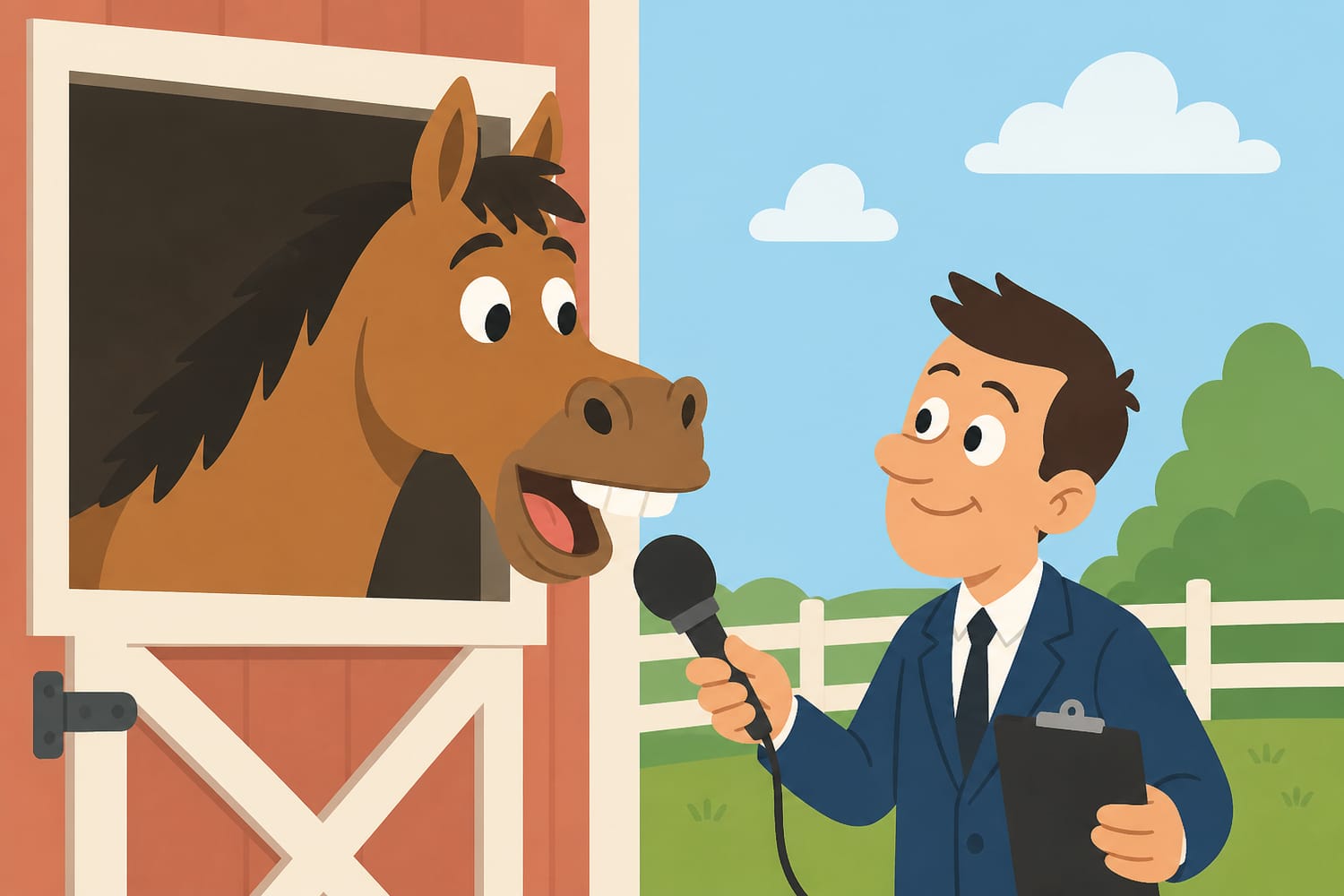
“I got it straight from the horse’s mouth” is livelier. It brings to mind a remarkably well-informed horse leaning over a stable door to share confidential news about Saturday’s race.
The phrase also remains useful. We live in a world of reposts, screenshots, forwarded messages, edited clips, and confident claims beginning with “Someone told me.” Knowing whether information came from the original source is as valuable now as it was to a hopeful bettor at a Victorian racetrack.
Other animal expressions endure for similar reasons. A phrase such as “cat got your tongue?” survives not because anyone believes cats collect human tongues, but because the image is strange, compact, and unforgettable.
The Final Word from the Stable
“Straight from the horse’s mouth” means directly from the original or firsthand source. The strongest historical evidence connects it to 19th-century British horse racing, where bettors wanted the most reliable tips possible—and where the horse itself was humorously imagined as the ultimate insider.
The alternative explanation involving a horse’s teeth is based on a real method of estimating age, but it fits the early evidence less neatly. As with many idioms, a plausible story has trotted alongside the documented history.
So the next time someone shares sensational news, ask where it came from. If the answer involves three cousins, an anonymous post, and “a guy who knows a guy,” you may want to remain skeptical.
Better to wait until you hear it straight from the horse’s mouth.