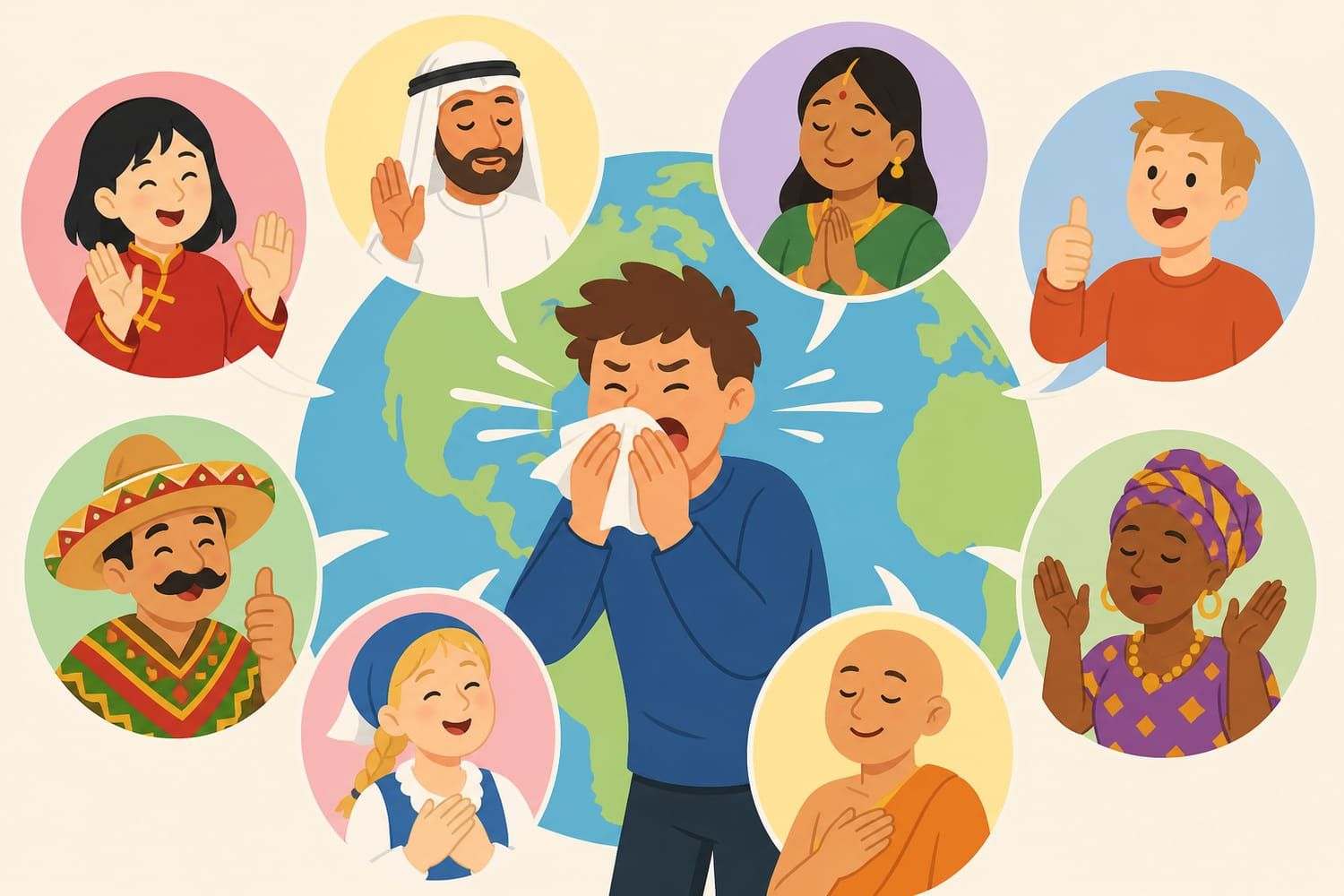
A Tiny Noise With a Global Conversation
What do people say when you sneeze around the world? Sometimes they wish you health. Sometimes they offer a blessing, hope you live a long life, or—as one Dutch saying has it—predict tomorrow’s weather. And sometimes they say nothing at all. The sneeze is familiar everywhere; the little conversation around it is not.
The Quick Guide: From “Health” to “Live Long”
A sneeze response is usually less about its literal meaning than its social job: acknowledging someone with a moment of goodwill. Here are a few expressions you might hear. They are examples, not rules for every speaker or setting.
| Language | A response to a sneeze | Basic meaning | |---|---|---| | English | Bless you | A blessing | | German | Gesundheit | “Health” | | Spanish | Salud | “Health” | | Italian | Salute | “Health” | | Dutch | Gezondheid | “Health” | | French | À tes souhaits | “To your wishes” | | Turkish | Çok yaşa | “Live long” | | Swedish | Prosit | A traditional good wish | | Hebrew | Livri’ut | “To health” |
The pattern is clear: good health is a popular thing to wish upon somebody whose nose has suddenly made an announcement. But the differences become more interesting when a second person joins the exchange—or when another sneeze arrives.
The Health Club Has a Lot of Members
German Gesundheit may already be familiar to English speakers. It means “health,” and it also offers an alternative to bless you in English. Dutch gezondheid, Spanish salud, and Italian salute make much the same wish in their respective languages. Finnish terveydeksi means “for health.”
These words can sound like miniature medical advice, but nobody expects a sneezer to provide a health update. They are conventional expressions of goodwill. It is rather like raising a glass and saying salud: the word names health, while the gesture says, “Here’s to you.” That overlap appears in toasts around the world, where a single word can turn a shared moment into a wish for someone’s well-being.
Of course, hearing salud does not prove that a toast is about to begin. If nobody is holding a glass and somebody is reaching for a tissue, context has probably solved the mystery.
One Sneeze, Two Sneezes, Three Sneezes…
In some places, the response changes if the sneezer keeps going. A well-known Spanish-language sequence is salud for the first sneeze, dinero (“money”) for the second, and amor (“love”) for the third. It is a pleasing escalation: first your health, then your finances, then your romantic prospects. But Spanish is spoken across many regions, and this sequence is not a universal rule for Spanish speakers.
Dutch has its own playful addition. After repeated sneezes, someone might say morgen mooi weer—“nice weather tomorrow.” Think of it as a bit of folklore, not a forecast to consult before hanging out the laundry. The ordinary first response remains gezondheid.
Turkish can turn the exchange into a brief dialogue. Someone says çok yaşa, meaning “live long.” After another sneeze, they may add sağlıklı yaşa, or “live healthy.” The sneezer can answer with a wish that the other person will live to see that long life, too. What began as an interruption becomes a small exchange of mutual goodwill.
For a closer look at regional variations and multiple-sneeze customs, Babbel’s guide to sneeze responses offers more examples. The useful takeaway is not to memorize a three-sneeze script before every trip. It is to notice that even a tiny courtesy can have a local rhythm.
Blessings—and a Reply to the Reply
English bless you is not the only response with a religious meaning. In a traditional Muslim exchange, the person who sneezes says alhamdulillah (“praise be to God”). Someone who hears them replies yarhamuk Allah (“may God have mercy on you”). The sneezer can then respond with a wish for God to guide the other person and improve their condition. The sequence is set out in a narration in Sahih al-Bukhari.
It would be misleading, though, to label that exchange simply “what Arabic speakers say.” Arabic speakers have different religious backgrounds and conversational habits, while the Muslim practice extends well beyond Arabic-speaking communities. The language of an expression, the people who use it, and the occasions when they use it do not always fit into one tidy box.
As for English bless you, its exact origin is uncertain. Stories involving the plague or fears about escaping souls are memorable, but no single story neatly explains the custom. What is certain is that a blessing after a sneeze is older than the usual plague-origin tale; Dictionary.com’s account of the expression notes that the Roman writer Pliny the Elder discussed the practice long ago. A good story is worth hearing, but it is not always a proven origin.
When Saying Nothing Is Perfectly Polite
If you sneeze in Japan or China and nobody says “bless you,” you need not assume you have offended the room. Sneezes generally are not given a routine verbal response in those settings. Korean speakers, too, do not typically have an automatic sneeze response equivalent to English bless you. Someone may still ask whether you are all right if you seem unwell; that is different from a phrase required after every sneeze.
This is one of the most useful lessons for travelers: silence is not necessarily a lack of care. Customs differ in what they ask people to acknowledge aloud. The same point comes up in greetings that ask “Have you eaten?”: a familiar question in one setting may sound unexpected in another, even when both serve a friendly purpose.
There is folklore even where there is no standard reply. The Smithsonian’s National Museum of Asian Art describes a Japanese saying that assigns different meanings to one, two, three, and four sneezes—including, eventually, the possibility that you have a cold. It is a saying about sneezes, not an instruction to announce a diagnosis across the room.
Even “Achoo” Has an Accent
Before anyone can reply, the sneeze has to happen. The physical event does not need translation, but the written imitation of it does. English has achoo; French has atchoum; Spanish has achís; Japanese has hakushon. These are examples of onomatopoeia—words that represent sounds—rather than precise recordings of what every sneezer produces.
Languages work with different familiar sounds and spelling patterns, so they turn the same untidy noise into different pronounceable words. That is why a sneeze can seem to acquire an accent on the page. It is the same idea behind why dogs do not say “woof” in every language: the sound happens first, and people put it into words afterward.
What Should You Say?
If you know the local expression and it suits the company, use it. If you do not, pay attention to what people around you do. There is no need to deliver a carefully translated blessing into a room that normally lets sneezes pass without comment. And if someone says something kind after your sneeze, a simple thank-you is rarely a bad place to start.
A sneeze may last a second, but its aftermath shows how much social meaning can fit into very little language. One person offers health, another wishes for a long life, and another quietly lets you get back to your sentence. Different responses; recognizable human impulse.